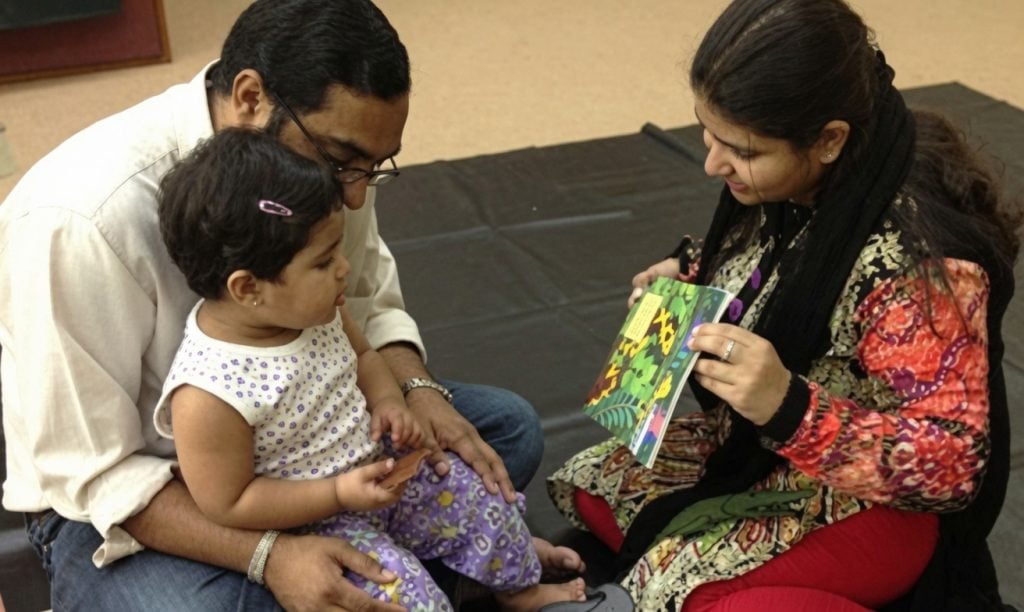
NOWSHERA, Pakistan: When Sana Atif was growing up in Karachi, her parents decided almost everything for her — from the shoes she wore to the friends she could keep. Their intentions were protective, but the result was suffocating.
Now 18, Sana believes excessive parental control can damage not only a child’s confidence but also the bond between parents and children.
“My parents controlled every aspect of my life, even choosing which shoes I should wear. The more they tried to control me, the more I wanted to break their trust.”
Sana’s anger reflects a growing but rarely discussed conflict inside Pakistani families, where many parents, driven by genuine fears for their children’s safety, attempt to protect them by controlling nearly every aspect of their lives.
Mental health experts warn that while protection is essential, excessive control can leave lasting emotional scars, undermining children’s confidence, independence and ability to make decisions long into adulthood.
Protection or control?
Shakirullah, a psychologist at the Directorate of Social Welfare (Merged Areas), describes overcontrolling parenting — often called “helicopter parenting” — as a style in which parents make almost every decision, enforce rigid rules, closely monitor daily activities and leave little room for independence.
Children, he says, learn confidence by making choices, solving problems and even making mistakes.
“When parents control everything, children become dependent and struggle to cope later in life.”
He refers to psychologist Diana Baumrind’s four parenting styles — authoritative, authoritarian, permissive and neglectful — and says authoritative parenting, which combines warmth with reasonable expectations, consistently produces the healthiest outcomes.
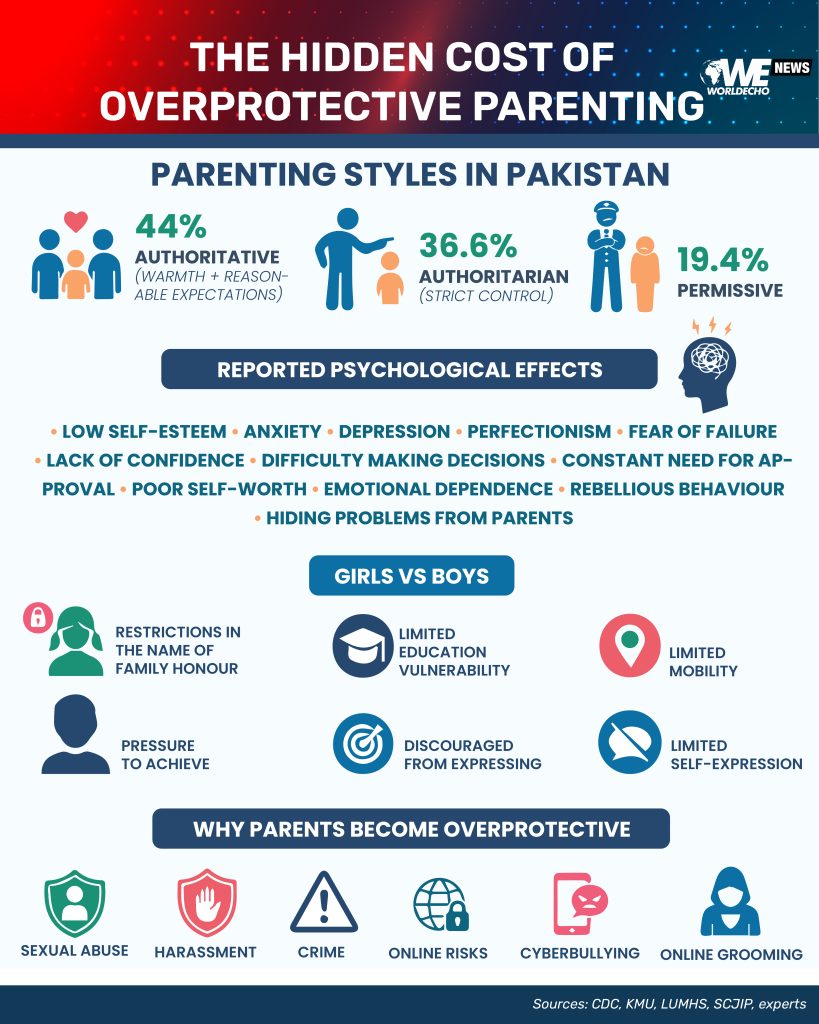
According to a 2025 study by researchers from Liaquat University of Medical & Health Sciences and the Sir Cowasjee Jehangir Institute of Psychiatry, 44 per cent of Pakistani parents practice authoritative parenting, while 36.6 per cent follow an authoritarian style and 19.4 per cent are permissive.
Shakir says excessive parental control often leads to low self-esteem, perfectionism, anxiety and depression because children never develop the confidence that comes from making their own decisions.
“I tried to leave home”
For 21-year-old Kamran Jamal from Multan, the consequences have been devastating.
“My parents always told me that speaking in front of elders was disrespectful and disagreeing with them was disobedience,” he says.
“They even chose my clothes and academic subjects. Sometimes I feel useless and incapable.”
He says he avoided expressing opinions in class and eventually lost confidence in himself.
“Many times, I tried to leave my house. I also attempted suicide two or three times because I feel that I am useless. My parents do not love me, so why should I stay alive?”
Research increasingly supports experiences like Kamran’s.
A 2022 study published in Frontiers in Psychology, involving nearly 2,000 adolescents, found that high levels of parental psychological control significantly increased suicidal thoughts by reducing resilience and increasing emotional and behavioural problems.
A 2026 study published in BMC Psychology similarly found that controlling parenting contributed to depression and socially prescribed perfectionism, both of which increased suicidal ideation among university students.
Nawal Haider, a lecturer in psychology at the University of Peshawar, considers overcontrolling parenting a form of emotional abuse because it deprives children of opportunities to think and decide for themselves.
Children raised under constant control, she says, often become rebellious, hide problems from their parents and carry anger, low self-esteem and poor self-worth into adulthood.
A cycle passed through generations
Dr. Syeda Javaria Bokhari, a clinical psychologist, researcher, and career counsellor based in Ontario, Canada, believes that parenting styles are often passed down from one generation to the next. According to her, individuals who grow up in highly controlled or authoritarian households frequently adopt similar parenting approaches with their own children because these behaviours become deeply embedded in their personalities. However, she notes that some adults who experienced strict parenting intentionally choose a more balanced and flexible approach when raising their children.
Discussing the impact of excessive monitoring, Dr. Bokhari says that while parents should remain involved in their children’s lives, constant surveillance of phones, social media accounts, and personal activities can damage trust. She explains that children need opportunities to make small decisions independently. Excessive monitoring often encourages children to hide information rather than communicate openly with their parents.
According to Dr. Bokhari, overprotection can disrupt a child’s psychological development. Children who are never allowed to solve problems independently may become overly dependent on others and struggle to make decisions. In some cases, constant supervision can leave children feeling frustrated, restricted, and emotionally suffocated.
While cautious about labelling overcontrolling parenting as emotional abuse, Dr. Bokhari acknowledges that excessive control can have negative consequences for children’s emotional wellbeing. She believes that most parents act out of concern and a desire to protect their children, although their methods may sometimes be counterproductive.
Drawing on the developmental theory of renowned psychologist Erik Erikson, Dr. Bokhari explains that adolescence is a critical stage of identity formation. Young people who are encouraged to explore their environment and make decisions develop a stronger sense of self, independence, and confidence.
Parents’ rears are real
Psychologists acknowledge that parents are not controlling their children without reason.
According to the US Centers for Disease Control and Prevention, at least one in four girls and one in 20 boys experience sexual abuse before turning 18.
The Council of the European Union estimates that one in five European children experience some form of sexual violence, while Pakistan recorded 1,630 child abuse cases during the first six months of 2024.
Those realities, says clinical psychologist Asiya Umer of Zamung Kor, naturally make parents more protective.
But fear can easily become overprotection.
“When children become afraid of their parents, they stop sharing their problems,” she says.
Instead of controlling every decision, parents should educate children about personal safety, discuss uncomfortable situations openly and build relationships based on trust.
Hafiza Zumar Malik, a clinical psychologist and Cognitive Behavioral therapist, agrees that many Pakistani parents are responding to genuine threats — including harassment, crime and online risks — rather than trying to dominate their children.
Nasreen Javed, a 44-year-old mother of three from Mardan (around 50 kilometres northeast of Peshawar), believes strict supervision has become unavoidable because of those dangers.
Asiya agrees that some strictness is necessary.
“Parents should protect their children without taking away their opportunity to learn, develop confidence and become independent,” she says.
Growing up without a voice
Twenty-seven-year-old Tabassum Ali Khan from Peshawar still remembers the moment she stopped defending herself.
As a child in grade 3, she was unfairly scolded by a teacher. When she tried explaining the incident at home, her parents interrupted. “The teacher must be right. You must have done something wrong.” From that day onward she stopped defending herself because she felt her opinions were useless.
Years later, after marriage, that silence remained.
When she once disagreed with her husband about attending a family gathering because she was unwell, she found herself trembling instead of speaking.
“My husband asked me why I couldn’t simply explain what I wanted, but I remained silent.”
Control leaves lasting scars
Huma Kanwal, a clinical psychologist and head of the Institute of Public Mental Health and Behavioural Sciences at Khyber Medical University, says such experiences are common.
Adults raised under excessive parental control often struggle with fear of failure, lack confidence despite strong abilities and constantly seek approval from others.
Some even choose controlling spouses because the behaviour feels familiar.
Through her work with UN Women on gender-based violence, Kanwal says she has seen women mistake controlling behaviour for love because it resembles the parenting they experienced growing up.
She adds that boys and girls often experience overcontrol differently.
Girls frequently face restrictions in the name of family honour, limiting education, mobility and self-expression, while boys are more commonly pressured to achieve and discouraged from expressing vulnerability.
Twenty-nine-year-old Ali Azhar from Quetta says he still questions every decision he makes because he grew up hearing that he was incapable of deciding for himself.
Similarly, 23-year-old Maria Hadi from Noshki — approximately 120 kilometres southwest of Quetta — recalls being scolded for returning home even slightly late, forbidden from joining school trips and never allowed to choose her own clothes.
Today, she says, she still seeks other people’s approval before making important decisions.
Finding the balance
Child protection experts argue that safety and independence should not be viewed as opposing goals.
Ahmed Ali Qureshi, Child Protection Officer at the Social Welfare Department in Mohmand tribal district of Khyber Pakhtunkhwa, says one of the most common complaints children raise is that parents invade their privacy by checking phones, reading messages and tracking locations without explanation.
Such behaviour, he says, gradually erodes trust and contributes to anxiety, depression and low self-esteem.
Instead, he recommends open conversations about online risks, transparent use of parental-control tools such as Google Family Link or Microsoft Family Safety, and teaching children about cyberbullying, online grooming and responsible digital behaviour.
Pakistan is a signatory to the UN Convention on the Rights of the Child, whose Article 12 recognises every child’s right to have their views considered according to their age and maturity.
Giving children a voice, Qureshi says, does not weaken parental authority. Rather, it builds the trust that encourages children to seek help when they face abuse, exploitation or danger.
For Sana Atif, that trust never existed.
Instead, years of constant control left her dreaming not of freedom alone, but of escape.
Her words serve as a reminder that while love can protect, it can also become a cage when children are never allowed to grow inside it.