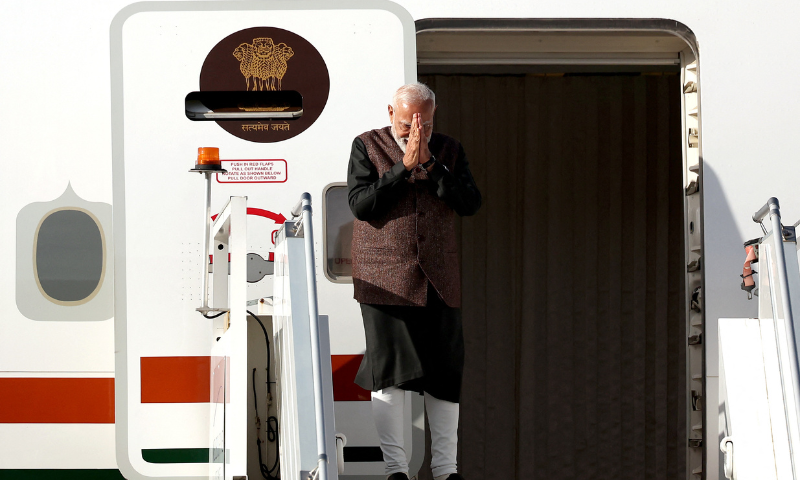



AUCKLAND: Indian Prime Minister Narendra Modi arrived in New Zealand on Friday, facing mounting criticism over a proposed free trade agreement and renewed scrutiny of his government’s human rights record, with political leaders, civil society groups and activists voicing concerns over migration, minority rights and religious freedoms.
Although New Zealand’s government has promoted the agreement as a catalyst for trade, investment and job creation, the deal has triggered opposition from sections of the governing coalition and advocacy groups, exposing deep divisions over its economic and political implications.
Opposition to Trade Deal
Prime Minister Christopher Luxon has championed the agreement, signed in April, as a major economic breakthrough that would expand exports and strengthen commercial ties with the world’s most populous country.
However, members of the populist New Zealand First Party, a coalition partner in Luxon’s government, have criticised provisions relating to migration and visas.
Government minister Shane Jones sparked outrage after telling a local radio programme: “I don’t care how much criticism we get, I am just never going to agree with a butter chicken tsunami coming to New Zealand.”
Modi Faces Human Rights Criticism
Modi’s visit has also revived criticism of his domestic policies, with opponents accusing his government of promoting an exclusionary brand of Hindu nationalism and failing to protect the rights of religious minorities.
Prominent evangelical preacher Brian Tamaki accused Modi of persecuting Christians in India and made inflammatory remarks calling for retaliation against Hindus and Sikhs in New Zealand.
“Let’s purge New Zealand of Hindus, Sikhs and others,” Tamaki said on Instagram.
“While we’re at it, if they’re burning churches down, why don’t we burn —- their temples down? Tit for tat.”
New Zealand’s Race Relations Commissioner condemned the comments as “utterly appalling.”
Indian Community Raises Alarm
The visit comes against a backdrop of growing concern among Indian-New Zealanders over what they describe as rising racial hostility.
Earlier this year, Māori activist Che Wilson was accused of insulting an Indian-born New Zealand lawmaker during a haka performance that allegedly contained racially charged mockery.
Massey University anthropologist Sita Venkateswar said Indian-New Zealanders were increasingly being singled out.
“A ‘butter chicken tsunami’, slurs set to a haka, graffiti on a school wall — South Asians are already the most frequent targets of racially motivated incidents in our data,” she told AFP.
“That is real, and it is wrong.”
Modi is expected to spend just over a day in New Zealand, the final stop of his July 6-11 tour, which also included Indonesia and Australia.
He is scheduled to attend an official ceremony at Government House and participate in a business and sports event in Auckland before addressing the Indian diaspora at Auckland’s Spark Arena.