


Key Points
- Minister highlights Pakistan’s restored macroeconomic stability and investor confidence.
- Five Es framework anchors long-term national economic strategy.
- IT, agriculture and mining identified as priority export sectors.
- Overseas Pakistanis encouraged to expand investments and entrepreneurship.
- University of Chicago backs civil-service transformation programme.
- Curriculum reform planned jointly with PIDE and University experts.
- Climate partnership to strengthen emissions trading and weather forecasting.
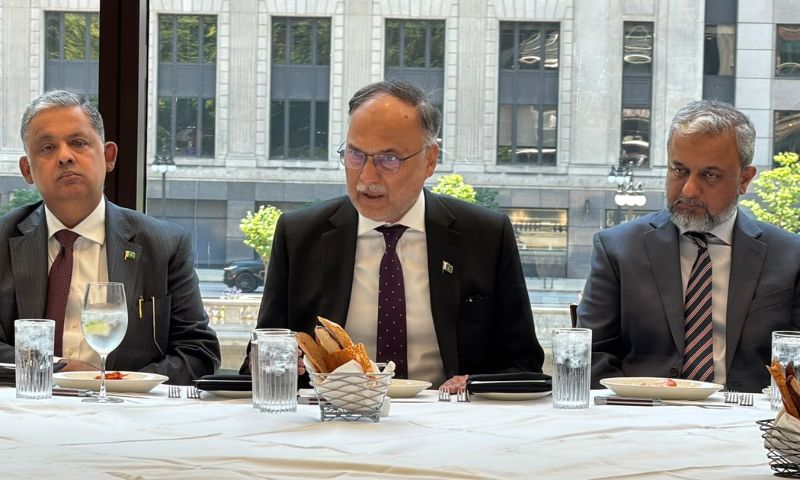
ISLAMABAD: Pakistan’s Federal Minister for Planning, Development and Special Initiatives Ahsan Iqbal on Wednesday called on the Pakistani-American business community to become active partners in Pakistan’s next phase of economic growth, urging them to invest their capital, expertise and global networks as the country seeks to transform recent macroeconomic gains into sustained development.
Addressing one of the most distinguished gatherings of Pakistani-American business leaders in Chicago, the Minister spoke to a 20-member delegation comprising entrepreneurs, technology innovators, financiers, artificial intelligence founders and investors, with more than one-third having previously served as senior executives in Fortune 500 companies.
The Minister said Pakistan had reached a defining moment in its history where improvements in national security, diplomacy and macroeconomic stability must now translate into higher investment, stronger exports and long-term economic prosperity.
“Pakistanis abroad remain deeply connected to their homeland, and the Pakistani-American community has distinguished itself across technology, finance, healthcare, energy and academia,” he said.
Referring to the economic reforms undertaken under Pakistan’s government, Iqbal said Pakistan had restored macroeconomic stability, reduced inflation, lowered policy rates and earned international recognition as one of the world’s leading economic turnaround stories.
“The vision is there. The economy has been rebuilt. What we need now is your capital, your networks and your expertise,” the Minister told participants.
He said Pakistan’s constructive role in promoting regional peace had strengthened investor confidence and opened new avenues for international trade and strategic partnerships, making it an opportune time for overseas Pakistanis to include Pakistan in their investment and professional portfolios.
Most members of the delegation are already engaged in philanthropic and investment activities in Pakistan. The meeting sought to institutionalise that engagement under the government’s flagship URAAN Pakistan economic transformation agenda.
URAAN economic vision
The Minister outlined the government’s ambition of building a $1 trillion economy by 2035 and expanding it to $3 trillion by 2047 through the URAAN Pakistan framework.
He said the strategy is built around five priority pillars — Exports, E-Pakistan, Environment and Climate Change, Energy and Infrastructure, and Equity and Empowerment.
Iqbal identified information technology, agriculture, manufacturing, tourism, mining and minerals, the blue economy, skilled manpower and creative industries as sectors capable of significantly increasing Pakistan’s export earnings and creating sustainable employment opportunities.
He assured participants that the government remained committed to creating an enabling environment for investment, innovation and entrepreneurship and expressed confidence that overseas Pakistanis would play a central role in achieving Pakistan’s long-term economic ambitions.
Strengthening the knowledge economy
The Minister also reaffirmed the government’s commitment to strengthening Pakistan’s knowledge economy through closer engagement with Pakistani-American academics and researchers.
He highlighted ongoing collaboration with leading American educational institutions, including the University of Illinois Chicago, the Illinois Institute of Technology, the University of Chicago and the broader US-Pakistan Knowledge Corridor, while also underlining efforts to engage overseas experts in advancing Pakistan’s artificial intelligence readiness and technological transformation.
University of Chicago partnerships
Earlier, the Minister held three separate meetings with senior officials and faculty members at the University of Chicago, resulting in agreements to pursue collaboration in public-sector reform, education and climate resilience.
In a meeting with Prof Madhav Rajan and Professor Katie Hiranyak, discussions focused on public policy, governance and public-sector transformation.
The Minister observed that Pakistan continues to rank among the lowest in South Asia on key education indicators and stressed that developing human capital remains the government’s foremost national priority.
He said retraining federal and provincial civil servants was essential to overcoming institutional inertia and improving policy implementation.
Both sides agreed to launch a hybrid academic programme enabling Pakistani students to undertake coursework in Chicago while completing research projects in Pakistan.
They also agreed to jointly design a modern public-sector transformation programme through the University of Chicago’s public-policy and business schools to equip Pakistani civil servants with contemporary technological, managerial and analytical skills aligned with global standards.
Curriculum reform
During a separate meeting with development economist Dr Christina Brown and Research Director Zohaib Hassan from the university’s Economics Department, discussions centred on education reform in collaboration with the Pakistan Institute of Development Economics (PIDE).
The two sides agreed to undertake a comprehensive review of Pakistan’s school and university curricula aimed at modernising education and addressing structural weaknesses.
Participants discussed reducing the country’s longstanding dependence on English as the exclusive medium of instruction, arguing that broader use of languages understood by students would improve learning outcomes and expand educational access.
Climate resilience cooperation
In another meeting with Sam Ori, Executive Director of the Institute for Climate and Sustainable Growth, discussions focused on climate resilience and sustainable development.
The Minister noted that Pakistan remains among the world’s most climate-vulnerable countries despite contributing only a negligible share of global greenhouse gas emissions. He recalled that the devastating floods of 2022 represented the country’s costliest climate disaster.
Both sides agreed to deepen collaboration on emissions trading initiatives already underway with the Punjab government, continue work on a federal electricity tariff study aimed at promoting energy inclusion, negotiate a new memorandum of understanding with PIDE and launch specialised training in weather forecasting to strengthen Pakistan’s early-warning systems.
Concluding his engagements in Chicago, the Minister and participating institutions reaffirmed their commitment to translating their shared vision of economic cooperation, knowledge exchange, climate resilience and human-capital development into practical initiatives that support Pakistan’s long-term development goals.