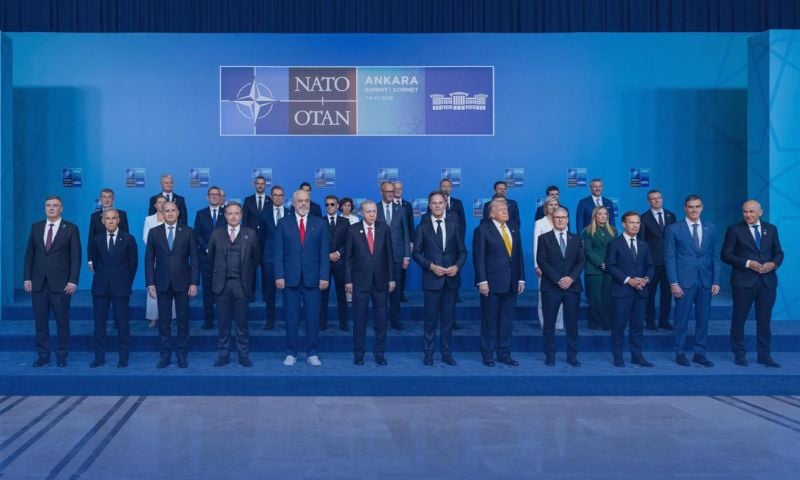
ANKARA, Turkiye: NATO leaders declared that Iran must never be allowed to obtain a nuclear weapon and called on Tehran to fully respect freedom of navigation in the Strait of Hormuz.
The position was outlined in the Ankara Summit Declaration issued after the meeting of Heads of State and Government of the North Atlantic Council in Turkiye’s capital. The declaration also reaffirmed the Alliance’s commitment to addressing strategic competition, hybrid threats, terrorism and regional instability.
The NATO summit was attended by Turkish President Recep Tayyip Erdogan as host, US President Donald Trump, Ukrainian President Volodymyr Zelenskyy, NATO Secretary General Mark Rutte, British Prime Minister Keir Starmer, French President Emmanuel Macron, Italian Prime Minister Giorgia Meloni, Canadian Prime Minister Mark Carney, and South Korean President Lee Jae-myung, among other leaders of the bloc member countries.
In the declaration, NATO said the Alliance would continue adapting to an increasingly complex global security environment shaped by strategic competition, persistent instability, hybrid threats and recurrent security shocks.
Ankara Summit Declaration issued by the Heads of State and Government participating in the meeting of the North Atlantic Council in Ankara, Türkiye
Read the full statement → https://t.co/mQOBHNYCXy#NATOsummit pic.twitter.com/RIoidXu2rQ
— NATO (@NATO) July 8, 2026
“Allies reiterate that Iran must never have a nuclear weapon and call on Iran to fully respect freedom of navigation in the Strait of Hormuz,” the declaration said.
International attention remains focused on security in the Strait of Hormuz, a strategic waterway through which a significant share of the world’s crude oil and liquefied natural gas exports passes.
Commitment to collective defence
The declaration opened with a reaffirmation of NATO’s commitment to collective defence under Article 5 of the Washington Treaty.
“We reaffirm our ironclad commitment to our collective defence under Article 5 of the Washington Treaty and to the transatlantic bond. An attack on one is an attack on all,” Allied leaders said.
The Alliance said its unity, solidarity and collective strength remained the foundation of peace, security and prosperity for the approximately one billion citizens of member states, while reaffirming its commitment to a 360-degree approach to deterrence and defence.
Defence spending and military capabilities
NATO leaders said European Allies and Canada had increased investment in core defence requirements by more than $139 billion in 2025 to address what they described as the long-term threat posed by Russia and the persistent threat of terrorism.
They announced more than $50 billion in new defence procurements and pledged to expand collective manufacturing capacity, strengthen defence industries and accelerate innovation.
The Alliance also committed to removing defence trade barriers among member states and enhancing industrial cooperation through NATO partnerships.
Leaders said NATO would continue investing in advanced military capabilities, including integrated air and missile defence, deep precision strike systems, uncrewed platforms, intelligence capabilities, cyber and space assets, while developing an interoperable transatlantic warfighting cloud and adopting advanced artificial intelligence models.
Continued support for Ukraine
The declaration reaffirmed NATO’s continued support for Ukraine, describing the country as an important contributor to transatlantic security.
The Alliance said European Allies and Canada now finance the vast majority of military assistance provided to Ukraine through bilateral and multilateral arrangements.
For 2026, NATO members pledged €70 billion in military equipment, assistance and training for Ukraine and committed to maintaining at least equivalent levels of support in 2027, the declaration stated.
The declaration also welcomed the European Union’s decision to provide multi-year financial support to Ukraine through the Ukraine Support Loan.
NATO leaders concluded the declaration by expressing appreciation to Turkiye for hosting the summit and reaffirming their commitment to strengthening the Alliance in response to evolving global security challenges.