ISLAMABAD: The federal cabinet, chaired by Prime Minister Shehbaz Sharif, on Tuesday approved Pakistan’s first-ever four-year Hajj Policy and Plan (2027–2030), introducing long-term planning, digital reforms, and new facilities aimed at improving services for pilgrims.
The cabinet highly appreciated Minister for Religious Affairs Sardar Muhammad Yousaf and his ministry’s team for successful Hajj arrangements this year, said a statement issued by the PM Office’s media wing on Tuesday.
A detailed briefing informed the cabinet that, unlike previous one-year Hajj policies, the newly approved Hajj Policy and Plan covers four years from 2027 to 2030. The policy is designed to enable long-term planning, improve operational efficiency, and provide better facilities for intending pilgrims.
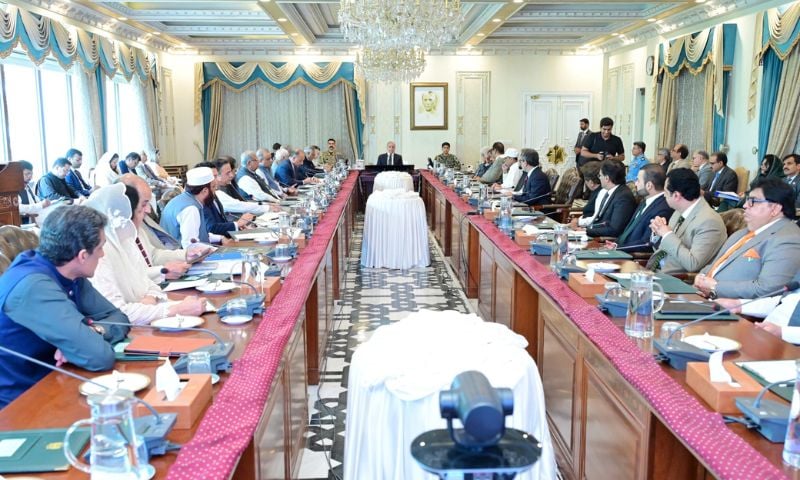
Prime Minister Muhammad Shehbaz Sharif chairs a meeting of the Federal Cabinet. Islamabad, 7 July 2026. pic.twitter.com/BO3P4E6uFc
— Prime Minister’s Office (@PakPMO) July 7, 2026
The cabinet was informed that standard operating procedures (SOPs) and other regulations would be formulated to implement the policy, while amendments could be made whenever required to ensure compliance with Saudi Arabia’s laws and regulations.
Under the new framework, intending pilgrims will be able to register for Hajj for any year up to 2030 according to their preferences, replacing the existing annual registration process. A priority waiting list will also be maintained to streamline future allocations.
اسلام آباد: 7 جولائی 2026.
وزیرِ اعظم محمد شہباز شریف نے آج اسلام آباد میں وفاقی کابینہ کے اجلاس کی صدارت کی.
وفاقی کابینہ نے حج پالیسی اور پلان برائے 2027-2030 کی منظوری دے دی. وفاقی کابینہ نے رواں برس بہترین حج انتظامات پر وفاقی وزیرِ مذہبی امور سردار محمد یوسف اور وزارت کی… pic.twitter.com/IffOyaSobj
— Prime Minister’s Office (@PakPMO) July 7, 2026
The policy further introduces a Shariah-compliant Hajj savings scheme, enabling prospective pilgrims to save in advance for future Hajj journeys.
Digital transformation of Hajj operations
The cabinet was informed that the entire Hajj management system will be digitised, including payment mechanisms, complaint handling, and monitoring processes to improve transparency and service delivery.
The policy also allocates quotas for both government and private Hajj schemes while introducing long-duration and short-duration Hajj packages. It includes mandatory training for pilgrims, Takafol arrangements, and emergency response mechanisms.
The cabinet directed that the appointment of Hajj assistants be carried out through a transparent, merit-based process and instructed the relevant authorities to ensure third-party validation of both government and private Hajj operations.
Healthcare outsourcing approved
The federal cabinet also approved the outsourcing policy for the services of the Isolation Hospital and Infectious Treatment Centre (IHITC) and the Regional Blood Centre (RBC) in Islamabad to improve the quality of healthcare services provided to citizens.
Following the approval, the Ministry of National Health was directed to ensure that the outsourcing process complies fully with the applicable rules and regulations.
Pakistan Railways posts strong revenue growth
The cabinet received a detailed briefing from the Minister for Railways on the performance of Pakistan Railways during the last fiscal year.
The minister informed the meeting that Pakistan Railways generated revenue exceeding Rs115 billion during fiscal year 2025–26, compared with Rs95 billion in 2024–25, reflecting an increase of 24.19 percent.
Freight revenue increased by more than Rs8 billion, while other sources of income rose by over Rs7 billion. Revenue generated through railway property and land exceeded Rs6 billion, and passenger-related income also registered a 3.37 percent increase.
The cabinet was further informed that operational improvements had enhanced both passenger services and freight cargo movement across the railway network.
The federal cabinet commended Minister for Railways Hanif Abbasi and his team for the improved performance.
At the outset of the meeting, Prime Minister Shehbaz Sharif briefed the cabinet about his visit to Turkiye and expressed the hope that relations and brotherhood between Pakistan and Turkiye in various sectors would be further strengthened and consolidated.
He said that during the visit, meetings were held with prominent business groups. Turkish companies were invited to invest in energy, mining and minerals, and infrastructure. Turkish companies were also invited to expand the scope of investment in Pakistan’s priority sectors.