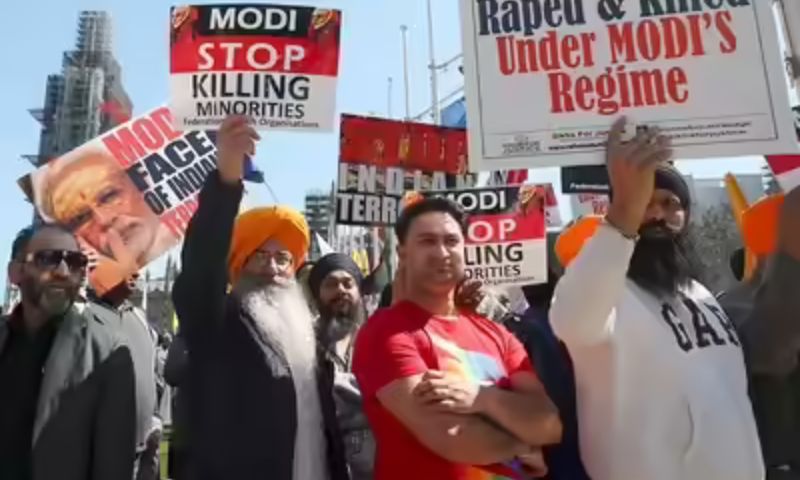
MUMBAI, India: In a country that prides itself on being the world’s largest democracy, a disturbing pattern is emerging, one where religious identity has become a license to persecute, and where the law appears to protect the persecutors rather than the persecuted.
The latest incident in Mumbai’s Juhu area, where a Muslim shopkeeper was targeted by four women simply for wearing a beard and cap, has exposed what critics call India’s deepening crisis of Hindutva extremism and the hollowing out of its cherished secular ideals.
Location: Mumbai
At Mannat Showroom, owner Rafat Hussain was allegedly targeted by four Hindutva women because of his Muslim identity. An FIR was later registered against Rafat Hussain.
According to Rafat Hussain, the women first asked to see wedding clothes and then abused him… pic.twitter.com/e5AMbjmXNs
— The Muslim (@TheMuslim786) June 19, 2026
The story of Rafat Hussain is not an isolated tale of communal hatred, it is a window into a systemic problem that has grown increasingly brazen under Prime Minister Narendra Modi’s decade-long rule. From the streets of Mumbai to the villages of Uttarakhand, a pattern of targeted violence, police complicity, and judicial bias against Muslims has become alarmingly routine.
A pre-planned attack in the name of faith
On the evening of June 13, four women entered Hussain’s showroom, Mannat Ethnic Designer, in Juhu, Mumbai. They claimed to be shopping for wedding clothes, but what followed was something far more sinister. The women, whom Hussain later identified as Hindutva activists, began using language that made him suspicious. Then, they turned openly hostile.
“They said, ‘You are Muslim, you people are like this only and you do things in the wrong way,'” Hussain recounted in a widely circulated video that has sparked outrage online.
When he tried to escape and reach the Santa Cruz police station, a mob of nearly 150 people gathered outside within 20-25 minutes, raising communal slogans. “Unki itni himmat thi ke police station ke andar kam se kam 20-25 chokre chadke aare the mujhe maarne ke liye,” he said. But the most shocking twist came next: instead of the women being booked for harassment and intimidation, it was Hussain who had a First Information Report (FIR) registered against him.
Hussain, an elderly shopkeeper who has run his business for 12-15 years, captured the tragedy in a single sentence: “My only crime is that I am sitting in my showroom in Juhu wearing a beard and a cap.”
Juhu, Mumbai, Fadnavis’s Maharashtra.
At Mannat Showroom, an elderly Muslim owner, Rafat Hussain, was allegedly targeted & abused by 4 Hindutva women because of his religious identity.
They reportedly came pretending to buy wedding clothes & then began verbally abusing him,… pic.twitter.com/ev7J0ABkUp
— Muslim IT Cell (@Muslim_ITCell) June 19, 2026
A pattern, not an isolated incident
This incident is part of a disturbing chain of communal violence across India. In February 2026, a gym owner in Uttarakhand’s Kotdwar, Deepak Kumar, intervened to stop a Bajrang Dal mob from harassing a 70-year-old Muslim shopkeeper, Wakeel Ahmed, over the use of the word ‘Baba’ in his shop’s name.
Kumar famously identified himself as “Mohammad Deepak” in a moment of solidarity, but soon found himself the target of Hindutva groups. Three FIRs were filed in the case, one against the protesters, one on behalf of the shopkeeper, and one against Kumar himself. His daughter stopped going to school, and his family lived in constant fear.
Even more alarming are the events in Maharashtra’s Sangli district, where around 20 Muslim families fled their ancestral village in Arala after years of harassment, mob attacks, and discriminatory policing.
The complaint filed by residents detailed how a dispute over a mutton shop escalated into a communal assault, with attackers raising “Jai Shri Ram” slogans and shouting “Let’s break them, kill the Pakistanis.” Several accused were granted bail and celebrated openly in the village, shattering any remaining confidence among the Muslim families that they could safely continue living there.
‘Muslims Have No Right to Live in India’: Uttarakhand Kali Sena Leader https://t.co/tjqjYtJ4rv
— Clarion India (@TheClarionIndia) June 16, 2026
In Dehradun’s Bairagiwala village, tensions escalated following the killing of a BJP OBC Morcha leader. What followed was a campaign of intimidation so severe that many Muslim families fled, and the village mosque was closed to avoid further flare-ups. Against this backdrop, Kali Sena leader Bhupesh Joshi openly declared, “Muslims have no right to live in India,” and demanded that mosques be removed and the azaan banned.
The rhetoric of extremism and the silence of the ‘secular’ leadership
The question that haunts India’s conscience is: how does the world’s largest democracy allow such open calls for ethnic cleansing and religious persecution?
Critics point to the growing impunity enjoyed by Hindutva groups, fueled by rhetoric from the highest offices in the land. While Prime Minister Modi frequently speaks of “Sabka Saath, Sabka Vikas,” his administration has been accused of turning a blind eye, or worse, to the systematic targeting of minorities.
After the Mumbai incident, one social media user aptly captured the helplessness of the community: “Need to install CCTV in every Muslim shop, masjid, and dargah so that such pre-planned attacks on Muslims by Hindutva terrorists can be exposed later, otherwise there will be no justice from biased police or judiciary.”
Where does India go from here?
The Mumbai incident, the Uttarakhand confrontation, the fleeing of families from Arala, and the hate speeches in Dehradun paint a grim picture of a nation grappling with an identity crisis. The so-called secularism that India’s founders enshrined in its Constitution appears to be crumbling under the weight of majoritarian politics.
For Rafat Hussain, the ordeal has left him in a state of perpetual fear. “Abhi mujhe dar lagta hai bas khadne ke liye yeh showroom me,” he said. “Kya maloom kal kaun kaha se ajaye aur mere upar bada haatsa hojaye.”
As India approaches another election cycle, the world will be watching closely. Will the country’s institutions rise to protect its minorities, or will the voice of Hindutva extremism continue to drown out the cries for justice?
For now, the answer remains uncertain, but for millions of Indian Muslims, each day brings new evidence that the law of the land is not blind, but biased.