ISLAMABAD: Pakistan’s Prime Minister Shehbaz Sharif has announced that the government will substantially reduce petrol prices after a retreat in global oil markets, saying the administration was committed to passing on the benefits to consumers.
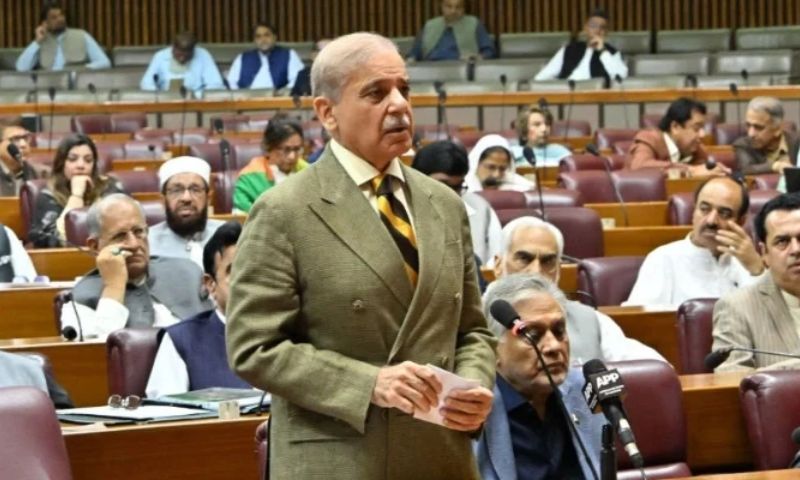
Addressing the National Assembly in Islamabad on Friday, the prime minister said the government had fulfilled its promise to provide relief to the public and would unveil a fresh reduction in petroleum prices following its weekly review later in the day.
“We had promised that we would bring down petroleum prices and return every penny of relief to the people,” Sharif told lawmakers, adding that the forthcoming reduction would be “significant”.
The announcement comes as international oil prices have eased in the wake of a Pakistan-mediated peace agreement between the United States and Iran, which helped restore confidence in energy markets and allowed oil tankers to resume passage through the Strait of Hormuz.
Sharif praised members of his cabinet for steering the country through the recent energy crisis and also commended provincial chief ministers for supporting federal efforts aimed at cushioning the impact of soaring fuel costs through targeted subsidies.
He noted that the federal government had spent around Rs128 billion to shield consumers when oil prices surged during the regional conflict. Last week, Islamabad reduced petrol prices by Rs4 per litre and diesel prices by Rs2 per litre for the period ending 19 June.
Pakistan switched to weekly fuel assessments after the US-Iran conflict disrupted global energy supplies.
Pakistan, which traditionally reviews fuel prices every two weeks, switched to weekly assessments after hostilities involving US and Iran disrupted global energy supplies.
The conflict led to the temporary closure of the Strait of Hormuz, one of the world’s most important maritime routes, through which roughly one-fifth of global oil and gas shipments pass under normal conditions.
The disruption triggered a sharp rise in crude prices and fuel costs worldwide, contributing to inflationary pressures in Pakistan and other countries.
At the start of the crisis, petrol in Pakistan was priced at Rs258.17 per litre before climbing to a peak of Rs458.41 per litre. Prices later eased to just above Rs370 per litre.
Diesel prices, meanwhile, rose from Rs275.70 per litre to as high as Rs520.35 per litre during the period of market turbulence.
Petrol is widely used by motorists, motorcyclists and rickshaw drivers, making fuel prices a major concern for middle- and lower-income households.
Diesel, meanwhile, plays a crucial role in freight transport and agriculture, meaning fluctuations in its price have a broader impact on inflation and the cost of essential goods.
The latest reduction is expected to provide some relief to consumers and businesses as Pakistan seeks to contain inflation and support economic recovery.