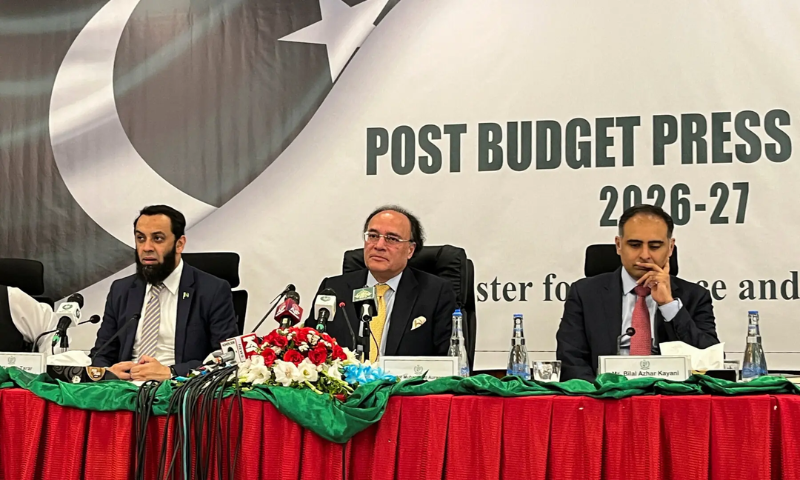
ISLAMABAD: Finance Minister Muhammad Aurangzeb on Saturday said that Pakistan’s economy was steadily transitioning from stabilisation to growth, as he elaborated on the federal budget proposals unveiled a day earlier for the fiscal year 2026–27
“The economy is moving in the right direction […] we will now move from economic stability to growth,” Aurangzeb said while addressing a post-budget press conference.
The finance minister said the government had focused on strengthening both the tax system and export sector in the budget. He noted that the country had achieved notable economic gains during the outgoing fiscal year and added that the available fiscal space had been utilised as effectively as possible.
“The main theme of this budget is export-led growth. A key question has been what constitutes the enabling environment for exports, and in this budget, we have made comprehensive efforts to address those factors,” he added.
Aurangzeb announced an additional allocation of Rs70 billion in subsidies to enable exporters to obtain financing at a concessional rate of 4.5 percent, a move aimed at enhancing export competitiveness and improving liquidity within the sector.
He also confirmed the abolition of the super tax for businesses with annual earnings exceeding Rs500 million, describing the decision as a significant policy measure.
According to the finance minister, Prime Minister Shehbaz Sharif and the federal cabinet had specifically directed that the super tax be eliminated for all exporters when the budget proposals were reviewed. He said the measure would be formally incorporated into his winding-up speech at the conclusion of the budget session.
He emphasised that these tax reforms were part of a broader economic strategy designed to incentivise production, promote documentation of the economy and support export-oriented industries, rather than being standalone measures.
“This is about setting the right direction of travel — moving towards a tax system that supports growth rather than constrains it,” he remarked.
He said efforts were being made to implement a modern tax administration system driven by automation and artificial intelligence, with reduced human involvement to enhance efficiency, transparency and compliance.
“We want to move towards a technology-driven, faceless system in income tax and sales tax, similar to what has been introduced in customs,” he said, adding that digital monitoring was already yielding additional revenues and would play a key role in improving compliance going forward.
Aurangzeb said Pakistan remains in constant consultation with the International Monetary Fund (IMF) as the country is under a Fund programme.
“As far as the IMF is concerned, since we are in an IMF programme, we remain in constant consultation with them. All discussions are being carried forward with their input. That is a requirement of being in the programme,” he said.
Finance Minister Muhammad Aurangzeb said the government was prioritising the agriculture sector, noting that agricultural financing had surpassed Rs2 trillion. To promote mechanisation and improve productivity, he said customs duties, additional customs duties and regulatory duties on the import of agricultural machinery and equipment had been abolished.
Aurangzeb said the government had prioritised tax relief for lower-income salaried individuals, reducing the tax rate in the 5 percent slab to 1 percent and lowering the 15 per cent slab to 13 per cent. He added that the government had received encouraging feedback on measures affecting higher-income brackets and surcharge adjustments.
He further noted that taxes on the construction sector had been reduced to stimulate economic activity and attract investment.
The finance minister acknowledged that pressure on the energy sector remained a key challenge.
Responding to a question, Aurangzeb said the government had created adequate fiscal buffers to absorb the secondary effects of rising global oil prices and expressed confidence that the existing financial support arrangement with the provinces would remain in place over the next three years.
He said Pakistan had already felt the impact of higher oil prices in April, when the country’s oil import bill rose by $1 billion. However, coordinated government efforts, particularly through the National Command and Monitoring Centre (NCMC), helped contain the additional burden, reducing it to approximately $500 million in May.