


WASHINGTON/TEHRAN: The United States and Iran traded fresh military strikes on Wednesday, sharply escalating tensions in the Gulf after Washington launched retaliatory attacks over the downing of a US Army Apache helicopter and Tehran responded by targeting American military sites in the region.
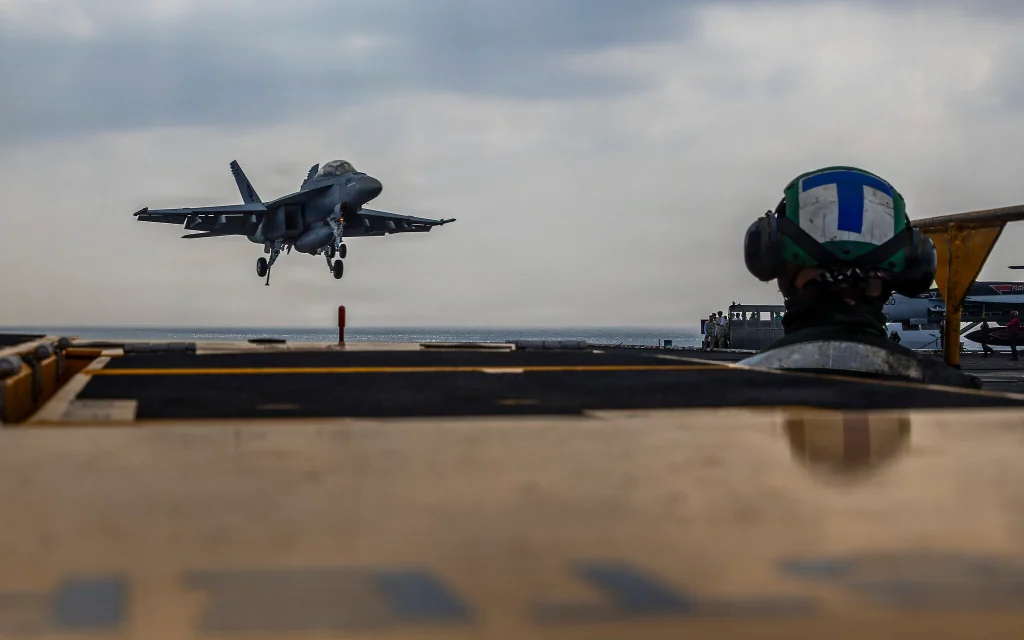
US forces launched what President Donald Trump described as retaliatory strikes against Iran after an American Army Apache helicopter was shot down near the Strait of Hormuz.
Hours later, Iran claimed it had responded by targeting US military facilities in the Gulf, including the headquarters of the US Fifth Fleet in Bahrain and US military facilities in Jordan.
In a statement carried by state media, the Guards said long-range missiles struck four targets at the Al-Azraq air base in Jordan, including what they described as facilities used by F-35 fighter jets and a US military command centre.
The Guards had earlier said Iran carried out drone attacks against the headquarters of the US Fifth Fleet in Bahrain and warned of “heavier responses” if Washington continued its military operations against Iran.
The exchange of attacks came despite ongoing diplomatic efforts and a fragile ceasefire that had largely halted direct hostilities between Iran and Israel since April.
Trump, in a telephone interview with ABC News, said the United States was responding “in a strong manner” to “what they did with our helicopter last night.”
“And I believe the response should be very strong, very powerful, and that’s what this one is,” he said.
US Central Command (CENTCOM) said American forces “began launching self-defense strikes against Iran, at 5 pm ET (2100 GMT) today at the Commander in Chief’s direction” and “the mission is a proportional response to unjustified Iranian aggression.”
U.S. Central Command (CENTCOM) forces began launching self-defense strikes against Iran at 5 p.m. ET today at the Commander in Chief’s direction, in response to yesterday’s downing of a U.S. Army Apache helicopter. The mission is a proportional response to unjustified Iranian…
— U.S. Central Command (@CENTCOM) June 9, 2026
Iranian media reported that explosions were heard on Iran’s southern coast near the Strait of Hormuz.
The US Army Apache helicopter is the second crewed aircraft that Washington has confirmed was shot down by Iran during the war, following the loss of an F-15 fighter plane in April.
CENTCOM said the two crew members were rescued after their helicopter went down near the coast of Oman.
“The Soldiers were safely rescued within approximately two hours and are in stable condition,” CENTCOM said in a post on X.
A spokesperson said a naval surface drone helped rescue the crew members.
Iran Strikes Back
Iran’s Revolutionary Guards said on Wednesday they had launched a drone strike against a US military base in Bahrain in response to American attacks on southern Iran, warning that further action would follow if Washington continued its operations.
In a statement carried by Iranian media, the Islamic Revolutionary Guard Corps (IRGC) said the United States had struck several locations in the southern Iranian areas of Jask, Sirik and Qeshm earlier in the day.
“The warmongering US regime attacked several points in Jask, Sirik and Qeshm early this morning under false pretexts, damaging a telecommunications mast in Sirik and destroying two water tanks in the city,” the statement said.
The Guards added that their naval forces launched a drone attack against what they described as the US Fifth Fleet headquarters in Bahrain at 2:30 am local time (2300 GMT Tuesday).
“In response to the enemy’s vicious move, the IRGC naval fighters launched a drone strike on the Bahraini 5th Navy,” the statement said, warning of “heavier responses” should US attacks continue.
Iranian media also reported fresh explosions in areas near the Strait of Hormuz during the early hours of Wednesday. The Mehr and Fars news agencies said blasts were heard on Qeshm Island and in the southern port city of Bandar Abbas.
Separately, Iran’s Khatam al-Anbiya Joint Military Command said several US military bases in the region had been targeted in response to what it called American “aggression in southern Iran”.
State media reported that the Revolutionary Guards had carried out drone attacks against the headquarters of the US Fifth Fleet in Bahrain as well as other American military sites across the Gulf.
Strait of Hormuz
The US-Iran conflict has severely disrupted shipping via the Strait of Hormuz, through which about a fifth of global oil usually passes, while Washington has imposed a blockade on Iranian ports.
The price of the main US oil benchmark — West Texas Intermediate — jumped 1.4 percent shortly before Asian markets opened Wednesday, reaching $89.40 per barrel following the news of renewed US strikes.
Oil prices had retreated previously after Trump hinted at a deal with Iran in the coming days.
The US strikes came just hours after Trump had said negotiations to end the Middle East war were in their final stages — a claim he has made repeatedly in the past few weeks.
A shaky ceasefire between the warring parties has been in place since April 8, but it faced a major test when Iran and Israel renewed attacks over the weekend, before each side announced a halt.
Israeli attacks on Lebanon
Israeli attacks on Lebanon continued, however, and Lebanese officials said 11 people were killed in airstrikes on Tuesday on the historic city of Tyre in the south of the country.
The Israeli military also warned the entire city to evacuate.
An AFP correspondent saw residents of Tyre, including from the Christian quarter, fleeing and heavy traffic heading north after the Israeli warning.
Another correspondent in the coastal city of Sidon, further north, saw displaced people arriving from Tyre, some with belongings hastily strapped to the roofs of their cars.
Tehran has insisted that a halt to the war must include a truce in Lebanon, which was drawn into the conflict when Iran-backed Hezbollah militants fired rockets at Israel on March 2.
Israel responded with an extensive campaign of airstrikes and a ground invasion that has killed more than 3,600 people. Exchanges of fire with Hezbollah have not stopped despite an ongoing truce.
Iran’s Foreign Minister Abbas Araghchi urged foreign forces meanwhile, to leave the Strait of Hormuz and surrounding areas, warning that they faced a risk of being caught in the crossfire if they remained.
Foreign forces in proximity to our territory are at constant risk on account of their own human errors, plain accidents, or potentially being caught in crossfire.
To reduce risk, best solution is for them to leave.
We prefer language of diplomacy but speak other languages too. pic.twitter.com/5DDgHAscBj
— Seyed Abbas Araghchi (@araghchi) June 9, 2026
“The Strait of Hormuz is NOT international waters but shared between Iran and Oman,” Araghchi said. “Foreign forces in proximity to our territory are at constant risk on account of their own human errors, plain accidents, or potentially being caught in crossfire.
“To reduce risk, best solution is for them to leave. We prefer language of diplomacy but speak other languages too,” he said.