
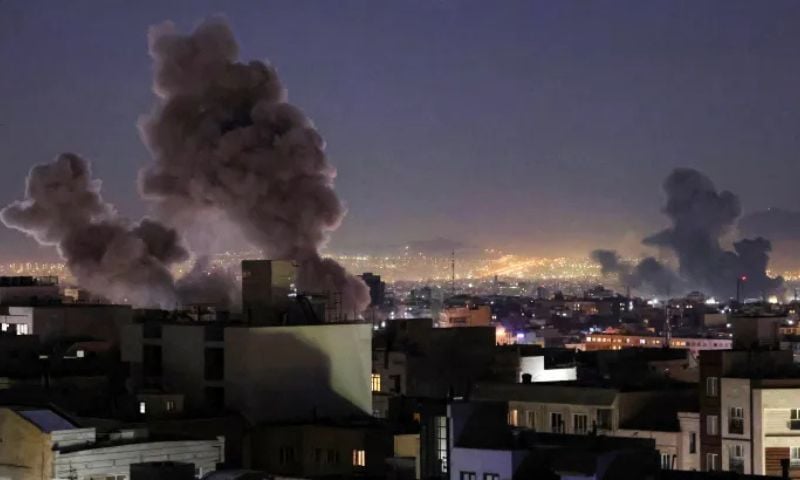
JERUSALEM/TEHRAN: Israel and Iran exchanged fresh military strikes early Monday, with both sides claiming to have targeted strategic sites, in the most serious escalation since an April ceasefire halted months of direct hostilities between the regional rivals.
The flare-up, which also drew in other countries in the region, saw Israel striking Iran after the Islamic Republic targeted it in vengeance for an airstrike on Beirut’s southern suburbs.
It followed weeks of negotiations seeking to bring about a definitive end to the regional war sparked by US and Israeli strikes on Iran on February 28.
No casualties have been reported so far in either Israel or Iran.
The attacks included a strike on an Iranian petrochemical complex and a missile attack on Israel by Yemen’s Houthi rebels.
The Israeli military said it struck and dismantled Iranian defence systems deployed across several areas in the country.
AFP journalists in Jerusalem and the West Bank city of Ramallah heard a series of explosions and the Israeli army said it worked to intercept a new wave of Iranian missiles.
Iran’s Revolutionary Guards said they had struck Israel’s Nevatim and Tel Nof air bases “in response to a missile attack launched by the Zionist regime”.
Tehran blamed Washington for the resumption of fighting and said the flare-up would affect peace talks.
“No one believes that the Zionist regime would carry out any action without prior coordination and cooperation with the United States,” foreign ministry spokesman Esmaeil Baqaei said at a press conference in Tehran.
“It is perfectly natural that the diplomatic process initiated to put an end to this imposed war would be affected.”
Nonetheless, “diplomatic consultations are naturally continuing in all circumstances”, Baqaei added.
Trump Calls for Calm
Yemen’s Iran-backed Houthi rebels, meanwhile, announced a missile attack on Israel on Monday, the first since early April, and declared a ban on Israeli shipping in the Red Sea, raising the spectre of a return to major disruption on the key route.
Trump called for calm from both Israeli Prime Minister Benjamin Netanyahu and the Iranians, but Israel accused Tehran of making a “grave mistake”.
“I call the shots. I call all the shots. He doesn’t call the shots,” Trump said in an interview with the Financial Times on Sunday, referring to Netanyahu.
In an interview with Fox News, Trump said: “What I would suggest to Iran: You’ve shot your missiles, that’s enough, get back to the table and make a deal.”
Iran Launches Missiles After Beirut Strike
Iran’s missile barrage came hours after Israel struck Beirut’s southern suburbs, targeting what it described as Hezbollah facilities in the Dahiyeh district, a stronghold of the Iran-backed Lebanese group.
According to Lebanon’s health ministry, the strike killed at least two people and wounded 20 others, including women and children.
Iran’s Islamic Revolutionary Guard Corps (IRGC) said the missile attack on Israel was a warning against further military action and threatened broader retaliation if Israeli strikes continued.
The IRGC said repeated attacks would be met with a wider response, while senior Iranian officials accused Israel of escalating tensions and jeopardising regional stability.
The April ceasefire had largely halted direct military exchanges between Iran and its adversaries, but recent attacks in Lebanon and elsewhere have raised concerns about its durability.
Israel Says It Hit Military Targets Across Iran
Following the Iranian missile launches, Israel announced a series of air strikes against targets inside Iran.
The Israeli military said its air force struck military sites in western and central Iran before later reporting attacks on several targets at the Mahshahr petrochemical complex in Khuzestan province.
“A short while ago, the Israeli Air Force struck military targets belonging to the Iranian regime in western and central Iran,” the military said.
Iranian state television reported explosions in Tehran, Tabriz and Isfahan, though authorities did not immediately provide details regarding casualties or damage.
“Several explosions were heard in Tehran, Tabriz and Isfahan,” state media reported.
Israeli officials said the country’s air defence systems had intercepted multiple incoming missile salvos during the night.
Israel Tightens Security Measures
As the attacks unfolded, Israel’s Home Front Command ordered schools across the country to close and imposed heightened security restrictions.
“Following an assessment of the situation, the Home Front Command has decided to modify the instructions and place the entire country under a restricted activity level,” the military said.
Officials said educational activities would remain suspended while security assessments continued.
Israeli authorities were still evaluating the scale of the Iranian attack and monitoring for further launches.
Ceasefire Faces Major Test
The latest exchange has placed the April 8 ceasefire under significant strain and renewed fears of a broader regional conflict involving Iran, Israel, Hezbollah and other allied groups.
Diplomatic efforts by regional and international actors have sought to preserve the truce, but repeated cross-border attacks and retaliatory strikes have increased concerns that the ceasefire could unravel.
Neither side indicated any immediate willingness to de-escalate, while military and political leaders in both countries signalled readiness for further action if attacks continue.