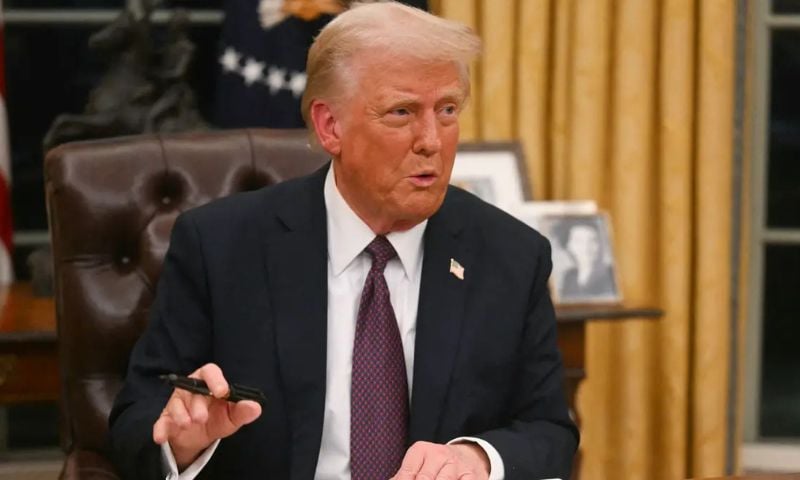
WASHINGTON: US President Donald Trump has said in an interview with NBC News that Washington is “very close” to reaching a peace deal with Iran but is currently seeking additional provisions to ensure Tehran does not obtain a nuclear weapon.
Trump said that the two sides are “very close” to signing a deal, but indicated he is seeking additional restrictions to prevent Iran from obtaining a nuclear weapon by any means.
“We have a couple of points. They don’t even seem like big points… They’ve conceded the fact that they will not have nuclear weapons. We had a clause in there that [they] will not develop nuclear weapons,” the US President said.
The US President said that the US will seize and destroy Iran’s highly enriched uranium, either with or without Tehran’s cooperation.
“We’ll take it out and destroy it, whether it’s on-site or whether we take it off-site,” he said in an interview on the NBC News programme ‘Meet the Press’.
Trump said the U.S. will work with Iran to destroy its uranium if they can make a deal.
“We’ll all go together. It’ll be our equipment. We’ll take it out and destroy it, whether it’s on-site or whether we take it off-site,” the president said. https://t.co/mgxPS2r2nc
— NBC Politics (@NBCPolitics) June 7, 2026
“He adds that he wants to keep US troops in the Middle East until “completion”, further stating he doesn’t “consider them in danger”.
The US President said that he would not unfreeze Iranian assets or lift any sanctions before a peace deal is reached between Washington and Tehran.
Trump said he would consider those steps after an agreement is done. “Comes after,” he said. “Yeah. If they behave, if they do a good job, we start talking. Yeah.”
Trump also said that he was not demanding that Lebanon be a part of a short-term deal with Tehran.
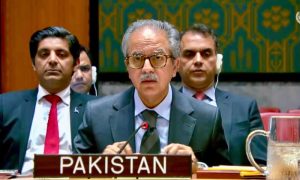
Pakistan-mediated indirect negotiations between the United States and Iran are ongoing as Islamabad intensifies diplomatic efforts to permanently end the conflict through dialogue and diplomacy.
On Sunday, Pakistan’s Interior Minister Mohsin Naqvi met Iranian Foreign Minister Abbas Araghchi in Tehran.
The interior minister’s visit comes amid renewed tensions between Washington and Tehran, with recent tit-for-tat attacks threatening the Pakistan-brokered ceasefire, in place since April 8.
Pakistan’s Interior Minister Mohsin Naqvi met with FM @araghchi to discuss issues of mutual interest and further strengthen cooperation between the two neighboring countries.#Iran #Pakistan pic.twitter.com/xVEBbNudaN
— Government of the Islamic Republic of Iran (@Iran_GOV) June 7, 2026
According to a Reuters report citing a source familiar with the matter, the US is considering making Iranian assets available to Gulf states to support reconstruction and repair efforts following damage due to Iranian attacks.
The report said Washington intends not only to consider Iranian assets for future rebuilding needs but also to examine whether such assets could be used to cover costs arising from previous attacks and destruction.
US Treasury Secretary Scott Bessent has reportedly directed officials to assess the financial impact of damage already sustained by Gulf partners, according to the Reuters report.
The development comes amid renewed military exchanges between Washington and Tehran, despite ongoing efforts to preserve the ceasefire following months of conflict across the region.
The proposal emerged one day after Mohsen Rezaei, an adviser to Iran’s supreme leader, stated that any comprehensive peace agreement would require the release of approximately $24 billion in Iranian assets currently held by the United States.
Meanwhile, US forces operating in the Middle East intercepted and shot down two Iranian one-way attack drones on Friday after they were assessed to be a threat to international maritime traffic transiting through the strategically important Strait of Hormuz, according to the US military.
In a statement posted on social media, the United States Central Command (CENTCOM) said American forces acted to neutralise the drones to safeguard freedom of navigation and protect commercial shipping routes in one of the world’s busiest maritime corridors.
Earlier today, U.S. forces in the Middle East shot down two Iranian one-way attack drones that threatened international maritime traffic in the Strait of Hormuz.
American forces remain postured and ready to continue defending against Iranian aggression.
— U.S. Central Command (@CENTCOM) June 7, 2026
“Earlier today, US forces in the Middle East shot down two Iranian one-way attack drones that threatened international maritime traffic in the Strait of Hormuz,” CENTCOM stated.
CENTCOM further stressed that American forces deployed across the region remain vigilant and prepared to respond to any perceived threats.
“American forces remain postured and ready to continue defending against Iranian aggression,” the statement added.
The Strait of Hormuz, situated between Iran and Oman, is regarded as one of the most strategically significant chokepoints in global trade, making any security-related developments in the area closely watched by governments and international markets alike.