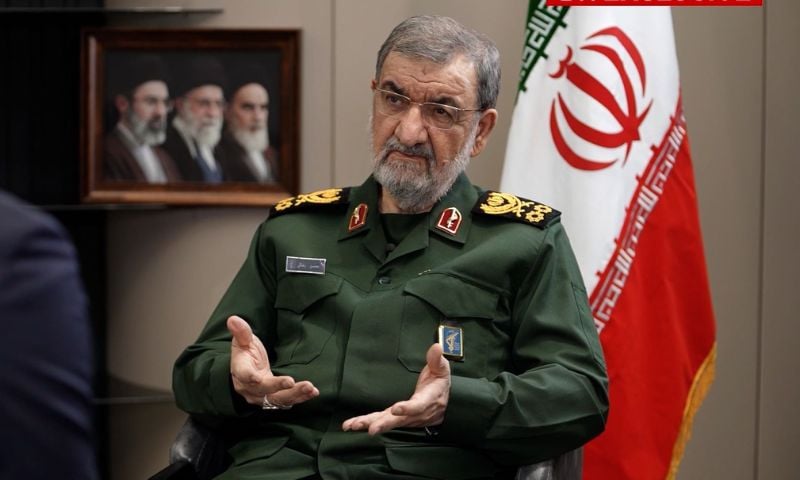
TEHRAN: The military advisor to Iran’s Supreme Leader on Friday said a potential peace agreement between the United States and Iran hinges on the Trump administration agreeing to release $24 billion in frozen Iranian assets.
“The negotiations are at a deadlock and (US President Donald) Trump must break this deadlock,” Mohsen Rezaei told CNN in an exclusive interview in Tehran. “The ball is in Trump’s court.”
Iran has reportedly requested the release of $12 billion in frozen assets immediately upon signing an interim agreement with the United States, with an additional $12 billion to be unfrozen at a later stage.
US officials have expressed concern that releasing funds at this point could weaken a key leverage over Tehran.
A potential peace deal between the United States and Iran hinges on the Trump administration agreeing to release $24 billion in frozen Iranian assets, a top Iranian official told CNN, warning that the US would “enter into a dark corridor” should it resume fighting.… pic.twitter.com/JuRtYS446J
— CNN (@CNN) June 5, 2026
President Trump has insisted that any agreement must appear significantly stronger than the 2015 nuclear deal and has sought to avoid measures that could be interpreted as handing over “pallets of cash,” a phrase he has used to criticise former President Barack Obama’s financial settlement with Iran.
In an interview with CNN, Rezaei outlined the thinking within Iran’s strategic decision-making circles regarding the country’s postwar outlook, the future of the Strait of Hormuz, and potential responses in the event of another attack.
In the interview, he also questioned the durability of any nuclear agreement with Trump, pointing to his withdrawal from the 2015 Iran nuclear deal and what he described as a strategy of “ambiguity” in negotiations.
Should talks fail, Rezaei said Iran is prepared for a potential US invasion of its territory: “then the world will understand Iran’s true capabilities, because our land power is many times greater than our missiles.”
He called the current war Iran’s first victory against its enemies in the Islamic Republic’s 47-year history.
“This is the first time Iran has emerged victorious in wars, while in previous wars Iran has always been defeated,” he said.
Iran Warns US Bases in Region Will Be Targeted in Case of Aggression
Earlier, Iran’s Foreign Minister Abbas Araghchi warned that United States military bases located in regional countries will be considered legitimate targets if they are used in any aggression against Iranian territory.
Speaking during an interview with a local television channel, Araghchi stated that Iran had clearly communicated its position to neighbouring states regarding the presence of US forces in the region. “We warned regional states that US bases used for any aggression against Iran are legitimate targets,” he said.
🚨FM Araghchi: We warned regional states that US bases used for any aggression against Iran are legitimate targets.
— IRIB (Islamic Republic of Iran Broadcasting) (@iribnews_irib) June 5, 2026
Reiterating Iran’s diplomatic outreach, he also emphasised Tehran’s desire to maintain and expand constructive relations with Gulf countries, particularly Saudi Arabia. “We are committed to fostering sustainable, constructive ties with Saudi Arabia,” Araghchi added.
The Iranian foreign minister further stated that Iran had been responding to US-Israel strikes for several days, describing the ongoing confrontation as a major test of resilience.
“Standing against the world’s greatest power, equipped with nuclear weapons, for 10 days is no joke,” he said, adding that “the world has realised the truth of the Iranian nation.”
Pakistan Continues Diplomatic Efforts to End US-Iran Conflict
It is pertinent to mention that Pakistan’s Interior Minister Mohsin Naqvi on Thursday met Iranian Interior Minister Eskandar Momeni, as Islamabad continued diplomatic engagement with regional stakeholders and pursued efforts to facilitate negotiations between the United States and Iran to permanently end the Middle East conflict through dialogue.
In May, Pakistan’s Chief of Defence Forces and Chief of Army Staff, Field Marshal Syed Asim Munir, visited Tehran. During his visit, Field Marshal Munir held high-level meetings with Iranian leaders as part of Pakistan’s mediation efforts to end the US-Iran conflict.
On April 8, Pakistan brokered a ceasefire between the US and Iran and intensified mediation efforts to permanently end the conflict through negotiations.
On April 11 and 12, Pakistan hosted high-stakes direct talks between the US and Iranian negotiators in Islamabad.
The Islamabad Talks between the US and Iran concluded without reaching a final agreement; however, they paved the way for diplomacy to permanently end the conflict.
Trump Claims US-Iran Deal is Close
On Wednesday, US President Donald Trump expressed optimism that a deal could be reached soon, telling reporters at the White House, “it could happen…over the weekend.”
“I hear the negotiation itself is going very well, actually,” Trump said of the latest bid to end the US-Israeli war in the Middle East, which began on February 28.