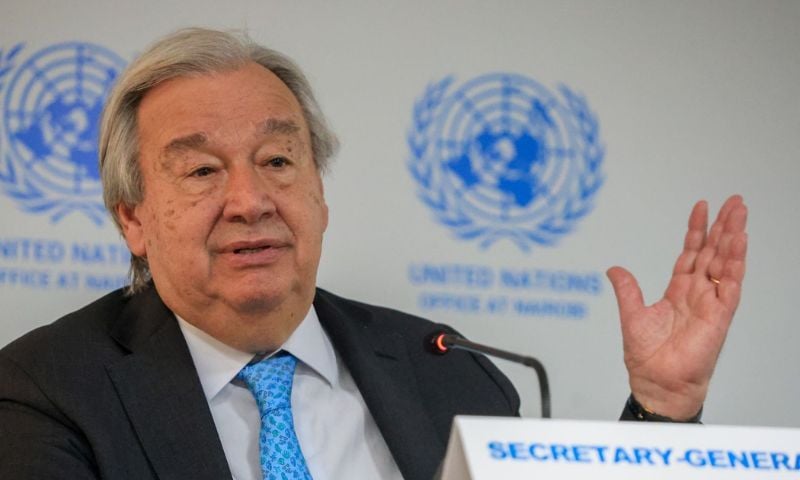



UNITED NATIONS: United Nations Secretary-General António Guterres has outlined three possible frameworks for maintaining stability along the Israel-Lebanon border after the United Nations Interim Force in Lebanon (UNIFIL) concludes its mandate on December 31, 2026.
The proposals, submitted to the UN Security Council, are aimed at sustaining efforts to prevent renewed hostilities between Israel and Lebanon’s Iran-backed Hezbollah movement while supporting the implementation of long-standing international commitments intended to secure lasting peace in the region.
Under each of the options, a continued UN military presence would remain in place to monitor developments along the border, assist the Lebanese Armed Forces in extending state authority, and contribute to political and diplomatic initiatives designed to reduce tensions and prevent further conflict.
Guterres stressed that effective monitoring of the boundary between Israel and Lebanon—known as the Blue Line—would remain essential after UNIFIL’s departure. He noted that recurring clashes and security incidents in recent years have underscored the need for continued international engagement to support stability and de-escalation efforts.
The secretary-general’s recommendations follow a decision by the UN Security Council in August 2025 to terminate UNIFIL’s mandate. The move came amid pressure from the United States and Israel, both of which argued that a new approach was needed to implement the provisions of a 2006 Security Council resolution that ended a month-long war between Israel and Hezbollah.
That resolution called for Hezbollah’s disarmament, the withdrawal of Israeli forces from Lebanese territory, and the deployment of the Lebanese Army across the country as the sole armed force operating within Lebanon. However, many of the resolution’s key provisions have yet to be fully implemented, leaving the situation along the border fragile.
In a letter sent to Security Council members, Guterres described the 2006 resolution as the principal framework for achieving a sustainable peace between the parties. He argued that recent hostilities demonstrate the continued relevance of the agreement and the importance of strengthening mechanisms that support its implementation.
The UN chief proposed three force configurations for the post-UNIFIL arrangement. The largest option would deploy approximately 5,525 personnel and would provide the most comprehensive capability for observing activity along the entire length of the Blue Line. The other proposals envisage smaller deployments, with personnel numbers ranging down to around 1,980, including unarmed military observers.
According to Guterres, all three models would retain the ability to facilitate communication between the parties, support conflict prevention efforts, and coordinate closely with Lebanese authorities.
The military component would also work alongside an enhanced UN political mission led by the UN Special Coordinator for Lebanon, who would continue diplomatic efforts aimed at implementing the 2006 resolution.
UN peacekeepers have maintained a presence in southern Lebanon for decades and have played a central role in monitoring ceasefire arrangements and reporting violations. The mission has operated in a region widely regarded as a stronghold of Hezbollah and has frequently found itself at the centre of regional tensions.
The security environment has become increasingly dangerous in recent years, with six UN peacekeepers killed during recent periods of unrest. Their deaths highlighted the risks faced by international personnel operating in the area and reinforced concerns about the potential for renewed conflict.
Speaking to reporters on Tuesday, UN spokesperson Stéphane Dujarric said the secretary-general hopes the Security Council will reach a decision on the future arrangements without delay, allowing sufficient time to prepare for the transition before UNIFIL’s mandate expires at the end of the year.
The Security Council is expected to review the proposals in the coming months as member states debate the most effective way to maintain stability along one of the Middle East’s most sensitive frontiers.