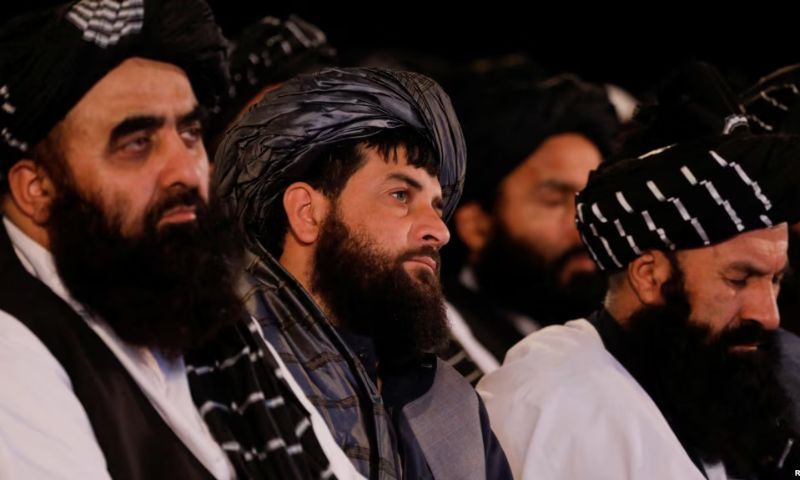



KABUL: Afghanistan’s Taliban regime is facing mounting public backlash as Afghan social media users are strongly condemning the interim Taliban regime leaders for betrayal of the militant movement’s own founder, Mullah Mohammad Omar.
A wave of criticism has emerged across Afghan social media platforms following the interim Taliban regime’s signing of a military-technical cooperation agreement with Russia last week, with many Afghan social media users accusing the regime’s current leadership of betraying the militant movement’s founder.
Mullah Omar, founder of the Taliban movement, fought during the Soviet occupation of Afghanistan in the 1980s. Today, his son, Mullah Mohammad Yaqoob, serves as the interim Taliban regime’s acting defence minister and is viewed as one of the regime’s most influential figures.
A large number of Afghan social media accounts have described the agreement as a betrayal of the sacrifices made during the anti-Soviet war.
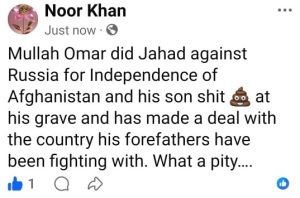
An Afghan social media user, Noor Khan, wrote that Mullah Omar had fought against Russia for Afghanistan’s independence, while his son, Mullah Yaqoob, has made a deal with the country his forefathers fought against.
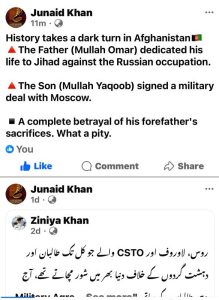
Another Afghan social media user, Junaid Khan, described the development as a “dark turn” in Afghan history. He wrote that the deal contrasts the father’s struggle against Soviet occupation with the son’s agreement with Moscow. He termed Mullah Yaqoob’s action a complete betrayal of his forefather’s sacrifices.
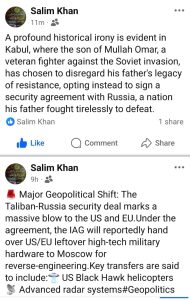
Another Afghan, Salim Khan, called the development a “profound historical irony,” arguing that the son of a fighter who resisted Soviet invasion had chosen to pursue security cooperation with Russia.
“A profound historical irony is evident in Kabul, where the son of Mullah Omar, a veteran fighter against the Soviet invasion, has chosen to disregard his father’s legacy of resistance, opting instead to sign a security agreement with Russia, a nation his father fought tirelessly to defeat,” Salim Khan wrote.
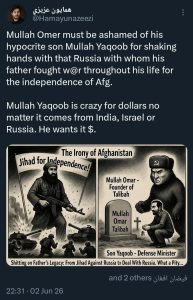
Hamayun Azeezi accused the current Taliban leadership of abandoning the ideals associated with Mullah Omar’s legacy in pursuit of political and economic interests.
“Mullah Omer must be ashamed of his hypocrite son Mullah Yaqoob for shaking hands with that Russia with whom his father fought w@r throughout his life for the independence of Afg,” Azeezi wrote on social media.
“Mullah Yaqoob is crazy for dollars no matter it comes from India, Israel or Russia. He wants it $,” Azeezi wrote.
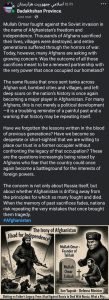
An Afghan social media page, “Badakhshan Province”, questioned whether the sacrifices made during decades of conflict were intended to culminate in renewed cooperation with a country many Afghans still associate with occupation, war and destruction.
“Mullah Omar fought against the Soviet invasion in the name of Afghanistan’s freedom and independence. Thousands of Afghans sacrificed their lives, villages were destroyed, and entire generations suffered through the horrors of war. Today, however, many Afghans are asking with growing concern: Was the outcome of all those sacrifices meant to be a renewed partnership with the very power that once occupied our homeland?” the Afghan social media page posted.
“The same Russia that once sent tanks across Afghan soil, bombed cities and villages, and left deep scars on the nation’s history is once again becoming a major player in Afghanistan. For many Afghans, this is not merely a political development – it is a troubling reminder of a painful past and a warning that history may be repeating itself,” the Badakhshan Province social media account wrote.
The reactions highlight a broader debate within Afghan society about the direction of the Taliban regime nearly five years after its return to power.
The controversy comes at a time when the Taliban regime faces criticism from various quarters over poor governance, economic management and security issues.
International organisations have repeatedly expressed concern about the continued presence of terrorist groups operating from Afghan territory.