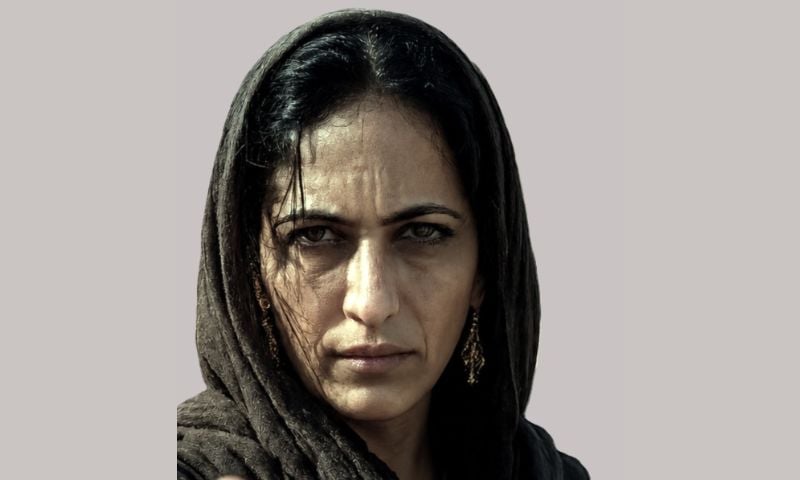
KARACHI: Pakistani law enforcement agencies have identified a key female propagandist, facilitator and recruitment agent of the internationally banned terrorist outfit, Baloch Liberation Army (BLA), during a joint intelligence-based operation in Karachi.
According to official sources, Pakistan government will soon announce head money of Rs 1 million each for providing information about key woman BLA facilitator Habiba Peerjan and her handler, Daad Shah.
The head money will be given to individuals who can provide information about the whereabouts of the woman facilitator and her handler of the terrorist network.
Official sources said that law enforcement agencies conducted an extensive operation to arrest Habiba Peerjan, the wife of Haneef and a resident of Dasht in District Kech, in Gulshan-e-Mazdoor, Karachi, on May 25, 2026. However, she managed to escape before the area was fully cordoned off.
During the search of her residence, law enforcement personnel recovered diaries and written documents and correspondence related to BLA terrorist activities.
During a recent Intelligence based operation in Karachi, credible material and documents have led to a key female Terrorist facilitator on the run, who has close personal links with BLA commanders and has a major role in both terrorist propaganda campaign and terrorist recruitment and facilitation.
Official sources said the recovered documents and collected materials indicate that Habiba Peerjan has very close links with BLA and remained in direct personal contact with several terrorist commanders, including Rustam Peerjan. These documents reveal that she visited Rustam Peerjan twice in Dasht Forest, including one visit on February 14.
Investigators believe these visits and extended stays away from family and home were part of her attempt to maintain close personal relations with BLA commanders.
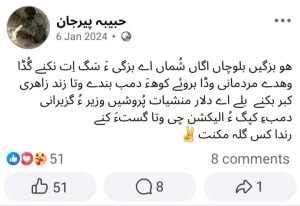
Habiba Peerjan facilitated the logistical support for BLA through the transportation of weapons, equipment and terrorists. The documents also indicate that she maintained contacts with key BYC figures and was involved in glorifying terrorist activities and disseminated anti-state propaganda through poetry on social media platforms.
A social media account with her name also shared poetry in Baloch language, which urged people to reject elections and generated anti-state sentiments.
Officials believe Habiba was in contact with Daad Shah, who is linked to the Indian intelligence agency Research and Analysis Wing (RAW), which had earlier also deployed Commander Gulbushan Yadev in Balochistan to organise and promote terrorism.
Daad Shah received multiple cash payments, upto Rs 1 million, which he distributed to terrorist recruiting agents and facilitators like Habiba, through various couriers, in order to avoid suspicion and detection.
The money was distributed through local couriers rather than via bank accounts or mobile applications in order to avoid any record or financial trail.
Investigators believe that this dangerous terrorist network operates through a complex web consisting of several layers. This Indian sponsored network operates through financial handlers, couriers, ideological motivators, facilitators, and field contacts working in a well-organised network to avoid detection.
Daad Shah had earlier worked as a shopkeeper in Karachi before moving to Gwadar, where he stayed for around three years to help establish a terrorist support network before returning to Karachi.
Habiba Peerjan has been in direct contact with handlers like Daad Shah and was a key BLA asset involved in diverse activities ranging from motivating, recruiting, hosting and supporting suicide bombers.
According to investigators, she provided ideological motivation, arranged temporary shelter, and helped convince vulnerable Baloch women to join terrorist activities.
Sources said terrorist groups operating in Balochistan increasingly rely on women to exploit Baloch cultural sensitivities, based on deep respect for women, in order to avoid detection and move suicide bombers, money and weapons.
In terms of recruitment and operational tactics, according to security analysts, Baloch terrorist groups BLA and BLF significantly differ in terms of their recruitment strategies from the banned Tehreek-e-Taliban Pakistan (TTP).
The Baloch terrorists exploit and rely more on women than the TTP terrorist network, both for recruitment, facilitation and terrorist attacks, as well as to motivate youth to join terrorist organisations by glorifying terrorist acts through poetry and public protest.
While the TTP generally avoids using women in terrorist attacks due to conservative Pashtun tribal values and patriarchal cultural norms, in contrast, the Baloch terrorist outfits have a more liberal organisational culture by recruiting as well as glorifying women terrorists.
According to some experts, BLA and BLF have a similar approach towards using women in their terrorist activities as ISIS in Syria, where women were recruited not just for use in terrorist attacks but also as comfort women for the terrorist commanders.
This was evident because at times these terrorist women are deliberately staying away from their own homes and families, including husbands and parents, for months to live with terrorist commanders.
Habiba also wrote poetry which glorifies anti-state behaviour and rejection of peaceful mainstream politics. Her dissident poetry is used within terrorist organisations to motivate and glorify terrorists.
This content is used to motivate potential suicide attackers by spreading hatred against their own country and government, justify violence against peaceful civilians, including women and children, law enforcement personnel, and state institutions.
Major efforts to trace and apprehend Habiba Peerjan are still afoot at the time of filing this report and officials believe that announcing a large amount of Rs 1 million to gain information about the whereabouts of both Habiba Peerjan and her handler, Daad Shah, can help law enforcement agencies reach them.