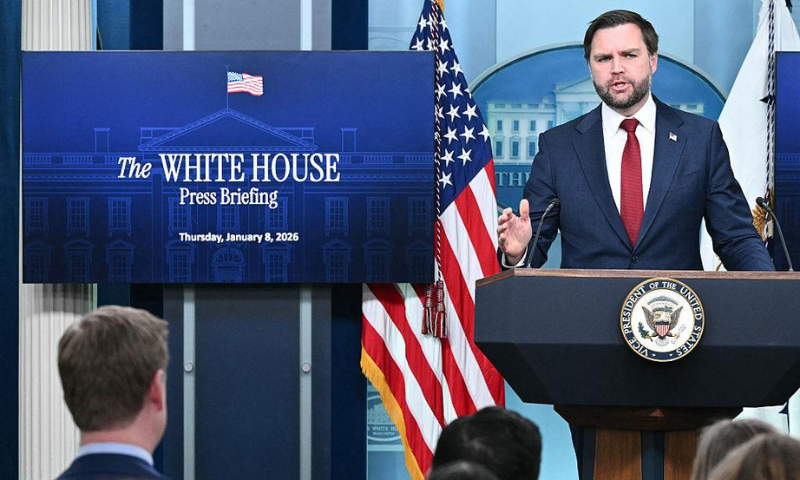



WASHINGTON: US Vice President JD Vance said Thursday that President Donald Trump has not yet approved a proposed 60-day ceasefire extension with Iran, despite significant progress in negotiations between Washington and Tehran.
“It’s hard to say exactly when or if the President is going to sign the MOU,” Vance, who has played a key role in the negotiations, told reporters.
“We’re going back and forth on a couple of language points. We’ve made a lot of progress here.”
Vance said the Iranians were negotiating in “at least so far in good faith” and both sides wanted to reopen the Straits of Hormuz — but there was still disagreement on Iran’s stockpile of enriched uranium.
NOW: Vice President JD Vance says the U.S. has made “a lot of progress” in negotiations with Iran and believes Tehran is “negotiating at least so far in good faith.”
“The Iranians, they want a deal,” Vance said. pic.twitter.com/QVwqxC16z9
— Fox News (@FoxNews) May 28, 2026
“Hopefully, we’ll continue to make progress, and the president will be in a position where he can endorse the agreement, but obviously that’s still TBD,” meaning to be determined, he added.
US sources earlier told AFP that the two sides had reached an agreement on a memorandum of understanding (MOU) to prolong the truce for 60 days.
US Treasury Secretary Scott Bessent earlier said that “we perhaps have the makings of a deal here” but said some of Trump’s red lines had still not been met.
When asked whether there is a potential agreement with Iran on the table, Treasury Secretary Scott Bessent said the negotiating teams “have been going back and forth,” but reiterated President Trump “has several red lines.”
“He’s not going to take a bad deal. He’s going to make… pic.twitter.com/Sv3RlzoJEY
— CBS News (@CBSNews) May 28, 2026
“He’s not going to take a bad deal. He’s going to make a great deal for the American people,” Bessent said in a briefing at the White House.
US sources had earlier confirmed a report by the Axios news outlet that the MOU would open the Strait of Hormuz but leave Iran’s nuclear program unresolved, with further talks to follow on the issue.
Axios reported that the 60-day deal will say that shipping through the Strait of Hormuz will be unrestricted, with no tolls or harassment and with Iran having to remove all mines within 30 days.
The US will, in return, lift its naval blockade on Iran’s ports, but only in proportion to how much commercial shipping is restored, it said.
The memorandum will also contain an Iranian commitment not to pursue a nuclear weapon, Axios said. Among the first issues to be addressed is how to dispose of Iran’s stocks of enriched uranium.
Trump said during a cabinet meeting on Wednesday that he was “not satisfied” yet with Iran’s offers and warned that he could “finish the job” militarily.
Trump has repeatedly insisted that Iran cannot have a nuclear weapon under any deal to end the war that the US and Israel launched on February 28. A fragile ceasefire has been in place since April 7.
🇺🇸🇮🇷 Trump’s red line on Iran: ‘a deal that wasn’t gonna be good for us’
‘They’re very good negotiators, they’re crafty’
‘In the end, we have all the cards’ pic.twitter.com/6Bd9llYXAd
— Commentary Donald J Trump Truth Social Posts On X (@TrumpTruthOnX) May 29, 2026
Washington and Tehran both accused each other of violating the truce earlier on Thursday following an exchange of fire.
But Treasury chief Bessent insisted the ceasefire remained in effect.
“President Trump always prefers a peace deal, so everything we have done thus far has been defensive, and at present that’s what we’ll continue doing,” he added.
Ceasefire Deal Nears: US sources
US sources told AFP on Thursday that US and Iranian negotiators edged toward a deal to extend their fragile ceasefire for 60 days, but the potential breakthrough was still hanging on President Donald Trump’s approval.
The development came after Washington and Tehran accused each other of violating the truce, underscoring the volatility of talks three months after the Middle East war began with US-Israeli strikes on Iran.
The US sources confirmed reporting by Axios that the two sides had agreed on a memorandum of understanding to prolong the ceasefire and launch negotiations on Iran’s nuclear programme.
Under the proposed deal, shipping through Hormuz would be unrestricted, with no tolls or harassment; Iran would remove all mines within 30 days; and the United States would lift its naval blockade if commercial traffic resumes, Axios reported.
Strait standoff
A key focus of the proposed deal is restoring full traffic through the Strait of Hormuz, the closure of which has curbed the vast flows of oil and gas that normally pass through it.
Oil prices bounced higher Thursday after reports of the strikes, reversing much of Wednesday’s deal-driven fall.
Markets remained choppy as traders balanced hopes of a ceasefire extension against the risk of renewed fighting. Brent crude slipped after earlier jumping around 2.5 percent, while Wall Street closed higher even as European and Asian markets mostly fell.
The war’s economic toll has become harder to ignore, with analysts warning that prolonged disruption in Hormuz could keep energy prices high and make inflation harder to contain.
Trump threatened US ally Oman when asked about a possible short-term arrangement allowing it and Iran to control the strait.
Oman controls the southern side of the Strait of Hormuz through its Musandam Peninsula exclave, making it a key geopolitical player alongside Iran in one of the world’s most critical oil shipping chokepoints.
Media reports said that Iran had discussed with Oman the creation of a “Gulf Strait Authority” to jointly oversee shipping through the Strait of Hormuz and potentially impose transit fees on vessels using the strategic waterway.
“No, the strait is going to be open to everybody,” Trump said. “It’s international waters, and Oman will behave just like everybody else or we’ll have to blow them up.”
US Treasury Secretary Scott Bessent on Thursday also threatened to “aggressively target” Oman if it helped impose tolls in the strait.
Bessent added Washington would halt Iranian airlines’ access to landing slots, refuelling and ticket sales, while allowing travel for religious pilgrimage and humanitarian reasons.
Oman mediated US-Iran talks in Geneva before the war and has itself come under attack from Tehran.