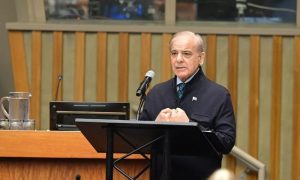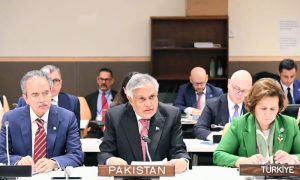
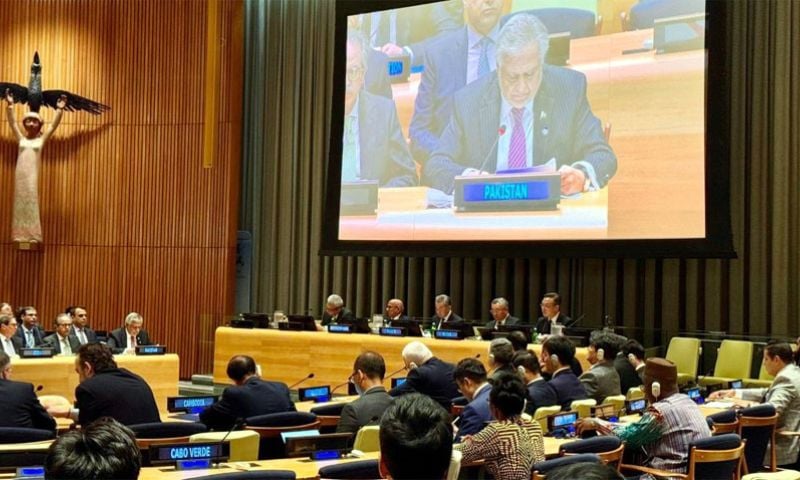
NEW YORK: Pakistan’s Deputy Prime Minister and Foreign Minister Ishaq Dar has reaffirmed Pakistan’s strong commitment to multilateralism, calling for a more inclusive, rules-based international order anchored in the United Nations system.
He was speaking at a meeting of the Group of Friends on Global Governance at the United Nations Headquarters in New York on Thursday.
Dar said the international community was facing interconnected crises, including prolonged conflicts, widening inequality, climate emergencies, food and energy insecurity, debt distress, and challenges posed by emerging technologies.
“At the same time, faith in collective action is eroding, with unilateralism and the selective application of international law undermining global stability,” he said, adding that the world urgently needed renewed solidarity and effective global governance based on the principles of the UN Charter.
Statement by H.E. Senator Mohammad Ishaq Dar @MIshaqDar50, Deputy Prime Minister and Foreign Minister,
at the Meeting of Group of Friends of Global Governance on the Topic “Reforming and Improving Global Governance; Working Together to Address Global Challenges”, on 28 May 2026,… pic.twitter.com/hikmmYkQdS— Ministry of Foreign Affairs – Pakistan (@ForeignOfficePk) May 28, 2026
Highlighting Pakistan-China ties, Dar said the two countries stood united in support of a “just and inclusive global governance architecture” rooted in international law and centred on the United Nations.
“As iron brothers and all-weather strategic cooperative partners, our two countries have consistently worked together for peace, development, and the legitimate aspirations of the developing world,” he said.
Dar also praised Chinese President Xi Jinping’s Global Governance Initiative, describing it as a timely and forward-looking framework aimed at addressing global governance deficits.
He further noted that the initiative complemented China’s Global Development Initiative, Global Security Initiative, and Global Civilisation Initiative, which together offered a comprehensive vision for sustainable development, collective security, and equitable governance.
Calling for reforms in global institutions, Dar stressed the need for a more democratic international financial system, greater climate justice, fairer trade arrangements, and inclusive governance of emerging technologies.
He also emphasised the importance of applying international law uniformly and without double standards, respecting the sovereignty and territorial integrity of all states, and resolving disputes through dialogue and diplomacy.
The Deputy Prime Minister reiterated Pakistan’s support for the right to self-determination of people living under foreign occupation in accordance with international law and relevant UN resolutions.
Dar welcomed the establishment of the Group of Friends of Global Governance at the United Nations, describing it as an inclusive platform for dialogue and cooperation on the future of multilateralism.
On UN reforms, he said the Security Council must become more democratic, representative, and accountable, with greater representation for small and medium-sized states.
“Adding new permanent members would violate the fundamental principle of sovereign equality and make the Council even less representative,” he said.
Dar concluded by reaffirming Pakistan’s commitment to working closely with China and other international partners to strengthen multilateral cooperation, uphold international law, and promote lasting global peace and stability.
“China can always count on Pakistan’s steadfast support for the vision of building a Community with a Shared Future for Mankind,” he added.