Key Points
- Pakistan told the UN Security Council that Jammu and Kashmir remains an internationally recognised dispute under the Council’s agenda.
- Islamabad accused India of undermining international law through its stance on the Indus Waters Treaty and covert cross-border activities.
- Protection of minority rights and adherence to UN Charter principles were essential for regional peace and stability.
ISLAMABAD: Strongly criticising India at the United Nations Security Council, Pakistan accused New Delhi of violating the UN Charter, disregarding UNSC resolutions on Jammu and Kashmir, and threatening regional peace through unlawful policies.
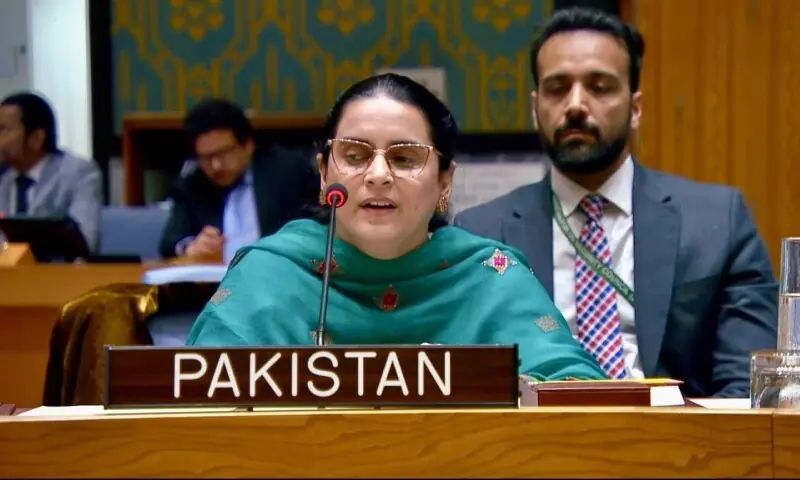
Pakistan’s Counsellor at the UN, Saima Saleem, rejected remarks made earlier by the Indian representative and described them as an attempt to deflect attention from India’s own record.
She was delivering a right of reply during the UNSC open debate on “Maintenance of International Peace and Security: Upholding the Purposes and Principles of the UN Charter and Strengthening the UN-Centred International System.”
She reminded the Council that the dispute over Jammu and Kashmir remained an internationally recognised issue on the UNSC agenda.
India’s refusal to implement Security Council resolutions constituted a breach of obligations under the UN Charter, she argued.
Referring to the Indus Waters Treaty, the Pakistani diplomat said treaties should serve as instruments of peace rather than coercion.
She warned that any move affecting water access for millions of Pakistanis would endanger livelihoods, food security and regional stability.
Islamabad had already declared that water sharing under the Treaty is Pakistan’s red line, and any tampering with or diversion of the river flows would be considered as an act of war.
With regards to terrorism, India may export violence abroad through state-sponsored terrorism — from terrorist proxies to extra-judicial assassinations — but it cannot hide its fingerprints in the country of origin. Kulbhushan Jadhav remains a living evidence of India’s covert… pic.twitter.com/grxe7mTBIb
— Permanent Mission of Pakistan to the UN (@PakistanUN_NY) May 27, 2026
On terrorism, Pakistan responded to Indian accusations by saying that the covert operations of international target killing and supporting terrorists for sabotage inside Pakistan are proof of India’s state-sponsored terror.
Saleem cited the case of Kulbhushan Jadhav as evidence of Indian involvement in destabilising activities.
She also referred to recent violence in Quetta, including a train bombing claimed by the banned militant group BLA (Baloch Liberation Army).
Anti-Pakistan terrorist organisations operating from Afghan territory had received Indian backing, she maintained.
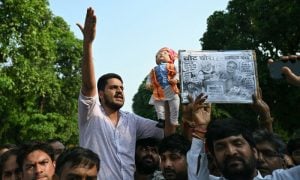
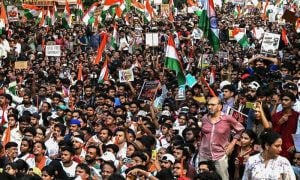
Pakistan further accused India of pursuing discriminatory policies against minorities, particularly Muslims, under a “Hindutva project.”
The Pakistani envoy alleged that Muslims, Sikhs, Christians and Dalits in India faced systematic discrimination, violence and marginalisation.
During the debate, Pakistan argued that India’s policies contradicted core UN Charter principles, including peaceful settlement of disputes, sovereign equality, non-intervention and respect for human rights.
Islamabad maintained that Pakistan remained committed to peaceful conflict resolution, international law and a UN-centred international system.