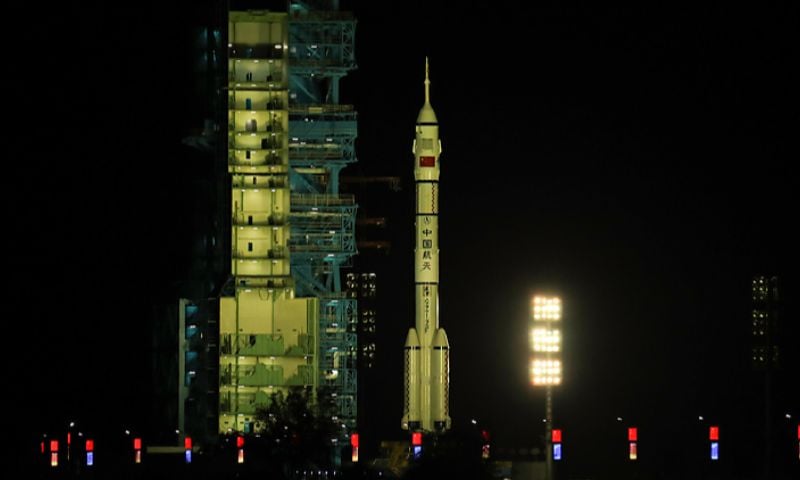



JIUQUAN, China: China has launched its Shenzhou-23 mission, sending three astronauts to the Tiangong space station as part of its expanding space programme and long-term ambitions to land humans on the moon by 2030, state media reported.
The Long March 2-F rocket lifted off at 11:08 pm (1508 GMT) on Sunday from the Jiuquan Satellite Launch Centre in north-western China’s Gobi Desert, according to footage aired by state broadcaster CCTV and reports from CGTN.
The rocket rose in a cloud of flames and smoke as it carried the Shenzhou-23 spacecraft into orbit.
State media said three astronauts are on board, including space engineer Zhu Yangzhu, 39, and former air force pilot Zhang Zhiyuan, 39, both undertaking their first spaceflight.
The crew also includes Lai Ka-ying, 43, who previously worked in Hong Kong’s police force, marking the first space mission involving an astronaut from Hong Kong.
Chinese space authorities said one member of the crew will remain in orbit for a full year, the first such long-duration mission for China.
The astronaut designated for the year-long stay will be announced later.
The mission will include scientific experiments in life sciences, materials science, fluid physics and medicine.
The one-year stay in orbit is aimed at studying the physical and psychological effects of long-term exposure to microgravity, including impacts on bone density, muscle loss and radiation exposure.
Macquarie University astrophysicist Richard de Grijs said the mission would test both human endurance and onboard systems required for long-duration spaceflight far from Earth.
He said such missions are essential for developing reliable life-support systems, including water and air recycling, and for managing potential medical emergencies in orbit.
The Shenzhou-23 mission forms part of China’s broader goal of sending astronauts to the moon before 2030, in competition with NASA’s Artemis programme.
China is also developing its next-generation Mengzhou spacecraft, with an orbital test flight expected in 2026.
The spacecraft is intended to eventually replace the Shenzhou series and support lunar missions.
Beijing aims to establish a preliminary crewed lunar research base, known as the International Lunar Research Station, by 2035.
China has significantly expanded its space programme over the past three decades, investing billions of dollars to narrow the gap with the United States, Russia and Europe.
It has previously achieved major milestones, including landing the Chang’e-4 probe on the far side of the moon in 2019 and deploying a rover on Mars in 2021, state media reported.