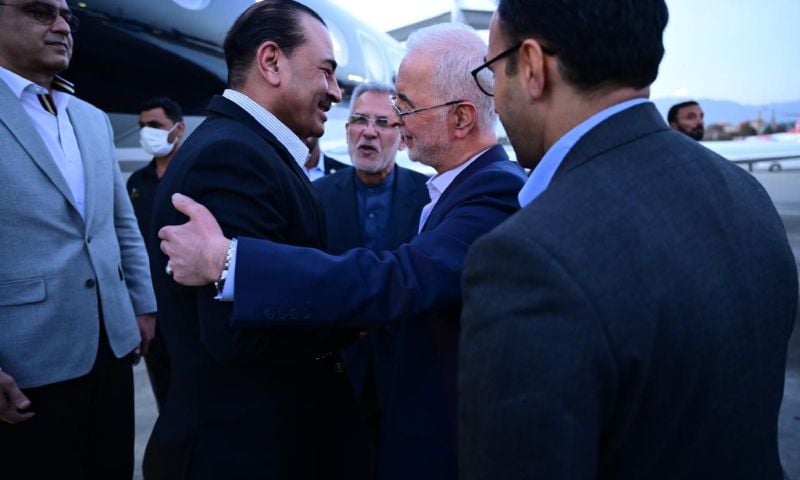
ISLAMABAD: Pakistan’s Chief of the Army Staff and Chief of Defence Forces Field Marshal Syed Asim Munir arrived in Tehran on Friday as part of ongoing mediation efforts, a military statement said.
He was received and warmly welcomed by Iranian Minister for Interior Eskandar Momeni apon arrival at the airport, military’s media wing Inter Service Public Relations (ISPR) said.
Pakistan’s Minister for Interior, Mohsin Naqvi was also present at the reception.
During the visit, he is expected to discuss the ongoing US-Iran talks, regional peace and stability, and other key issues with senior Iranian leadership, security sources said.
The high-level visit comes at a critical moment amid growing regional tensions, stalled negotiations, and renewed international pressure to prevent further escalation in the Middle East.
On April 8, Pakistan brokered a ceasefire between the US and Iran and intensified mediation efforts to permanently end the conflict through negotiations.
Last month, Pakistan hosted direct talks between the US and Iranian negotiators in Islamabad.
The Islamabad Talks between the US and Iran concluded without reaching a final agreement; however, they paved the way for diplomacy to permanently end the conflict.
It is pertinent to mention that Field Marshal Asim Munir traveled to Tehran in April for high-level discussions with Iranian officials.
Islamabad based security analyst Syed Muhammad Ali told We News English that Field Marshal Sayed Asim Munir’s second Tehran visit since the Iran War started indicates three things. First, Pakistan is the only country which is sustaining this delicate but critical peace process for the past several weeks and Islamabad continues to enjoy trust and confidence of both Trump administration and Iranian leadership despite their mutual distrust.
“Secondly, Pakistan’s Interior Minister Mohsin Naqvi, who is also in Tehran for the past few days has made enough progress in convincing Iranian leadership to demonstrate greater flexibility for durable peace with the US before Field Marshal Asim decided to again visit Tehran to finalise these with Iranian leadership and convey this progress to Washington.,” he said.
He said thirdly, the recent statements by President Trump and Secretary Marco Rubio, acknowledging Pakistan’s vital role in the painstaking peace process indicates that hopes for successful negotiations are also growing in Washington as well.
Rubio praises pakistan’s mediation efforts
Earlier, today US Secretary of State Marco Rubio praised Pakistan’s role in ongoing efforts to facilitate a peace agreement between Washington and Tehran, saying Islamabad has done an “admirable job” as a key intermediary in the diplomatic process.
“The primary interlocutor on this has been Pakistan and continues to be and they’ve done a, you know, I think an admirable job. And that’s what we continue to work through,” he said speaking to reporters in Sweden.
“Obviously, other countries, you know, have interests because especially Gulf countries that are, you know, in the middle of all this, may have their own situation going on. We talk to all of them. But I would just say that the primary country we’ve been working with on all of this is Pakistan, and that remains the case,” he said.
He said that US administration is in constant communication with Pakistan’s army Chief Field Marshal Syed Asim Munir and ‘the highest levels of our government are constantly talking to him.’
Negotiations with Iran were ongoing
US President Donald Trump said on Thursday that negotiations with Iran were ongoing through mediator Pakistan, adding that Washington would secure a deal with Tehran to end the conflict, as Islamabad intensified diplomatic efforts for regional peace.
“I can’t tell you. Right now we’re negotiating, and we’ll see,” Trump told reporters at the White House when asked about possible accommodations in talks with Iran.
“We’re going to get it one way or another; they’re (Iran) not going to have a nuclear weapon,” he added.
Trump reiterated that the United States would not allow Iran to acquire a nuclear weapon, saying any outcome would ensure Tehran is denied such capability.