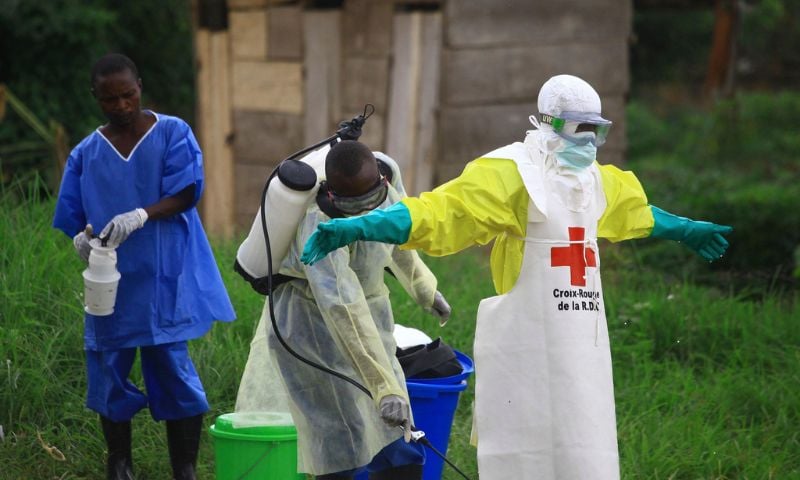
KINSHASA, DR Congo: The World Health Organization on Sunday declared an international public health emergency over a deadly Ebola outbreak in the Democratic Republic of Congo and neighbouring Uganda, warning of a high risk of spread from a strain for which no vaccine or specific treatment exists.
The outbreak, caused by the Bundibugyo strain of the Ebola virus, has killed more than 80 people and infected hundreds more, according to Congolese authorities and the WHO.
Highlights from Disease Outbreak News on #Ebola disease caused by Bundibugyo Virus Disease, Democratic Republic of the Congo & Uganda – 16 May 2026:
🔴 As of 15 May, a total of 246 suspected cases and 80 deaths (4 deaths among confirmed cases) have been reported. 65 contacts… pic.twitter.com/uwUZJFyRpH
— World Health Organization (WHO) (@WHO) May 17, 2026
The UN health agency said the situation constituted a “public health emergency of international concern” under international health regulations, although it did not yet meet the threshold for a pandemic emergency.
WHO Director-General Tedros Adhanom Ghebreyesus said the outbreak posed serious regional risks due to increasing suspected infections, cross-border transmission and limited medical countermeasures.
“I determine that the epidemic constitutes a public health emergency of international concern,” Tedros wrote on X, while noting that the outbreak “does not meet the criteria of pandemic emergency”.
After having consulted the #DRC and #Uganda where the #Ebola disease caused by Bundibugyo virus is known to be currently occurring, I determine that the epidemic constitutes a public health emergency of international concern (PHEIC), as defined in the provisions of IHR.
My full… pic.twitter.com/zhYVEyxSI8
— Tedros Adhanom Ghebreyesus (@DrTedros) May 17, 2026
Case confirmed in Goma
Concerns intensified after health officials confirmed a positive case in the eastern Congolese city of Goma, a densely populated commercial hub.
Professor Jean-Jacques Muyembe, director of the Congolese National Institute for Biomedical Research, told AFP that the infected woman had travelled to Goma after her husband died of Ebola in Bunia while she was already carrying the virus.
The WHO said confirmed cases had also emerged in Uganda’s capital Kampala, including one fatality involving a Congolese national who travelled from eastern Congo.
According to the Africa Centres for Disease Control and Prevention, at least 336 suspected cases and 88 deaths had been recorded as of Saturday, mainly in Ituri province in northeastern Congo bordering Uganda and South Sudan.
No vaccine for new Ebola strain
Congolese Health Minister Samuel-Roger Kamba warned that the Bundibugyo strain had no approved vaccine or targeted treatment.
“This strain has a very high fatality rate, which can reach 50 percent,” he said.
Vaccines currently exist only for the Zaire strain of Ebola, first identified in 1976. The Bundibugyo variant was first detected in Uganda in 2007.
Medical charity Doctors Without Borders described the outbreak as “extremely concerning” and said it was preparing a large-scale emergency response.
“The number of cases and deaths we are seeing in such a short timeframe, combined with the spread across several health zones and now across the border, is extremely concerning,” said MSF emergency programme manager Trish Newport.
Risk of wider regional spread
The WHO warned that the true scale of the outbreak remained unclear because many affected areas were difficult to access and only a limited number of samples had undergone laboratory testing.
The agency said the high positivity rate among tested samples and evidence of cross-border transmission suggested the outbreak could be significantly larger than officially reported.
Health authorities said the outbreak’s “patient zero” was a nurse who sought treatment in Bunia on April 24 with Ebola-like symptoms.
The WHO urged countries neighbouring Congo to strengthen border screening, emergency preparedness and surveillance measures, while advising against blanket border closures or trade restrictions.
Ebola, believed to originate in bats, spreads through direct contact with infected bodily fluids and can cause fever, vomiting, haemorrhaging and organ failure.
The virus has killed around 15,000 people across Africa over the past five decades.