In a province where academic and literary pursuits often struggle against limited resources, one college professor has quietly undertaken a task that many institutions have failed to accomplish.
At Government Degree College Pishin, Professor Faisal Rehan has spent years building what he calls the Balochistan Urdu Academy, not through grants, endowments, or official backing, but through his own modest salary and personal savings.
What began as an individual academic need has gradually evolved into a serious intellectual effort to preserve the literary and cultural memory of Balochistan.
Yet today, this effort stands at a crossroads caught between remarkable achievement and institutional indifference.
An idea born out of absence
The origins of the academy lie not in ambition, but in frustration.
During his doctoral research, Professor Rehan encountered a problem familiar to many scholars in peripheral regions: the absence of accessible material.
Much of the literature he needed, whether unpublished manuscripts or books printed decades ago, was either scattered across private collections or had vanished from circulation entirely.
For a researcher, this absence was not merely inconvenient; it was indicative of a deeper structural gap.
“Much of our literary history exists, but it is not available,” he has often remarked in academic discussions. “And what is not available eventually disappears.”
This realisation prompted a shift in his thinking. Rather than working within the limitations of existing systems, he began to imagine creating a space where such material could be preserved, organised, and republished.
From idea to institution
The concept took shape gradually. Around 2020, he began planning what would eventually become the Balochistan Urdu Academy.
By 2023, he had started collecting materials, revisiting old texts, and preparing manuscripts for publication.
In 2024, the academy was formally established.
Unlike traditional literary institutions, however, this academy did not emerge from state policy or institutional frameworks.
It was built entirely through personal initiative, an unusual model in a country where academic publishing typically depends on institutional support.
Professor Rehan drew inspiration from regional language academies such as those dedicated to Balochi, Brahui, and Pashto, which have historically contributed to linguistic preservation.
Yet he believed that Urdu, despite being widely spoken and written, had not received comparable attention in the context of Baluchistan’s regional literary history.
Over the past century, writers from diverse linguistic and ethnic backgrounds, including Baloch, Pashtun, Saraiki, Punjabi, and Urdu-speaking communities, have contributed significantly to Urdu literature.
Their work spans poetry, fiction, criticism, and scholarly research.
However, much of this intellectual output has remained undocumented, unarchived, or simply inaccessible.
Reviving lost literature
Against this backdrop, the academy’s primary objective has been to recover and republish forgotten works.
So far, Professor Rehan has published six books, each representing a distinct effort to reclaim lost or neglected literary material.
One of the earliest publications, Safar-o-Hazar by Usman Qazi, is a 420-page collection of essays that captures the intellectual and cultural landscape of Balochistan.
Written in a refined and scholarly style, the book traverses themes ranging from local dialects and regional identity to national and global politics.
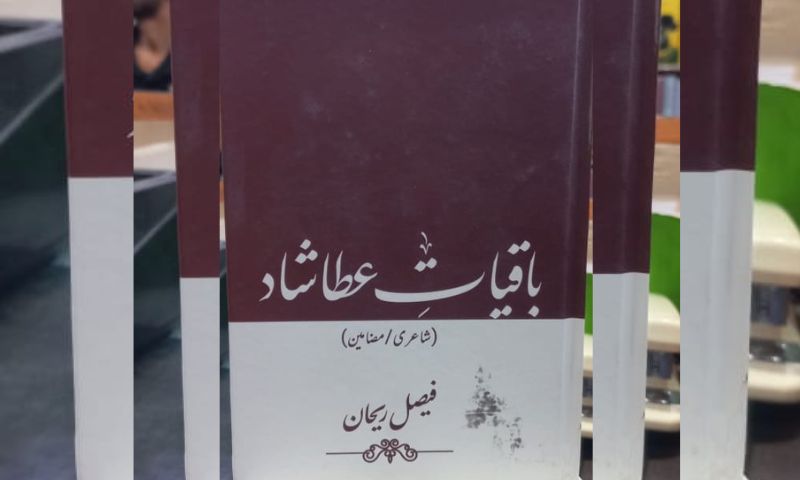
Another important work, Baqiyat-e-Atta Shad, brings together prose writings of Atta Shad that were previously scattered across old newspapers and literary journals.
By compiling and annotating these texts, the academy has effectively preserved a critical part of Balochi and Urdu literary heritage.
Similarly, the republication of Bandhan, a rare Urdu novel by Mouladad Muhammad Shahi, offers a vivid portrayal of Quetta in the 1950s.
Through its references to places like Jinnah Road and Qandari Bazaar, as well as its multicultural characters, the novel provides a historical snapshot of urban life that might otherwise have been lost.
The academy has also revived the works of Abdul Rehman Gor, a writer whose contributions to poetry and fiction had faded from public memory despite their significance.
In addition, Saat Rang Aur Aik Gyaan by Khadim Mirza, widely regarded as one of Balochistan’s most important short story writers, has been republished after nearly three decades.
His work, often described as both technically accomplished and intellectually rich, remains relevant to contemporary literary discourse.
Completing this initial series is Kaghaz Ka Badan by Shaheen Rahi Bukhari, a short story collection first published in 1982 and later forgotten.
The book, which includes a foreword by renowned Urdu writer Intizar Hussain, has been carefully edited and reissued, restoring it to literary circulation.
A growing archive, a shrinking space
Despite these achievements, the physical reality of the academy tells a different story.
Today, it exists within a single room, a modest space filled with shelves, files, and boxes containing manuscripts, drafts, and research material accumulated over the years.
Within this confined space lies an expanding archive: completed research projects, unpublished manuscripts, and rare literary compilations waiting for resources that have yet to materialise.
For Professor Rehan, this contrast between intellectual richness and material limitation is a constant challenge.
The burden of self-reliance
Perhaps the most striking aspect of this initiative is its complete reliance on personal funding.
All six published books have been financed by Professor Rehan himself. Printing costs, editing, compilation, and every stage of the process have been sustained through his own income.
While this level of personal commitment is rare, it is also unsustainable.
“I can no longer afford to publish more books,” he has acknowledged in conversations with peers. “Even though the work is ready.”
Several manuscripts, including major research projects, remain unpublished due to financial constraints. Without external support, the pace of work has slowed significantly.
Silence from institutions
Efforts to secure institutional support have so far yielded little response.
Requests to government departments and academic institutions for funding, collaboration, or even basic recognition have not resulted in meaningful engagement.
Appeals to include the academy’s publications in public libraries have also gone unanswered.
This institutional silence, observers say, reflects a broader disconnect between policy frameworks and grassroots intellectual initiatives.
A wider pattern of neglect
Professor Rehan’s experience is not an isolated case.
Across Balochistan, independent writers, researchers, and scholars often operate without institutional backing.
In the absence of funding mechanisms, archival systems, and publishing platforms, many such initiatives struggle to survive.
The result is a gradual erosion of cultural and intellectual heritage.
Quetta-based journalist Abdul Karim, who has worked with international media organisations, believes that initiatives like the Balochistan Urdu Academy are essential in regions where formal research infrastructure is limited.
“These efforts are not just about literature,” he says. “They are about identity, history, and the transmission of knowledge.”
The cost of inaction
For local writers and academics, the implications are clear.
Every unpublished manuscript represents a gap in the historical record. Every forgotten book signifies a lost opportunity for learning and reflection.
Without timely intervention, much of this material may disappear permanently, not because it lacks value, but because it lacks support.
Beyond one individual
Ultimately, the story of the Balochistan Urdu Academy is not just about one professor.
It is about the fragile state of intellectual work in regions that exist outside mainstream academic centres.
It is about the tension between individual effort and institutional responsibility.
And it is about a question that remains unanswered:
What happens to a society that fails to preserve its own knowledge?
An uncertain future
For now, the academy continues to exist quietly, persistently within the limits imposed upon it.
Its shelves remain filled with stories waiting to be told, research waiting to be published, and history waiting to be remembered.
Whether these efforts will receive the recognition and support they deserve remains uncertain.
But one thing is clear: without intervention, the cost will not be borne by one individual alone, it will be shared by generations to come.