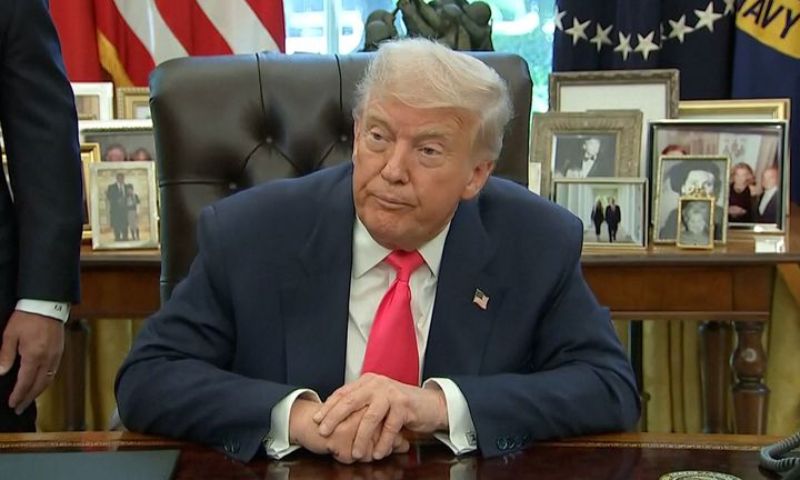



BEIJING: US President Donald Trump claimed on Thursday that Chinese President Xi Jinping had offered Beijing’s help to reopen the Strait of Hormuz and assured Washington that China would not provide military equipment to Iran.
In an interview to Fox News after high-level talks with Xi in Beijing, Trump said the Chinese leader had expressed support for keeping the strategic waterway open and had offered assistance if needed.
“He said he’s not going to give military equipment… he said that strongly,” Trump said, referring to Xi’s remarks on Iran.
Trump added that Xi had told him: “He’d like to see the Hormuz Strait open, and said ‘if I can be of any help whatsoever, I would like to help’.”
China’s Xi ‘would like to see a deal made’ to open the Hormuz Strait — Trump
‘He did offer, he said: if I can be of any help at all, I would like to be of help’ pic.twitter.com/kOXD3HKagK
— RT (@RT_com) May 14, 2026
The Strait of Hormuz is one of the world’s most important energy shipping routes, carrying a significant share of global oil exports.
Meanwhile, US Secretary of State Marco Rubio said Washington was not seeking Beijing’s help on Iran. He said that Trump and Xi had found “common ground” regarding the Strait of Hormuz.
“We’re not asking for China’s help. We don’t need their help,” Rubio told NBC.
Trump is currently on a state visit to China, where he held high-level talks with Xi at the Great Hall of the People in Beijing.
Earlier today, Trump told Xi that the United States and China would have a “fantastic future together”.
“It’s an honour to be with you. It’s an honour to be your friend, and the relationship between China and the USA is going to be better than ever before,” Trump said during the meeting.
According to a Chinese foreign ministry statement, the two leaders discussed the Middle East conflict, the war in Ukraine and developments on the Korean Peninsula.
“The two heads of state exchanged views on major international and regional issues, including the situation in the Middle East, the Ukraine crisis, and the Korean Peninsula,” the ministry said.
Pakistan’s diplomatic efforts to end US-Iran conflict
Meanwhile, Pakistan continued diplomatic engagement aimed at de-escalating tensions between Washington and Tehran.
Pakistan’s Deputy Prime Minister and Foreign Minister Ishaq Dar said on Thursday that Islamabad remained committed to “proactive diplomacy” and efforts for regional peace and stability.
Speaking at a Regional Envoys’ Conference in Islamabad, Dar said Pakistan would continue pursuing stronger regional partnerships and diplomatic engagement amid evolving regional and global dynamics.
“At a time of evolving regional and global dynamics, Pakistan remains committed to proactive diplomacy, stronger strategic partnerships, enhanced economic cooperation with our brotherly countries, and continued efforts for regional peace and stability,” Dar said.
US Assistant Secretary of State for South and Central Asian Affairs Paul Kapur met Dar in Islamabad on Thursday to discuss bilateral relations, regional developments and diplomatic efforts.
According to Pakistan’s Foreign Office, Dar appreciated Trump’s “vision for peace”, the Iran-US ceasefire understanding and the April visit of US Vice President JD Vance to Pakistan.
The Foreign Office said Dar reiterated Pakistan’s commitment to resolving issues through dialogue and diplomacy, while Kapur appreciated Islamabad’s mediation role.
Pakistan brokered a ceasefire between Iran and the United States on April 8 following weeks of regional escalation involving Israel, Iran and Washington.
Three days later, Islamabad hosted direct negotiations between US and Iranian delegations for high-stakes talks to end the conflict.
The first round of Pakistan-mediated talks between Washington and Tehran, held in Islamabad on April 11 and 12, ended without a final agreement.
However, Islamabad Talks paved the way for continued negotiations to end the conflict through dialogue and diplomacy.
Vance led the US delegation during the Islamabad talks, while Iran’s negotiating team was headed by Parliament Speaker Mohammad Bagher Ghalibaf.
On Wednesday, Chinese Foreign Minister Wang Yi also praised Pakistan’s mediation role during a telephone conversation with Dar.
Trump, speaking earlier this week, also commended Pakistan’s efforts to facilitate diplomacy between Washington and Tehran.
“They’re great. I think the Pakistanis have been great. The Field Marshal and the Prime Minister of Pakistan have been absolutely great,” Trump said, referring to Prime Minister Shehbaz Sharif and Chief of Army Staff Asim Munir.