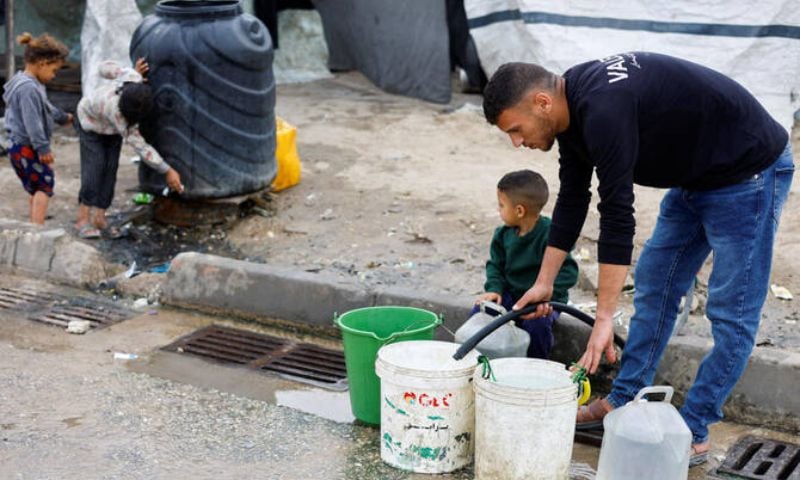
GENEVA: Doctors Without Borders (Médecins Sans Frontières) on Tuesday accused Israeli authorities of systematically restricting access to water in Gaza, warning that the deprivation has become a deliberate tool of warfare against the Palestinian population.
In a report titled “Water as a Weapon,” the medical charity alleged that the destruction of civilian water infrastructure, combined with persistent obstruction of essential supplies, forms part of a broader pattern of collective punishment.
The organisation said such actions contribute to what it described as “the deliberate infliction of destructive and inhumane conditions of life” in the territory.
According to MSF, this “engineered scarcity” of water is unfolding alongside ongoing violence, including attacks on civilians, the destruction of homes and the collapse of healthcare facilities.
The findings are based on testimonies and operational data collected by the group across 2024 and 2025, according to AFP.
“Israeli authorities are fully aware that without water, survival is impossible,” said Claire San Filippo, MSF’s emergency coordinator. “Yet essential water infrastructure has been systematically destroyed, while the entry of critical supplies continues to be obstructed.”
The report cited data from the United Nations, European Union and the World Bank indicating that nearly 90 per cent of Gaza’s water and sanitation systems have been either damaged or rendered non-functional.
Facilities such as desalination plants, boreholes, pipelines and sewage networks have been severely impacted, leaving large parts of the population without reliable access to clean water.
MSF also documented incidents in which clearly marked water trucks and boreholes operated by aid agencies were reportedly targeted or destroyed. “Civilians have been injured and even killed while attempting to collect water,” San Filippo noted.
Despite the challenges, MSF said it remains one of the largest providers of drinking water in Gaza, second only to local authorities.
In the past month alone, the organisation supplied more than 5.3 million litres of water daily—enough to meet the minimum needs of over 407,000 people, representing roughly one-fifth of the enclave’s population.
However, the group warned that repeated displacement orders issued by Israeli forces have hindered humanitarian operations. “Our teams have been forced out of areas where we were supplying water to hundreds of thousands,” the statement said, highlighting the operational constraints faced by aid workers.
The organisation further revealed that nearly one-third of its requests to import essential water and sanitation equipment—including desalination units, pumps, storage tanks, chlorine and insect repellents—have either been denied or left pending without response.
MSF cautioned that the ongoing water crisis, combined with overcrowded living conditions, widespread displacement and a severely weakened healthcare system, has created what it termed a “perfect storm” for the outbreak and rapid spread of infectious diseases.
Calling for urgent action, MSF urged Israel to immediately restore water access to adequate levels across Gaza and allow the unhindered entry of humanitarian supplies.
The group also appealed to Israel’s international allies to exert pressure to ensure compliance with humanitarian obligations and facilitate aid delivery.