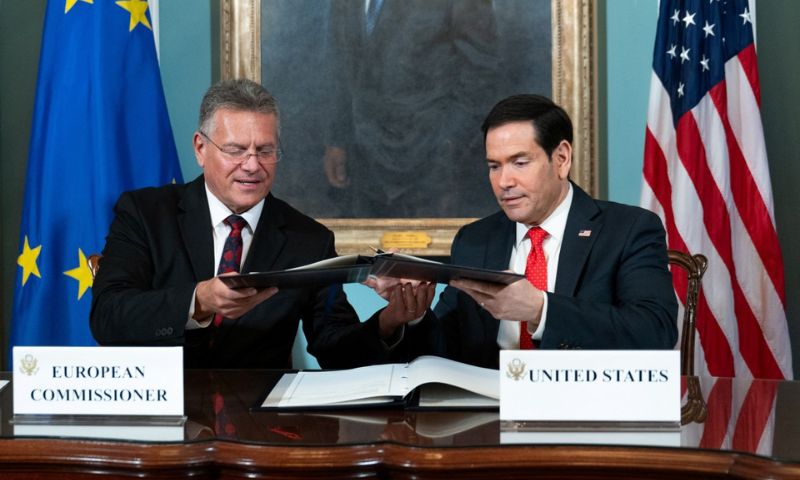



WASHINGTON, United States: The European Union and the United States signed an agreement to coordinate the supply of critical minerals, aiming to reduce dependence on China and strengthen supply chains for key industries.
The deal, signed by US Secretary of State Marco Rubio and EU trade chief Maros Sefcovic, focuses on securing materials essential for sectors such as defence, semiconductors and electric vehicles.
“The overconcentration of these resources, the fact that they’re dominated by one or two places, is an unacceptable risk,” Rubio said during the signing ceremony.
The agreement comes amid growing concerns over Beijing’s control of critical mineral exports, which are vital for modern technologies and weapons systems.
Focus on supply security
Sefcovic said the pact “formalizes our partnership across the entire value chain, from exploration and extraction to processing, refining, recycling and recovery.”
He stressed that the initiative is driven by economic security concerns, noting: “For us, it’s really a matter of economic security. It’s a matter of overcoming dependencies.”
Drawing on past experience, he added that reliance on limited suppliers had proven costly, particularly in the energy sector, and highlighted the need for a more diversified sourcing strategy.
“We simply want to learn from that experience and have a much more diversified portfolio of suppliers,” Sefcovic said.
Under the plan, both sides will explore setting minimum prices for critical minerals to prevent market manipulation, while also coordinating subsidies, stockpiling efforts and regulatory standards to facilitate trade.
The initiative could also pave the way for a broader agreement among allied nations, as Washington continues similar partnerships with countries including Mexico, Japan and Australia.
The move reflects a broader Western push to secure strategic resources and reduce vulnerabilities in global supply chains.