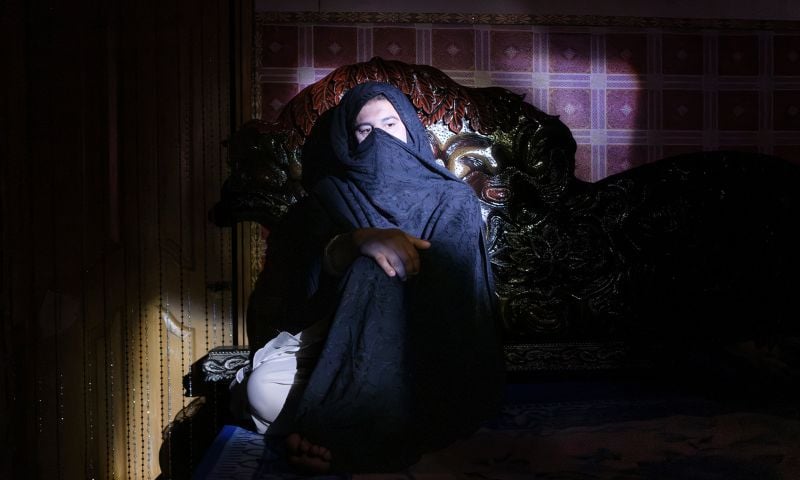
SWAT, Pakistan: Swollen lips, dark blue bruises, and red welts mark her back.
Sitting quietly in a corner of a shared room, tears rolling down her cheeks, Arzoo — a young transgender woman — recounts the night that changed everything. The room feels heavy, as if the walls themselves bear bear witness to her pain.
“Three men who are my regular visitors beat me badly when I refused their demand for sex,” she says, her voice trembling.
For Arzoo, this was not just another incident — it was the last straw in a life already lived on the edge. She had moved from Shangla to Swat four years ago, believing it would offer a safer space and better opportunities.
In Swat, she hoped to earn a living through dance performances at gatherings and private events — a common source of income for many in the transgender community.
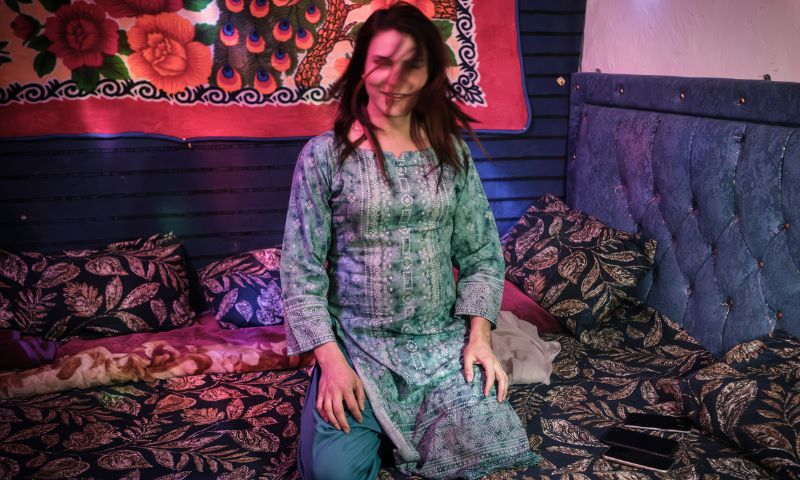
But as the old saying goes, all that glitters is not gold. The promise of safety has proven fragile, as violence and exploitation continue to shadow lives already pushed to the margins.
A crisis deepens
Pakistan’s transgender community continues to face a deepening national crisis marked by targeted violence, rising human immunodeficiency virus (HIV) prevalence, social exclusion, and police inaction.
The situation in Swat’s Mingora city is emerging as a stark microcosm of the broader struggle.
In many ways, Swat has become the tip of the iceberg, revealing a crisis that runs far deeper across the country.
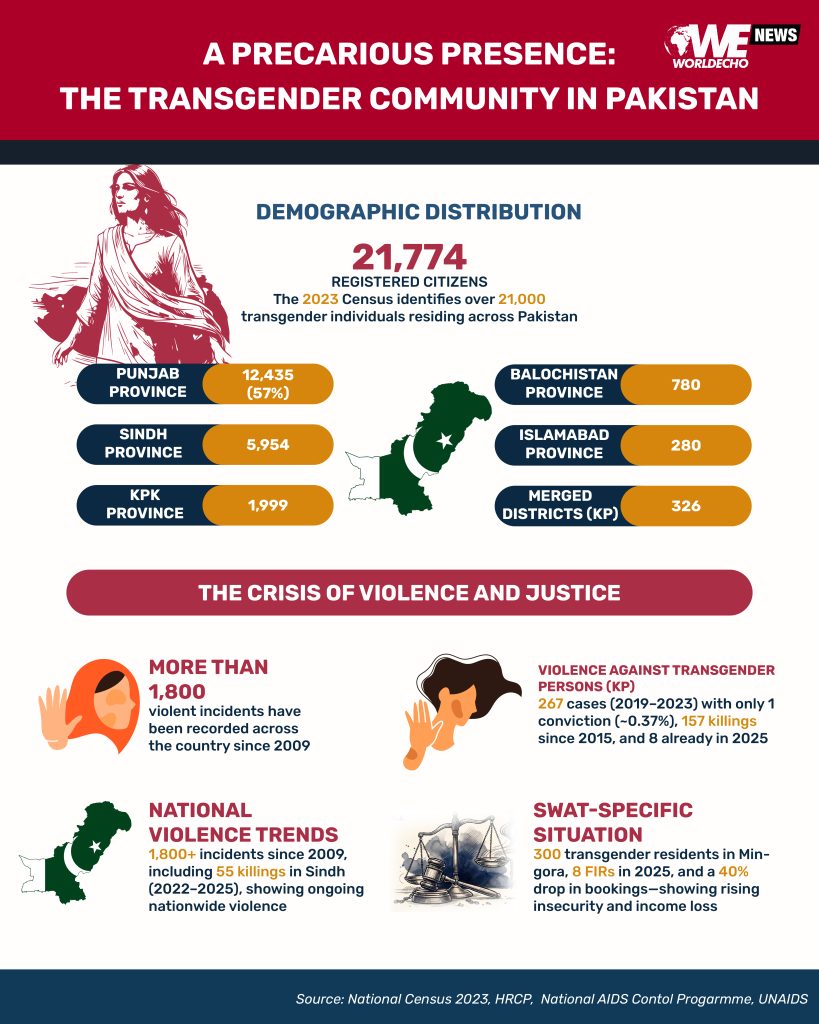
According to the 2023 national census, Pakistan’s registered transgender population stands at 21,774, with Punjab hosting approximately 57 per cent (around 12,435 individuals), followed by Sindh with 5,954 transgender persons, Khyber Pakhtunkhwa with 1,999, Balochistan with 780, Islamabad Capital Territory with 280, and the merged districts of Khyber Pakhtunkhwa with 326.
These figures, while modest on paper, barely scratch the surface of a largely invisible and undercounted community. Despite this nationwide presence, legal protections have yet to translate into lived security.
The landmark Transgender Persons (Protection of Rights) Act, 2018, which guarantees fundamental rights, including self-identification, the right to inheritance, and protection from discrimination, but its implementation remains weak, leaving the community vulnerable.
In practice, the law often exists more on paper than on the ground, leaving many to fend for themselves.
Violence without accountability
This gap between law and reality becomes most visible when examining patterns of violence.
In Khyber Pakhtunkhwa (KP), the Human Rights Commission of Pakistan’s data reveals that at least 267 cases of violence against transgender persons were reported in the province between 2019 and 2023 — yet only one conviction has been secured. Since 2015, as many as 157 transgender individuals have been killed in Khyber Pakhtunkhwa, including eight murders in 2025 alone.
This provincial trend is mirrored at the national level.
Nationally, human rights organisations report more than 1,800 incidents of violence against transgender persons since 2009. In Sindh, at least 55 killings were recorded between 2022 and 2025.
Weak criminal accountability
Weak accountability is further compounded by flaws in the criminal justice system. Khyber Pakhtunkhwa police data point to persistent gaps in prosecution.
In the Swat district, police registered eight First Information Reports (FIRs) in 2025 involving harassment and assault cases against transgender individuals.
Nevertheless, across Khyber Pakhtunkhwa, arrests frequently end in the release of suspects due to weak prosecutions or informal settlements, with no murder convictions recorded in recent years.
Policing under scrutiny
Concerns over policing practices have also reached the judiciary.
The Peshawar High Court in 2025 took notice of reported police-instigated expulsions of transgender residents from districts including Swabi and Nowshera, following reports of FIRs filed against performers.
Although the court intervened in 2025 by seeking a police response to allegations of harassment and expulsions, available reports do not indicate that the notice ended the persecution.
Humaira Ahmed, a lawyer based in Swat, says that subsequent reports continued to highlight police pressure, forced evictions, and ongoing insecurity for transgender residents, indicating that the broader social environment has remained largely unchanged.
Farzana Riaz, president of the Khyber Pakhtunkhwa Transgender Association, criticises the lack of accountability.
“Police arrest suspects but release them soon after. The government remains silent. Not one perpetrator has been punished,” she claims.
These grievances are not limited to Khyber Pakhtunkhwa alone.
In Lahore, police raids in 2025 led to the arrest of dozens of transgender individuals at private gatherings under vague provisions of the Pakistan Penal Code related to “obscenity.”
Activists say such actions reinforce harassment rather than offer protection.
“Police routinely harass us and ignore our complaints,” says Abdul Wahid, a Peshawar-based transgender person and also a rights activist.
A silent epidemic
Alongside violence, another silent but equally dangerous crisis is unfolding.
Adding to the violence is a growing HIV crisis within the community. Violence against transgender people is increasing their risk of HIV, as many are pushed into survival-based sex work due to discrimination and lack of opportunities.
Abuse, harassment, and forced displacement, along with fear of police and social stigma, limit access to healthcare, testing, and treatment.
This environment also undermines their ability to negotiate safe sexual practices, further raising the risk of HIV infection.
Data from the National AIDS Control Programme’s Integrated Biological and Behavioural Surveillance (IBBS) Round-V (published in 2016–17) corroborates this.
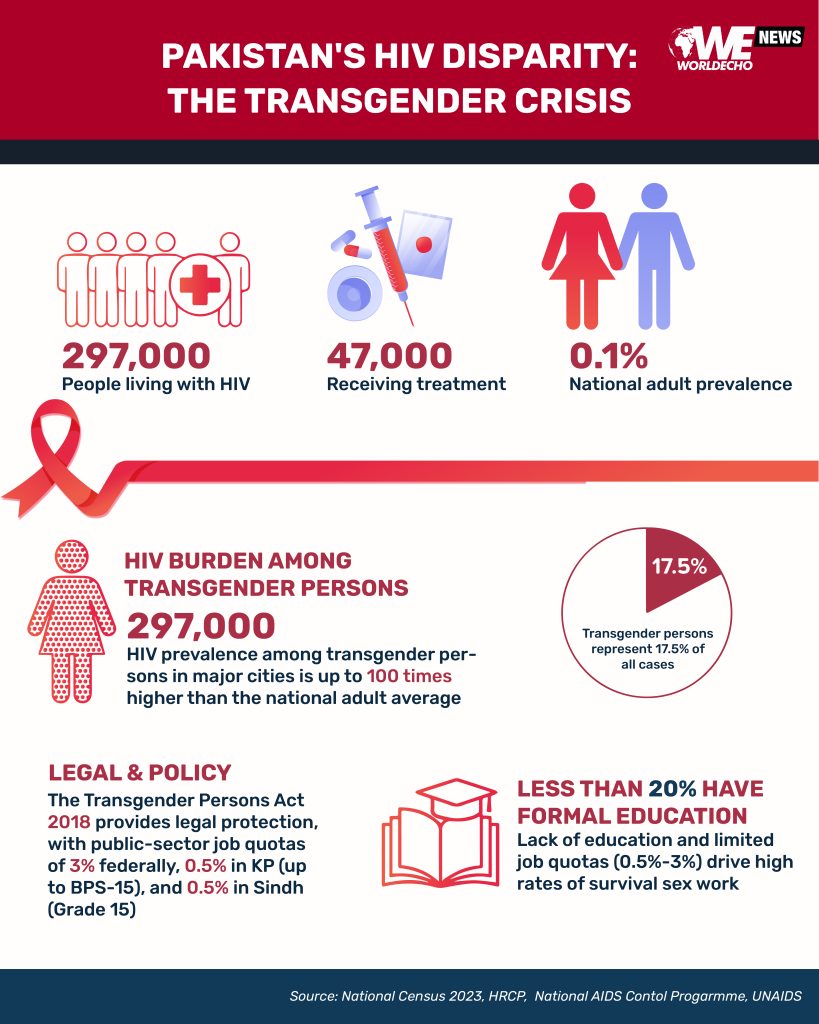
It shows that HIV prevalence among transgender persons in major Pakistani cities ranges from 5.5 to 10 per cent, compared to a national adult prevalence of 0.1 per cent.
Despite comprising a small share of the population, transgender individuals account for an estimated 17.5 per cent of the reported HIV cases nationwide, indicating a disproportionately high burden.
According to UNAIDS, Pakistan has approximately 297,000 people living with HIV, but only about 47,000 are receiving treatment, largely due to the stigma attached to it.
Transgender women face particular barriers in accessing healthcare due to stigma and discrimination.
In Karachi, HIV prevalence among transgender sex workers ranges from 3.6 to 27.6 per cent in various studies, including those comparing risk factors among hijra (transgender) sex workers in Larkana and other cities across Pakistan.
Experts link this health crisis directly to structural marginalisation.
Tabassum Adnan, a Swat-based human rights activist, attributes the high rates to economic marginalisation, limited employment opportunities, and widespread reliance on sex work, estimated to affect nearly 70 per cent of individuals within the community.
Injecting drug use — reported in up to 71 per cent of participants in some studies — further increases vulnerability. According to the National AIDS Control Programme, it compounds the risk significantly.
“Fear prevents many from visiting clinics. They are blamed for spreading disease, yet denied protection and healthcare,” says Ibrahim, a rights activist hailing from Lahore.
Evictions and insecurity mount
These overlapping crises are now converging most visibly in Swat.
In Mingora, where an estimated 300 transgender individuals reside, tensions have escalated amid local protests demanding their eviction, prompting several transgender persons to flee the district.
Local residents in Mingora’s Shahdara area, who held several protest demonstrations, accuse transgender migrants of “corrupting youth” and disrupting social norms, particularly through dance performances at events, a primary source of income for many.
“Art feeds our families. Don’t criminalise us,” says Nadia, a local transgender performer and dancer, adding that the public protests are rooted in injustice.
Amid rising tensions, some voices within the community are calling for restraint, and some residents have urged a balanced approach.
“Punish individuals if they commit crimes, but don’t target the entire community. Swat is their home too,” says Zareena Qizilbash, a local transgender resident.
Farzana, 28, a transgender woman from Mardan living in Swat, describes the daily insecurity: “We live in constant fear, including facing threats, attacks, and humiliation.”
Swat police maintain that their actions are based on specific complaints rather than identity. “We act on crimes, not assumptions,” says a police official, requesting anonymity.
However, activists argue that the reality on the ground tells a different story.
They say social hostility and informal pressure often lead to forced relocations and economic strangulation. In Swat, event bookings for transgender performers have reportedly declined by 40 per cent in recent months, according to Nadia, president of the transgender community in Swat.
“Evicting transgender residents violates constitutional guarantees of movement and residence. The law must prevail,” says advocate Rehana Hashmi.
Structural exclusion persists
Beyond immediate security concerns, long-term structural exclusion remains a critical challenge.
Nationwide, fewer than 20 per cent of transgender persons have access to formal education, according to advocacy groups.
Although provincial quotas exist for public employment, implementation remains minimal.
Under the Transgender Persons (Protection of Rights) Act 2018, Pakistan’s federal government mandates a 3 per cent employment quota for transgender individuals in public and semi-government sectors.
In Khyber Pakhtunkhwa, the provincial government has set a 0.5 per cent job quota for positions up to BPS‑15. Sindh, meanwhile, became the first province to reserve a 0.5 per cent quota for transgender persons in government departments, also for posts up to Grade 15.
Furthermore, access to formal education among transgender persons remains very limited. For example, a 2018 report by the UNDP titled “Transgender Persons’ Rights in Pakistan” found that fewer than 20 per cent of transgender individuals had access to formal education.
Most survive on event performances, earning between Rs500 and Rs2,000 per function per hour, while facing housing discrimination and social isolation.
A national reckoning
As the situation intensifies, the issue now transcends Swat and poses a national challenge. As Swat grapples with rising tensions, the broader question facing Pakistan remains unresolved: Will inclusion and legal protections translate into meaningful change, or will continued isolation deepen the crisis?
For many transgender Pakistanis, resilience persists despite adversity. “This is our home too. We want to live with dignity, not fear,” says Nadia.