NEW DELHI: Fresh violence has erupted in India’s northeastern state of Manipur, unsettling residents and raising fears that the fragile security situation may be deteriorating.
The unrest, which has simmered for nearly three years, intensified following a deadly attack on civilians on April 7, while Prime Minister Narendra Modi remained silent on the situation.
Amid the renewed tensions, nearly 60,000 Nepali-speaking residents in the state are reportedly living in fear and uncertainty.
According to officials in Bishnupur district, an armed group threw a bomb at a house in the Thronlaobi area of Moirang.
A five-year-old boy and a six-month-old girl were killed instantly while they slept, while their mother sustained serious injuries.
The attack occurred along a sensitive boundary between the Meitei-dominated valley and the Kuki-majority Churachandpur district, an area long regarded as volatile.
The killing of the children sparked immediate outrage, with residents taking to the streets demanding justice and improved security.
Reuters, citing Manipur Home Minister Govindas Konthoujam, reported that two more civilians were killed later the same day when security forces opened fire to disperse protesters.
Authorities said force was necessary to control the situation, but the deaths further inflamed tensions.
Reports circulating on social media about the movement of armed groups in nearby areas added to the panic, as residents complained of a lack of clear and reliable information.
On April 14, clashes between protesters and security personnel escalated, prompting authorities to impose a curfew.
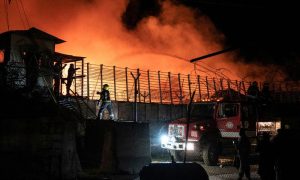
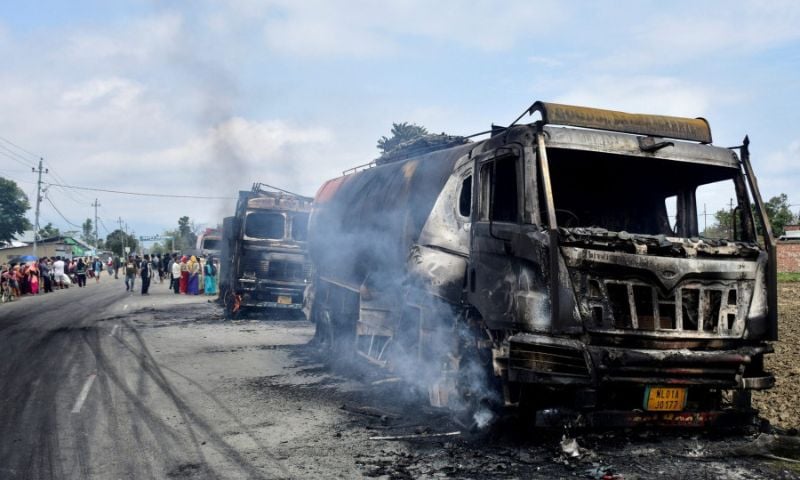
Despite restrictions, demonstrations continued, with protesters damaging vehicles, setting fire to security forces’ assets, and attempting to detain personnel.
Security agencies responded by deploying additional forces and using tear gas to bring the situation under control.
More than 20 protesters were injured in the clashes and several were arrested. At least two police vehicles were set ablaze.
In response, curfew orders have been enforced across multiple districts, including Bishnupur, Imphal West, Imphal East, Thoubal, and Kakching.
Authorities have also suspended internet and mobile data services, including VPN access, for an additional 48 hours in an effort to curb the spread of misinformation and restore order.
As violence persisted in Manipur, the influential Coordinating Committee on Manipur Integrity (COCOMI) on Sunday announced a boycott of the ruling Bharatiya Janata Party in the state.
At the same time, shutdown calls issued by various groups threatened to disrupt normal life across the Imphal Valley and Naga-inhabited areas.
COCOMI, a coalition of Meitei civil society organisations based in the Imphal Valley, urged residents to refrain from participating in any activities linked to the BJP or its leadership.
The group also called on Chief Minister Yumnam Khemchand Singh to provide a detailed explanation as to why his government had failed to prevent attacks on civilians.
Speaking to the media, senior COCOMI member Shanta Nahakpam criticised the state leadership, describing it as disconnected from civil society.
He alleged that the chief minister’s actions appeared driven by personal considerations and said the administration had lost focus on addressing key security concerns, including the movement of militants and the killing of innocent civilians.
“The Chief Minister, the present government and the previous government have not been able to provide any answers on the proxy war. Therefore, COCOMI and the people of Manipur announce the boycott of any activity of the BJP in Manipur. We appeal to everyone not to participate in any kind of activity of the BJP or any of its elected members and leaders,” Nahakpam said.
Manipur has long been considered one of India’s most sensitive regions, where tensions are deeply rooted in decades of mistrust and social divisions.
Analysts note that the current conflict is not driven by a single attack but rather reflects an accumulation of longstanding grievances.
The latest wave of unrest is widely traced back to April 2023, when the Manipur High Court directed the government to consider granting Scheduled Tribe status to the Meitei community, a move that further intensified existing fault lines.
Efforts to restore lasting peace in Manipur have so far fallen short. The federal government imposed President’s rule on February 13, 2025, following the resignation of Chief Minister N Biren Singh.
It was later lifted on February 4, 2026, after a new government was formed under Yumnam Khemchand Singh, but stability in the state remains fragile.
An estimated 60,000 Nepali-speaking (Gorkha) residents live in Manipur. Although they have not aligned themselves with any side in the conflict, many say they continue to feel unsafe.
Shiv Kumar Basnet, a former chief of Kanglatumbi panchayat, noted that more than 10,000 Nepali-speaking residents have been displaced from the state over the past decade.
“Those who remain here live in constant fear. We are caught in a conflict that is not ours,” he said.