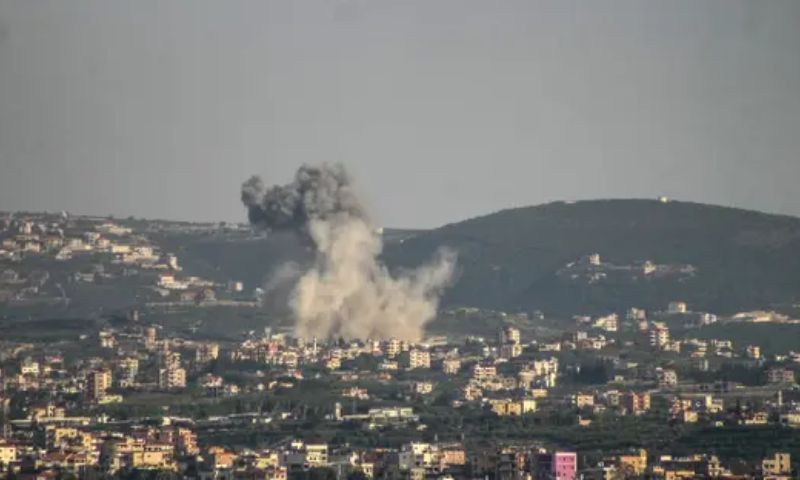



BEIRUT: Lebanon’s armed forces reported “acts of aggression” by Israel in the early hours of Friday, saying the incidents amounted to violations of a newly implemented 10-day ceasefire intended to halt weeks of cross-border hostilities.
The Lebanese army, in a statement shared on social media platform X, urged residents in the south to remain cautious, citing multiple reported violations shortly after the truce came into effect at midnight.
Lebanon’s army in an X post early on Friday called on residents in the south to exercise caution “in light of a number of violations” of the ceasefire agreement by “several Israeli acts of aggression.”
Read more: https://t.co/U8o5J2dlwd
— Al Arabiya English (@AlArabiya_Eng) April 17, 2026
The alert followed reports from Lebanon’s state-run National News Agency of Israeli shelling in the villages of Khiam and Dibbine, approximately 30 minutes after the ceasefire began. The Israeli military said it was reviewing the reports.
The 10-day ceasefire, announced by US President Donald Trump, is aimed at pausing fighting between Israeli forces and Hezbollah, although the group is not formally a signatory to the agreement. The arrangement is also viewed as part of broader diplomatic efforts linked to parallel regional de-escalation initiatives involving the United States, Israel and Iran.
Despite the truce, tensions remained visible on the ground. Israeli Prime Minister Benjamin Netanyahu confirmed that Israel agreed to the ceasefire to support diplomatic efforts but stressed that Israeli forces would remain deployed in southern Lebanon. He said troops were working to establish a buffer zone extending roughly 10 kilometres into Lebanese territory.
“That is where we are, and we are not leaving,” Netanyahu said. Hezbollah has indicated it may continue to resist any prolonged Israeli military presence, warning that what it considers occupation could prompt a response depending on developments, raising concerns over the ceasefire’s durability.
According to the US State Department’s framework, Israel retains the right to act against imminent threats, while otherwise being expected to suspend offensive operations. However, the wording has fuelled uncertainty over how strictly the ceasefire will be observed in practice.
According to media reports, hostilities continued up to the final moments before the truce took effect, with reports of rockets fired towards northern Israel and sirens sounding in border areas. Despite the agreement, sporadic celebrations were reported in Beirut, while some displaced families began returning to southern regions, even as authorities advised caution until the situation stabilises.
The agreement follows sustained diplomatic engagement, including rare coordination between Israeli and Lebanese intermediaries and US-led mediation efforts. It also intersects with broader regional negotiations aimed at containing wider conflict dynamics.
However, with large-scale displacement already affecting more than a million people in Lebanon and core political and security issues unresolved, the long-term viability of the ceasefire remains uncertain.