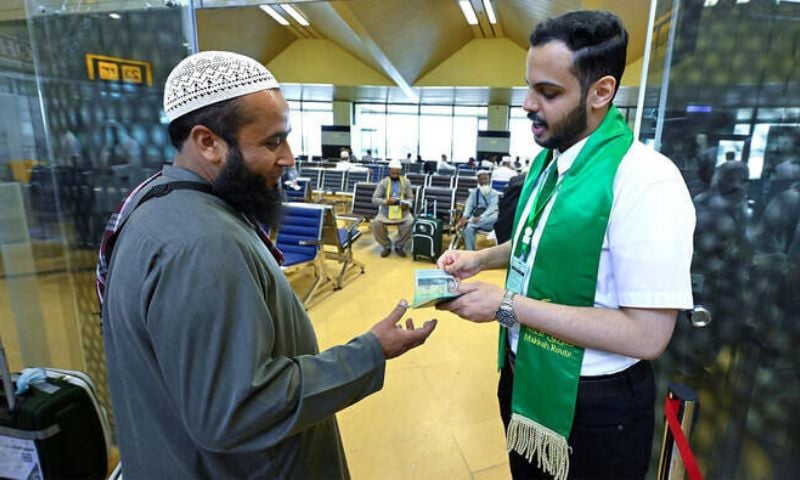
ISLAMABAD: Pakistan’s Ministry of Religious Affairs announced on Thursday that a total of 660 pilgrims will arrive in Madinah, Saudi Arabia, on 18 April via three flights, marking the start of the country’s pre-Hajj flight operations.
Saudi Arabia has allocated Pakistan a quota of 179,210 pilgrims for the upcoming Hajj.
Of these, approximately 118,000 places have been assigned to the government scheme, while the remainder will be managed by private tour operators.
A high-level meeting was held at the Directorate of Hajj in Madinah to review arrangements for the arrival of Pakistani pilgrims.
According to a briefing, a total of 660 Pakistani pilgrims will arrive in Madinah on 18 April 2026 on board three flights, with additional pilgrims scheduled to follow in the coming days,” the Ministry of Religious Affairs said.
“This will mark the start of this year’s Hajj operation for Pakistan, with a strong emphasis on organised and efficient services from day one.”
The statement added that all necessary systems have been put in place to welcome the pilgrims, with authorities focused on ensuring that every pilgrim begins their Hajj journey in Madinah in comfort, ease, and peace of mind.
Zahid Sohail, Director of Pakistan’s Hajj operations in Madinah, said that all arrangements were “fully computerised and properly planned”.
He added that the allocation of rooms for Hajj pilgrims had also been completed.
The ministry has also urged pilgrims to use the “Pak Hajj 2026” mobile app to access information about their flights, departure times, and designated airports.
Under Pakistan’s Hajj scheme, the government package is estimated to cost between Rs1,150,000 and Rs1,250,000 ($4,049.93–$4,236), subject to final agreements with service providers.
Pakistan’s pre-Hajj flight operations are expected to continue uninterrupted until May 21.
Hajj 2026 is expected to bring millions of Muslims from around the world to Makkah, continuing one of the largest annual gatherings of faith and devotion.
Hajj is one of the Five Pillars of Islam and is obligatory for Muslims who are physically and financially able to perform it at least once in their lifetime.
It symbolises unity, equality, and humility, as pilgrims stand together in simple garments regardless of nationality, wealth, or status.