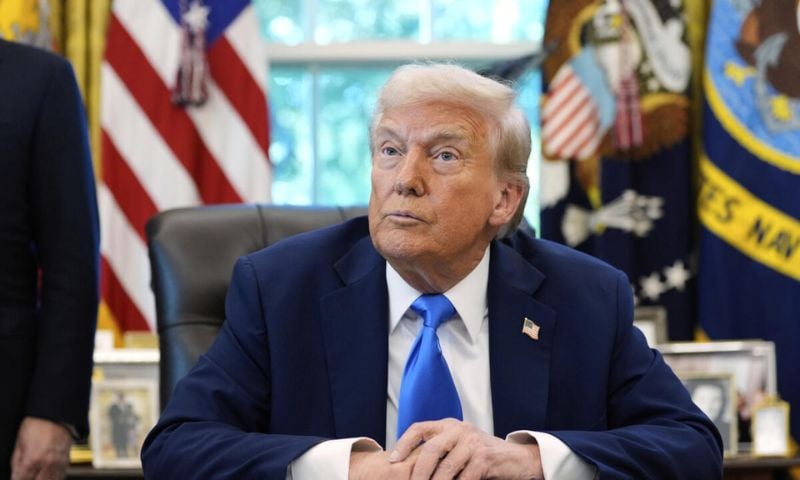
WASHINGTON: US President Donald Trump said on Sunday that Pakistan-mediated talks between the United States and Iran in Islamabad “went well” and saw agreement on most issues, but stressed that no progress was made on the nuclear question.
Trump’s statement comes after a historic direct talks between the United States and Iran — known as the Islamabad Talks — ended without an agreement on Sunday.
The US President said he had been fully debriefed by Vice President JD Vance, Special Envoy Steve Witkoff and Jared Kushner on the meeting held in Islamabad, which he said took place under the leadership of Pakistan’s Prime Minister Shehbaz Sharif and Chief of Defence Forces and Chief of Army Staff Field Marshal Syed Asim Munir.
“I have been fully debriefed by Vice President JD Vance, Special Envoy Steve Witkoff, and Jared Kushner, on the meeting that took place in Islamabad through the kind and very competent leadership of Field Marshal Asim Munir, and Prime Minister Shehbaz Sharif, of Pakistan,” Trump stated.
In a series of posts on his Truth Social platform, Trump said “most points were agreed to” during intensive talks lasting nearly 20 hours, but added that the “only point that really mattered, NUCLEAR, was not.”
The US president said the main obstacle to an agreement remained Iran’s nuclear programme, adding that Tehran was unwilling to abandon what he called its “nuclear ambitions.”
Progress on most issues
He said that while progress had been made on most issues.
Trump added that US representatives had engaged constructively during the Islamabad Talks with the Iranian delegation, comprised of Parliament Speaker Mohammad Bagher Ghalibaf and Foreign Minister Abbas Araghchi.
“In many ways, the points that were agreed to are better than us continuing our Military Operations to conclusion, but all of those points don’t matter compared to allowing Nuclear Power to be in the hands of such volatile, difficult, unpredictable people,” said Trump in the Truth Social post.
Trump said his representatives became “very friendly and respectful” towards their Iranian counterparts during the prolonged talks, despite deep differences between the two sides.
He said the Iranian officials, Mohammad Bagher Ghalibaf, Abbas Araghchi and Ali Bagheri, remained “unyielding” on what he described as the most important issue — Tehran’s nuclear programme.
He reiterated that Iran would “never have a nuclear weapon”.
Trump praises Pakistani leadership
Trump praised the Pakistani leadership’s role in facilitating the high-stakes talks.
He referred to Pakistan’s leadership, naming Prime Minister Shehbaz Sharif and Chief of Defence Forces and Chief of Army Staff Field Marshal Syed Asim Munir, describing them as “extraordinary men” and commending their role in enabling the diplomatic process.
Trump also reiterated his long-standing claim that US actions had previously prevented a regional war between nuclear-armed Pakistan and India, saying he had “saved 30 to 50 million lives” in relation to tensions involving India.
He said Washington would not accept Iran developing nuclear weapons, repeating that “IRAN WILL NEVER HAVE A NUCLEAR WEAPON,” and insisted that the issue be part of any agreement.
Blockade of Strait of Hormuz
Trump also announced a hardline response on maritime security, saying the United States Navy would begin steps to “BLOCKADE” vessels entering or leaving the Strait of Hormuz, which he described as an international waterway.
He accused Iran of attempting to exert pressure through control of the strategic chokepoint, alleging “extortion” and warning that vessels linked to Iranian interests would be intercepted in international waters.
Despite the tough language, Trump also suggested a phased approach, saying that at a later stage “all being allowed to go in, all being allowed to go out” could be restored if conditions were met.
Trump said the US Navy would begin the process of blockading vessels entering or leaving the Strait of Hormuz, citing concerns over maritime security and alleging that Iran had threatened shipping in the waterway.
He added that US forces had been instructed to interdict vessels in international waters that had paid what he described as “illegal tolls” to Iran.
Trump further warned of military consequences if Iranian forces targeted US or commercial vessels, saying Washington remained prepared to escalate its response.
He also indicated that other countries could join the proposed blockade, while reiterating that Iran would not be allowed to benefit from what he called “extortion” in international waters.
Trump’s remarks suggested that negotiations had advanced on multiple points and could continue.
US–Iran talks to continue
Pakistan-mediated talks between the US and Iran concluded in Islamabad on Sunday without an agreement after more than 21 hours of intensive negotiations, with all sides signalling that diplomatic engagement will continue.
US Vice President JD Vance said the discussions were substantive but fell short of a breakthrough, while indicating that Washington has put forward what it described as a final proposal.
“We’ve made very clear what our red lines are, what things we’re willing to accommodate them on, and what things we’re not willing to accommodate them on… and they have chosen not to accept our terms.”
Despite the lack of agreement, Vance signalled that diplomacy was still in motion, confirming that a proposal had been left on the table for Tehran to consider.
A SECOND ROUND OF TALKS IS EXPECTED SOON: LISTEN TO REMARKS AT THE END pic.twitter.com/voeO4TkDk5
— Sajjad Tarakzai (@SajjadTarakzai) April 12, 2026
“We leave here with a very simple proposal — a method of understanding that is our final and best offer. We’ll see if the Iranians accept it.”
He stressed that the core US objective remains ensuring that Iran does not develop nuclear weapons or the capability to rapidly acquire them.
“We need to see an affirmative commitment that they will not seek a nuclear weapon… not just now, but for the long term. We haven’t seen that yet. We hope that we will.”
Vance added that while discussions covered a wide range of issues — including Iran’s nuclear programme and frozen assets — the two sides were unable, for now, to bridge key differences.
“We talked about all those issues… but we just could not get to a situation where the Iranians were willing to accept our terms.”
He maintained that the US delegation had engaged in good faith and remained flexible during the negotiations, which involved continuous coordination with President Donald Trump and the broader national security team.
Iran stresses ‘good faith’
Iran’s Parliament Speaker Mohammad Bagher Ghalibaf has issued a series of posts on X following Pakistan-facilitated US–Iran talks in Islamabad, striking a cautiously constructive tone while reiterating deep mistrust shaped by past experiences.
Ghalibaf said Iran approached the negotiations with the intent to engage, but remained sceptical due to previous encounters with the United States.
“Before the negotiations, I emphasised that we have the necessary good faith and will, but due to the experiences of the two previous wars, we have no trust in the opposing side,” he wrote.
Iranian delegation members had put forward forward-looking initiatives during the discussions, he said, rushing to add, “but the process did not succeed in building sufficient trust with the opposing side in this round, appearing hopeful for the continuation of diplomacy.
At the same time, the Iranian Speaker expressed appreciation for Pakistan’s diplomatic role in facilitating the engagement.
“I am also grateful for the efforts of our friendly and brotherly country, Pakistan, in facilitating the process of these negotiations, and I send my regards to the people of Pakistan,” he stated.
Ghalibaf also highlighted domestic backing for the Iranian delegation, saying the nation of 90 million people had shown unity and support ahead of the talks, which he described as a source of encouragement for the negotiating team.
He further referred to the delegation’s efforts during the process and reaffirmed that Iran’s position remains anchored in national interest and public mandate.
Pakistan urges US, Iran to sustain dialogue
Pakistan on Sunday called on the US and Iran to maintain a “positive spirit” and uphold the ceasefire, as Foreign Minister and Deputy Prime Minister Ishaq Dar stressed Islamabad’s continued commitment to facilitating dialogue following the conclusion of talks in the capital.
Addressing a press conference after the Pakistan-hosted negotiations ended without an agreement, Dar emphasised that diplomacy must continue despite the absence of a breakthrough.
“We hope that the two sides continue with the positive spirit to achieve durable peace and prosperity for the entire region and beyond,” he said.
Highlighting the importance of maintaining stability, Dar underscored that adherence to the ceasefire remains critical.
“It is imperative that the parties continue to uphold their commitment to ceasefire,” he added.
Reaffirming Pakistan’s diplomatic role, the foreign minister said Islamabad would remain actively engaged in supporting future negotiations between Washington and Tehran.
“Pakistan has been and will continue to play its role to facilitate engagement and dialogue between the Islamic Republic of Iran and the United States of America in the days to come.”
Dar also expressed appreciation to both countries for responding to Prime Minister Shehbaz Sharif’s call for a ceasefire and for accepting Pakistan’s invitation to hold talks in Islamabad.
He noted that the negotiations, led by US Vice President JD Vance and Iranian Parliament Speaker Mohammad Bagher Ghalibaf, involved “intense and constructive” engagement over the past 24 hours, with Pakistan playing a key mediating role alongside its civil and military leadership.
Official statement of Deputy Prime Minsiter Ishaq Dar on US-Iran negotiations. Pakistan expresses gratitude to US, Iran for appreciating Pakistan’s efforts to help achieve the ceasefire.@MIshaqDar50@ForeignOfficePk#IslamabadTalks #Ceasefire… pic.twitter.com/YTu7ThRWro
— Pakistan TV (@PakTVGlobal) April 12, 2026
Separately, Pakistani officials said the opening round of US–Iran talks in Islamabad marked an “important first step” in a broader diplomatic process, urging both sides to continue engagement and build on the ceasefire.
They emphasised that Pakistan facilitated the discussions “in good faith” to create space for constructive dialogue, while remaining neutral and not commenting on the substance of negotiations.
Officials stressed that sustained diplomacy is essential, noting that “issues of such sensitivity and consequence cannot be resolved in a single sitting”.
Underscoring the need for continuity, they said “What remains important is that the channel stays open and the process moves forward in a constructive manner”.
Pakistan also called on all sides to act responsibly, urging them to “remain engaged in good faith, sustain the ceasefire, and avoid any action that could complicate the environment for further dialogue”.
Reaffirming its role, officials said Pakistan “remains firmly committed” to supporting de-escalation and “stands ready to continue facilitating constructive engagement” if required.
While the talks concluded without an agreement, Pakistan framed the process as a step forward in ongoing diplomatic efforts, signalling that channels of communication remain open and that further engagement is expected.