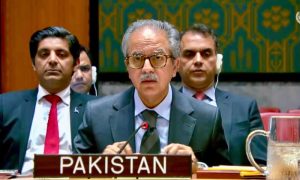
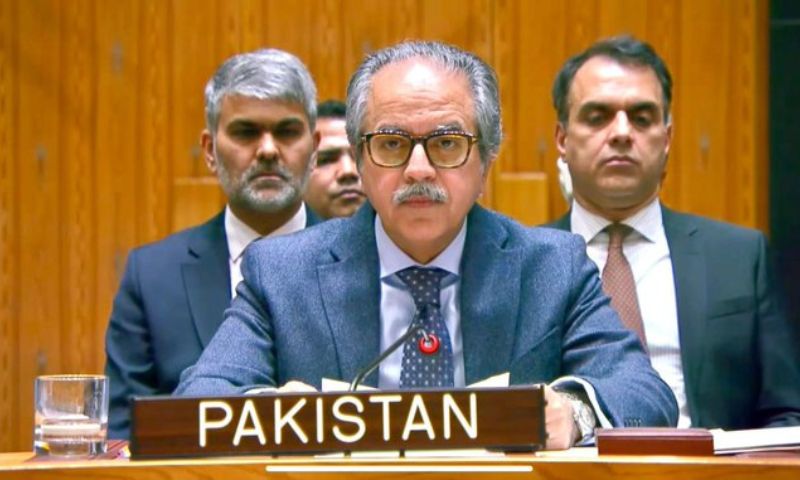
UNITED NATIONS: Pakistan’s Permanent Representative to the United Nations, Ambassador Asim Iftikhar Ahmad, on Tuesday urged restraint, dialogue and the swift reopening of the Strait of Hormuz, warning that the ongoing crisis is having severe economic consequences globally, including for Pakistan.
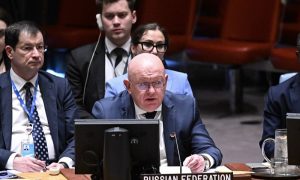
China and Russia on Tuesday vetoed a draft resolution at the UN Security Council aimed at reopening the Strait of Hormuz.
Speaking during a UN Security Council vote on a draft resolution, the Pakistani envoy stressed the importance of ensuring safe passage for civilian shipping and protecting maritime security.
Ambassador Iftikhar reiterated Pakistan’s continued and unwavering support and complete solidarity in these challenging times with Bahrain and other GCC countries, including Saudi Arabia, Qatar, Kuwait, United Arab Emirates and Oman, as well as Jordan.
He noted that these countries are not parties to the ongoing conflict in the Middle East, but are directly suffering from its consequences.
“Pakistan supports the sovereignty, territorial integrity, political independence and security of all brotherly countries in the region,” Ambassador Iftikhar said.
Explanation of Vote by Ambassador Asim Iftikhar Ahmad,
Permanent Representative of Pakistan to the UN,
After the Security Council Vote on Draft Resolution on the Strait of Hormuz
(7 April 2026)
********President,
At the outset, let me reiterate Pakistan’s continued and… pic.twitter.com/jsnOTHGXNI
— Permanent Mission of Pakistan to the UN (@PakistanUN_NY) April 7, 2026
The Pakistan envoy said that the Strait of Hormuz is an important international shipping route for goods and energy, adding that Pakistan calls for the security of ships and crew members, and the swift and safe passage of civilian ships, and the restoration of normal passage through the Strait.
“The situation in the Strait of Hormuz is adversely impacting countries around the world, including Pakistan. The consequences for the regional and global economy are evidently harsh, and ordinary Pakistanis are suffering,” Ambassador Iftikhar said.
The Pakistani envoy said that the closure of the Strait of Hormuz has resulted in one of the largest energy supply shocks in modern history.
“The impact is felt not only in terms of energy flows but also in fertilisers and other essential commodities, thus affecting food security, cost of living and squeezing the livelihood of the most vulnerable.”
Ambassador Iftikhar warned that if the military escalation in the Middle East and Hormuz disruptions persist, the suffering will extend far beyond the region, translating into widespread economic hardship.
“We agree on the urgency of the situation and the fundamental premise of the draft resolution, which is the reopening of the Strait of Hormuz and normalisation of the situation at the earliest. This is an important issue not only for the GCC countries but also for all other States in the region and beyond, including Pakistan,” the Pakistani envoy stated.
“It is also logical that any discussion or arrangement related to the Strait of Hormuz will have to take into account the legitimate interests of the GCC countries. Pakistan supported resolution 2817 that was presented by Bahrain on behalf of the GCC last month. We have consistently maintained that the resolution should be implemented in letter and spirit,” Ambassador Iftikhar maintained.
Pakistan called for time and space for diplomatic efforts to succeed in ending the ongoing Iran conflict.
“We continue to believe that time and space must be allowed for ongoing diplomatic efforts to facilitate a return to dialogue and engagement. These efforts have been widely acknowledged and appreciated, including by the UN Secretary-General and members of this Council,” the Pakistani envoy stated.
Ambassador Iftikhar said Pakistan remains committed to pursuing a durable political solution and is actively engaged with regional and international partners to de-escalate tensions and restore stability.
“We would continue seeking a durable diplomatic solution to the prevailing situation. This is the fundamental foundation of our ongoing diplomatic efforts, which we are determined to continue to pursue,” the Pakistani envoy told the Council.
Pakistan stressed that restraint, diplomacy and dialogue must prevail at this critical juncture.
“Pakistan has been actively engaged in diplomatic efforts towards that end in concert with its partners in the region and beyond.”
Pakistan’s Deputy Prime Minister and Foreign Minister Ishaq Dar hosted the foreign ministers of Egypt, Saudi Arabia and Türkiye in Islamabad last week to advance the pursuit of a peaceful resolution of the ongoing crisis through intensified diplomatic engagement, the Pakistani envoy said.
Ambassador Iftikhar said that after Pakistan’s Deputy PM Dar’s meeting with Chinese Foreign Minister Wang Yi in Beijing last week, China and Pakistan announced a five-point initiative with a sequenced roadmap encapsulating an immediate halt to hostilities; launch of inclusive peace talks; protection of civilians and critical infrastructure; restoration of maritime security in the Strait of Hormuz; and a firm reaffirmation of the UN Charter and international law as the indispensable framework for a lasting political settlement.
“Our objective is clear – a permanent end to hostilities, containing the expansion of this conflict and preventing any further loss of civilian life or destruction of critical infrastructure,” the Pakistani envoy told the Council.
Ambassador Iftikhar reaffirmed that Pakistan remains committed to continue playing its constructive role in promoting dialogue, fostering understanding, and supporting all efforts aimed at achieving lasting peace in the region.