
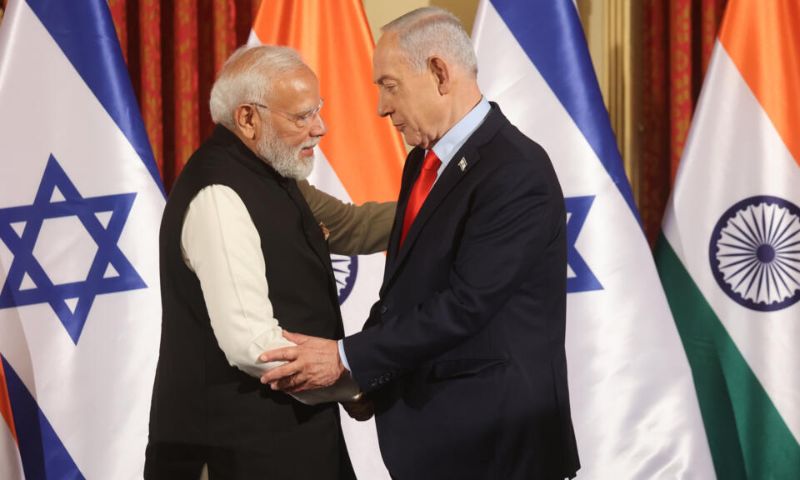
ISLAMABAD: India’s growing alignment with Israel has triggered concern among Muslim-majority countries, with critics arguing that New Delhi has prioritised strategic interests over longstanding principles.
Prime Minister Narendra Modi’s recent visit to Israel, portrayed domestically as a diplomatic success, has been viewed by some observers as a departure from India’s traditional foreign policy stance. The visit, centred on expanding cooperation in trade, defence and technology, is seen as signalling a shift towards a more transactional approach.
Historically, India maintained a balanced position, supporting Palestinian self-determination while engaging with multiple regional partners under the framework of the Non-Aligned Movement. However, critics contend that this balance has weakened, particularly amid ongoing humanitarian concerns in Gaza and the West Bank.
Human rights organisations, including Amnesty International and Human Rights Watch, have highlighted alleged violations in the region, yet India has largely refrained from publicly addressing these issues while continuing to strengthen ties with Israel.
Policy shift
The policy shift has also drawn criticism within India, with opposition parties and civil society groups questioning the move away from earlier principles. Concerns have been raised about the broader implications for India’s relationships with key partners in the Muslim world.
Strategic projects such as Iran’s Chabahar Port have reportedly slowed, while other economic and energy partnerships are being reassessed in light of evolving priorities.
Analysts suggest that India’s current approach reflects a more interest-driven foreign policy, but caution that closer alignment with Israel could carry geopolitical risks, particularly in a volatile region.
For many observers, the development highlights changing dynamics in international relations, with calls for careful engagement and reassessment of long-term regional partnerships.