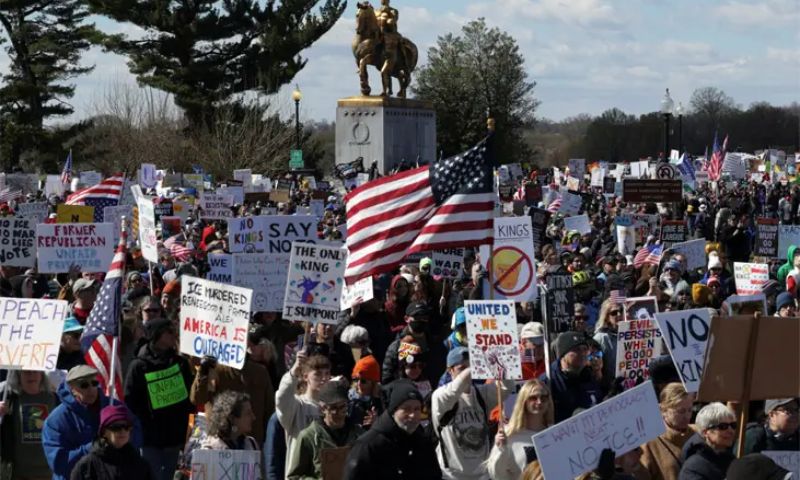
WASHINGTON: Widespread protests against U.S. President Donald Trump took place across the United States on Saturday, as demonstrators rallied under the “No Kings” movement in what organisers said could become the largest single-day non-violent mobilisation in the country’s history.
According to media reports, the demonstrations, now in their third nationwide iteration within a year, drew millions of participants across thousands of locations — not only in major metropolitan hubs like New York, Los Angeles, and Washington, but increasingly in smaller towns and traditionally Republican-leaning regions. Organisers described this geographic expansion as a defining feature of the latest protests.
At the heart of the growing unrest is a mix of long-standing political grievances and fresh anger over the ongoing conflict involving Iran. The war, launched jointly by the United States and Israel roughly four weeks ago, has added a new and potent dimension to anti-Trump sentiment.
Large crowds gathered in Minnesota, where more than 100,000 people assembled at the state capitol for a high-profile rally featuring prominent musicians Bruce Springsteen and Joan Baez. The state has recently become a focal point in national debates over immigration enforcement, further fuelling tensions.
Across the country, demonstrations reflected a widening coalition of dissent. Protesters voiced concerns over economic pressures, civil liberties, immigration crackdowns, and what they described as increasingly authoritarian governance. Many also expressed alarm over the administration’s expanding military posture abroad.
“The story isn’t just the size of these protests — it’s where they’re happening,” said a leading organiser of the movement, noting a sharp rise in participation from suburban and rural communities. Areas considered politically competitive, as well as deeply conservative states such as Idaho, Wyoming, and Utah, have seen a notable surge in protest activity.
In the Washington area, marchers gathered near Arlington before heading toward the National Mall, echoing historic civil rights demonstrations. While some motorists showed support, others reacted angrily, underscoring the deep political divisions shaping the national mood.
Participants cited economic strain and dissatisfaction with leadership as key motivations. “People are struggling to afford basic living, and the system feels broken,” said one protester who travelled from Virginia to join the march.
The Iran conflict has emerged as a central flashpoint. Demonstrators criticised the administration’s decision to engage militarily, with many arguing the war lacks justification and risks further destabilising the region.
The “No Kings” movement, which began last year, has steadily gained momentum. Previous protest days drew between four and seven million participants nationwide. This year, organisers say more than 3,000 rallies were planned, including events in remote areas and even overseas, with solidarity demonstrations reported in European cities such as Amsterdam, Madrid, and Rome.
Despite the scale of the protests, the White House dismissed the movement, characterising it as politically motivated dissent with limited broader appeal.
With U.S. midterm elections approaching later this year and the president’s approval ratings reportedly under pressure, analysts say the expanding protest movement could play a significant role in shaping the political landscape.