Key Points
- Washington signals openness to negotiations with Tehran.
- Strait of Hormuz tensions raise fears for global oil supply.
- UK warns Iran cannot “hold global economy hostage”.
- Germany urges Iran to enter serious negotiations immediately.
- Western leaders warn against distraction from Ukraine conflict.
- Concerns grow over Russia-Iran cooperation in global conflicts.
ISLAMABAD: The Group of Seven (G7) leading industrialised democracies issued a forceful statement Friday demanding an immediate end to attacks targeting civilians in the Middle East conflict, signalling unified international concern over escalating violence.
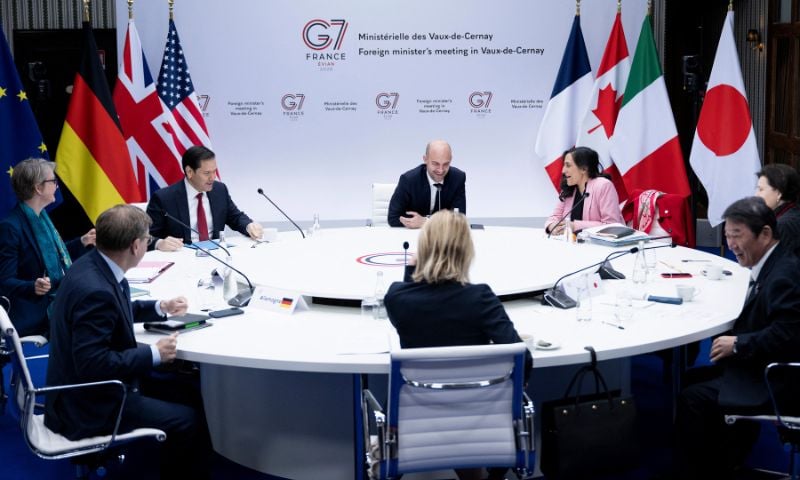
The call came after US Secretary of State Marco Rubio held extensive talks with foreign ministers from Canada, Germany, France, Italy, Japan and the UK at Vaux-de-Cernay Abbey outside Paris.
There can be no justification for the deliberate targeting of civilians in situations of armed conflict as well as attacks on diplomatic facilities,” the G7’s final communique stated.
This marks the first international diplomatic pushback against the US-Israeli offensive that began February 28 with air strikes that killed Iranian supreme leader Ali Khamenei, nearly one month ago.
Washington eyes exit
Rubio told reporters before departing France that the United States expects to complete military operations against Iran within “the next couple of weeks,” signalling an accelerated timeline for concluding the conflict.
However, he acknowledged Iran has not yet formally responded to proposals to end the war.
We’ve had an exchange of messages and indications from the Iranian system — whatever’s left of it — about a willingness to talk about certain things,” Rubio said, suggesting behind-the-scenes diplomacy is ongoing despite public silence from Tehran.
The comments came as US President Donald Trump had previously threatened strikes on Iranian energy infrastructure, only to reverse that stance to allow more time for negotiations.
Global supply threat
One of the G7’s primary concerns centred on Iran’s de facto blockade of the critical Strait of Hormuz, a chokepoint through which vast quantities of global energy supplies flow daily.
The blockade has driven international oil prices higher and left commercial vessels backed up waiting to transit the strategic waterway.
“Iran cannot be able to just hold the global economy hostage,” warned UK Foreign Minister Yvette Cooper, speaking for the broader alliance.
The G7 statement stressed the “absolute necessity to permanently restore safe and toll-free freedom of navigation in the Strait of Hormuz.”
Rubio confirmed he had secured allies’ backing for opposing Iranian threats to charge vessels tolls for passage.
“It’s dangerous to the world, and it’s important that the world have a plan to confront it,” the US chief diplomat said.
G7 urged Iran talks
German Foreign Minister Johann Wadephul called on the Iranian regime to engage in “serious negotiations with the United States now,” indicating the G7 sees a narrow window for diplomatic resolution.
“There are initial indications that such talks should be taking place,” Wadephul told reporters, though he declined to provide specifics on the proposed negotiations.
He stressed the need for enhanced international coordination, particularly as Russia and Iran have deepened cooperation across multiple theatres — from Ukraine to the Middle East.
“We need to strengthen our unity,” he said, emphasising that disunity among Western allies could invite further aggression.
Don’t forget Kyiv
With Ukrainian Foreign Minister Andrii Sybiha present at the meeting, European ministers made clear that the Middle East conflict should not come at the expense of continued support for Kyiv’s defence against Russian invasion.
Wadephul warned that Moscow was “cynically hoping that the escalation in the Middle East will divert our attention from his crimes in Ukraine.”
He cautioned that any weakening of Ukraine’s defence capabilities would “play into Putin’s hands” and allow the Kremlin to exploit Western preoccupation with the Iranian crisis.
The message underscores Western concerns that the two major conflicts are becoming entangled, with potential gains for adversaries if allied attention wavers.
About the G7: The Group of Seven comprises Canada, Germany, France, Italy, Japan, the United Kingdom and the United States, which originated from the first G6 summit held in 1975 at the nearby Château de Rambouillet in France.