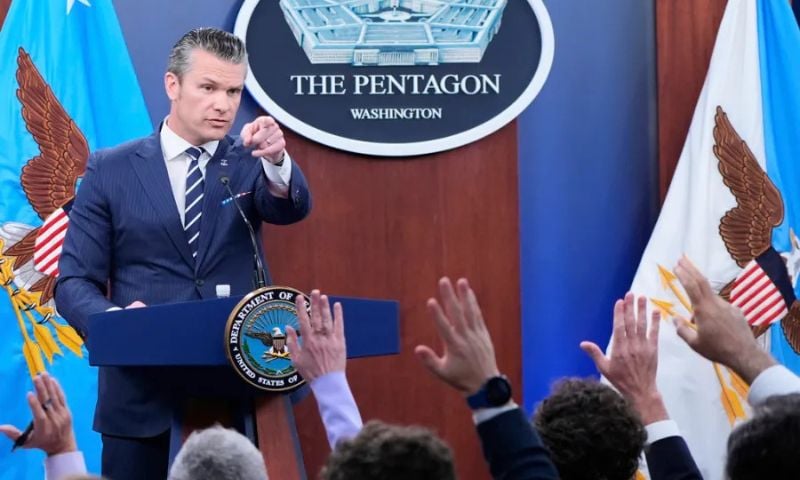
WASHINGTON: US Defence Secretary Pete Hegseth on Monday declined to rule out deploying American ground troops to Iran, as Washington’s military operation against Tehran entered its third day and widened across the region.
US forces began sweeping strikes on Saturday in coordination with Israeli military action.
Since then, hundreds of sites across Iran have been targeted, including missile facilities, naval assets and command-and-control centres.
Asked at a Pentagon press conference whether US troops were already on the ground in Iran, Hegseth replied: “No, but we’re not going to go into the exercise of what we will or will not do.”
“We’ll go as far as we need to go,” he added.
Hegseth said the conflict could last weeks. “Four weeks, two weeks, six weeks, it could move up. It could move back,” he said.
Not ‘endless war’
The defence secretary sought to distinguish the operation from previous US wars in Iraq and Afghanistan.
“No stupid rules of engagement, no nation building quagmire, no democracy-building exercise. No politically correct wars. We fight to win and we don’t waste time or lives,” Hegseth said.
“This is not Iraq. This is not endless,” he added, referring to past prolonged US interventions.
He said the objective was limited to degrading Iran’s military capabilities.
“Our ambitions are not utopian. They are realistic, scoped to our interests and the defence of our people and our allies,” he said.
Hegseth reiterated that the aim was to destroy Tehran’s missiles, navy and other security infrastructure.
He said the operation would not be an “endless war”, though it would not be completed overnight.
US claims air superiority over Iran
General Dan Caine, chairman of the Joint Chiefs of Staff, told reporters that US strikes had established local air superiority over Iran.
“Strikes by American forces resulted in the establishment of local air superiority. This air superiority will not only enhance the protection of our forces, but also allow them to continue the work over Iran,” Caine said.
However, he cautioned that achieving military objectives would take time and could involve further casualties.
“This is not a single overnight operation. The military objectives that Centcom and the Joint Force have been tasked with will take some time to achieve, and in some cases will be difficult and gritty work,” Caine said.
Meanwhile, Central Command later confirmed that a fourth US service member had died of injuries sustained during Iran’s initial retaliatory attacks.
CENTCOM Update
TAMPA, Fla. – As of 7:30 am ET, March 2, four U.S. service members have been killed in action. The fourth service member, who was seriously wounded during Iran’s initial attacks, eventually succumbed to their injuries.
Major combat operations continue and our…
— U.S. Central Command (@CENTCOM) March 2, 2026
Iran rejects negotiations
In Tehran, senior Iranian official Ali Larijani rejected reports that Iran was seeking to revive negotiations with Washington.
In a post on X, Larijani said Tehran would not negotiate with the United States.
He was responding to a report cited by Al Jazeera that The Wall Street Journal had reported on an “initiative to resume talks” through Omani intermediaries.
ترامپ با "آرزوهای واهی" منطقه را به آشوب کشاند و حالا نگران تلفات بیشتر نیروهای امریکایی است.
وی با عملکرد متوهمانه، شعار خودساخته "اول امریکا" را به "اول اسرائیل" تبدیل کرد و سربازان امریکایی را فدای قدرت طلبی اسرائیل نمود… ۱/۲— Ali Larijani | علی لاریجانی (@alilarijani_ir) March 2, 2026
Larijani said US President Donald Trump had plunged the region into chaos with “delusional fantasies” and feared further American casualties.
“Today, the Iranian nation is defending itself,” he wrote. “The armed forces of Iran did not initiate the aggression.”
لن نتفاوض مع الولايات المتحدة https://t.co/cvEweU8ODj
— Ali Larijani | علی لاریجانی (@alilarijani_ir) March 2, 2026
He later said Iran had “prepared itself for a long war” with the United States and Israel.
Iran, unlike the United States, has prepared itself for a long war. pic.twitter.com/0nTGu9u2K4
— Ali Larijani | علی لاریجانی (@alilarijani_ir) March 2, 2026
The conflict escalated sharply after Iran’s Supreme Leader Ayatollah Ali Khamenei was killed in a joint US-Israeli air strike on Tehran.
Iranian media reported that his wife, Mansoureh Khojasteh Bagherzadeh, 79, died after succumbing to wounds sustained in the same attack.
🔴 Ayatollah Khamenei’s wife succumbs to injuries from US–Israeli attack, attains martyrdom.
Follow: https://t.co/mLGcUTS2ei pic.twitter.com/BZrSBGwgxi
— Press TV 🔻 (@PressTV) March 2, 2026
President Masoud Pezeshkian said avenging Khamenei’s death was both “a duty and a right”.
Iran’s leadership moved quickly to project continuity. An interim council comprising the president, the head of the judiciary and a representative of the Guardian Council was established.
Ayatollah Alireza Arafi was named to the body, which will govern until the Assembly of Experts selects a permanent supreme leader.
Authorities announced a 40-day mourning period and seven days of public holidays.
Regional escalation
The conflict has widened across the Middle East.
Iran’s Revolutionary Guards said they had attacked 60 strategic targets and 500 US and Israeli-linked military targets in the region since the start of hostilities.
The statement said more than 700 drones and hundreds of missiles had been launched.
Iranian state television reported a new wave of missile and drone strikes under “Operation Honest Promise 4”, targeting sites in Beersheva.
The ISNA news agency said strikes had hit the headquarters of Tehran’s emergency services, injuring several staff members.
Loud explosions were also reported near a nuclear facility and airbase in the central city of Isfahan, according to Al Jazeera.
Israel’s ambulance service reported nine deaths in Beit Shemesh following Iranian missile strikes.
Gulf states also reported casualties and damage.
Shipping near the Strait of Hormuz was disrupted after attacks on commercial vessels.
Major operators suspended some regional activity, raising fears of a broader economic crisis.