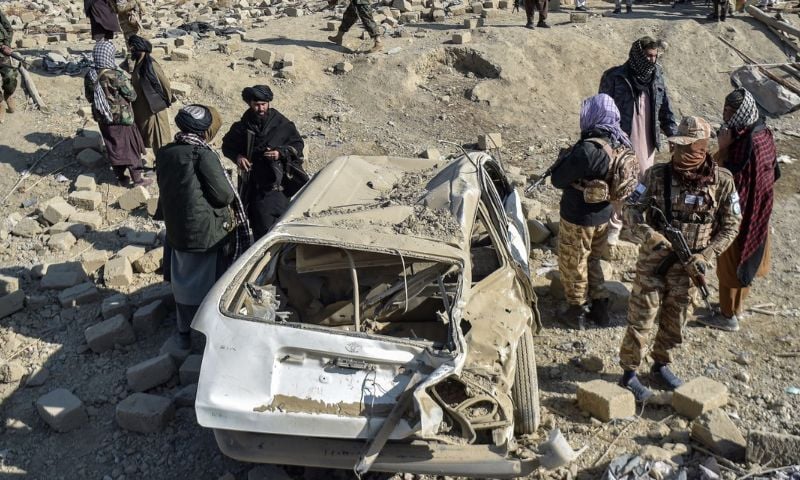
ISLAMABAD: Pakistan said on Saturday that 352 Afghan Taliban operatives had been killed and more than 535 injured so far during its retaliatory military operation launched in response to unprovoked aggression along the Pakistan-Afghanistan border.
Pakistan’s Information Minister Attaullah Tarar said that under “Operation Ghazab lil-Haq”, security forces had destroyed 130 Taliban checkposts and captured 26 Taliban checkposts.
He added that 171 tanks and armoured vehicles were neutralised, and 41 key Taliban positions in Afghanistan were effectively targeted through aerial strikes.
Operation Ghazb lil Haq
Update 2100 hours 28 February✅ Summary of Afghanistan Taliban losses
▪️352 Killed,
▪️535 + Injured,
▪️130 Check posts destroyed,
▪️26 Post Captured,
▪️171 Tanks and Armed vehicles Destroyed
▪️41 locations across Afghanistan effectively targeted…— Attaullah Tarar (@TararAttaullah) February 28, 2026
In response to the unprovoked border aggression, Pakistani forces launched a large-scale military operation and airstrikes on Taliban positions and terrorist hideouts in Afghanistan, targeting military positions in Kabul, Kandahar and several eastern provinces.
Meanwhile, Taliban spokesman Zabihullah Mujahid said in Kabul that the authorities were ready to resolve the crisis through dialogue.
“The Islamic Emirate of Afghanistan want to resolve this matter through dialogue,” Mujahid said.
According to Taliban officials, Pakistani forces struck military positions in Kabul, Kandahar and Paktia on Thursday night. The operation was launched in retaliation to the Taliban fighters’ attacks on Pakistan’s border posts and civilian population.
Pakistan’s response to terrorist attacks
Pakistan described the operation as an “immediate and effective” response to terrorist attacks originating from across the border.
In an earlier update, Tarar said 331 Taliban fighters had been killed and more than 500 wounded. He reported that 104 Taliban checkposts were destroyed and 22 positions captured.
The operation, according to Tarar, targeted two Taliban corps headquarters, multiple brigade and battalion command centres, sector headquarters, ammunition depots and logistics bases. More than 135 tanks, artillery pieces and armoured vehicles were neutralised, he said.
Security sources said the strikes involved air-to-ground missile attacks on Taliban military offices and posts and were launched after Afghan attacks a day earlier.
Tensions over terrorist sanctuaries in Afghanistan
The latest escalation follows years of strained relations between Islamabad and Kabul.
Pakistan has repeatedly accused Afghanistan’s Taliban authorities of harbouring leaders of the banned Tehreek-e-Taliban Pakistan (TTP) terrorist group, who Islamabad says use Afghan territory as a safe haven to plan and launch cross-border terror attacks.
The United Nations has previously reported links between the TTP and Afghanistan’s Taliban authorities.
Tarar accused the Afghan Taliban regime of providing sanctuary, training and facilitation to terrorists involved in terror attacks inside Pakistan.
He cited recent terror attacks on an imambargah and district courts in the capital, as well as the killing of Lieutenant Colonel Gul Faraz Ahmed in a suicide bombing, as evidence of the threat.
He said the “nexus between the terrorists and the Afghan regime is now as clear as daylight”. He said Afghanistan is being used as a base for planning and launching terrorist attacks.
Tarar also criticised the Taliban regime for human rights violations, describing the regime as illegitimate and repressive.
He said it suppressed women, children and minorities and had banned women from public spaces and education.
International reaction
United Nations Secretary-General Antonio Guterres said he was “deeply concerned by the escalation of violence” between Afghanistan and Pakistan, according to his spokesperson Stephane Dujarric.
“He calls for an immediate cessation of hostilities and reiterates his appeal to the parties to resolve their differences through diplomacy,” Dujarric said.
The United States voiced support for Pakistan’s right to defend itself.
A State Department spokesperson said Washington supported Pakistan’s right to respond to attacks by the Taliban, which it described as a Specially Designated Global Terrorist group.
The spokesperson added that the Taliban had failed to uphold counterterrorism commitments and had allowed terrorist groups to use Afghan territory as a base for attacks, destabilising the region.
Meanwhile, US President Donald Trump signalled strong ties with Pakistan’s leadership.
“Well, I would, but I get along with Pakistan, as you know, very well. Very, very well,” Trump told reporters, praising Pakistan’s leadership.
China expressed deep concern and urged both sides to exercise restraint.
“China supports combating all forms of terrorism and calls on both parties to remain calm and exercise restraint, properly resolve differences through dialogue and negotiation, achieve a ceasefire as soon as possible, and avoid further loss of life,” Foreign Ministry spokesperson Mao Ning said.
Russia also urged an immediate halt to hostilities. Foreign Ministry spokeswoman Maria Zakharova called the clashes a dangerous development and appealed for a return to political and diplomatic engagement.
European Union foreign policy chief Kaja Kallas called on both sides to de-escalate tensions and engage in dialogue. She said that Afghan territory must not be used to threaten or attack other countries.
Islamabad has said that durable peace depends on concrete measures to curb terrorism and prevent cross-border violence by Afghanistan-based terrorist groups.