


MOSCOW: Russia on Saturday criticised US President Donald Trump and Israel for embarking on a “dangerously irresponsible attack” on Iran, which Moscow said was plunging the entire Middle East into the abyss.
The Middle East plunged into renewed military confrontation on Saturday as the United States and Israel launched coordinated strikes against Iran, targeting its leadership, missile sites, and naval assets.
Tehran responded with retaliatory missile and drone attacks across the Gulf, prompting regional airspace closures, flight suspensions, and warnings from international powers.
Russia condemned the US and Israeli strikes, accusing them of plunging the Middle East “into an abyss of uncontrolled escalation” with potential humanitarian, economic, and radiological consequences.
Deputy Chairman of Russia’s Security Council Dmitry Medvedev criticised Trump’s actions, questioning the US’s long-term strategic patience compared with Iran’s historical endurance.
United Nations rights chief Volker Turk called for restraint and a return to diplomacy, warning that civilians always bear the brunt of conflict.
US and Israeli strikes on Iran
Trump announced the operation as “major combat operations” aimed at dismantling Iran’s missile and naval capabilities.
In a video address posted on his Truth Social platform, Trump said the strikes sought to eliminate “immediate threats from the Iranian regime” and prevent Tehran from acquiring nuclear weapons.
Trump also addressed Iranian forces directly, urging members of the Islamic Revolutionary Guard and other military personnel to surrender, offering “total immunity” to those who lay down their arms, and warning of “certain death” for those who resist.
He also called on the Iranian public to rise against the government, saying: “When we are finished, take over your government. It will be yours to take… the hour of your freedom is at hand.”
— Donald J. Trump (@realDonaldTrump) February 28, 2026
Israeli Defence Minister Israel Katz described the operation as “pre-emptive” to neutralise threats to Israel and confirmed that several sites in Tehran were targeted.
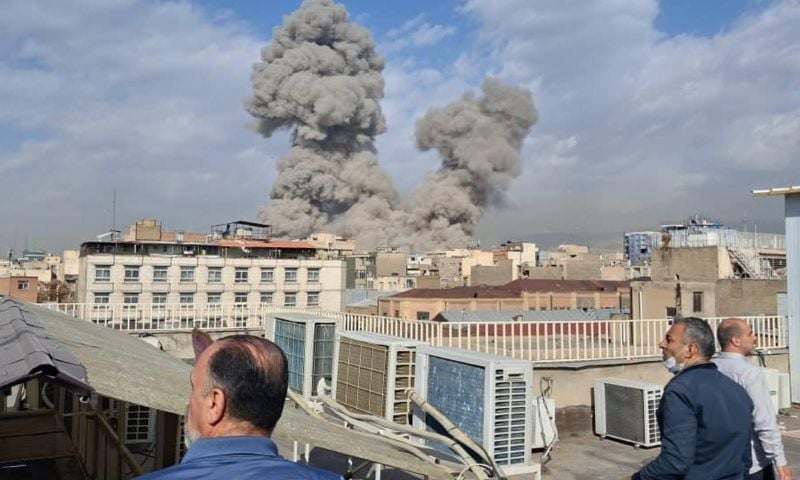
Explosions were reported in Iran’s capital and other cities, including Isfahan, Qom, Karaj, Kermanshah, and Tabriz.
The sound of three explosions in central Tehran pic.twitter.com/LrxS3t9r0X
— Iran Military Monitor (@IRIran_Military) February 28, 2026
Iranian state media reported intermittent communications outages and a near-total internet blackout, according to Netblocks, complicating the flow of information.
Iran retaliates
Iran’s Revolutionary Guards said it launched a first wave of retaliatory missile and drone attacks against Israel and warned that US bases and interests in the region were within range.
Explosions were reported in Kuwait, the United Arab Emirates, Bahrain, and Qatar.
🚨🇺🇸 US bases in the MidEast attacked by Iranian missiles
According to Fars News, the following bases were hit:
🔸Al Udeid Air Base in Qatar
🔸Al Salem Base in Kuwait
🔸Al Dhafra Air Base in the UAE
🔸US 5th Fleet Base in Bahrain pic.twitter.com/fwfOAPW8n9
— Sputnik (@SputnikInt) February 28, 2026
Bahrain reported a missile strike near the US Fifth Fleet’s service centre.
In Abu Dhabi, UAE authorities said Iranian missiles were intercepted by air defences, but shrapnel killed one person and caused material damage.
Footage of Iranian missiles hitting the US naval base in Bahrain. pic.twitter.com/xITrjz30jX
— Press TV 🔻 (@PressTV) February 28, 2026
Qatar reported intercepting Iranian missiles targeting its territory.
Both the UAE and Saudi Arabia condemned the attacks, calling them a “blatant violation” of sovereignty.
The Israeli military said it detected missiles launched from Iran, triggering air-raid sirens across Jerusalem and other areas.
Schools and workplaces were closed, and the country’s airspace was restricted for civilian flights.
Pakistan calls for diplomacy
Pakistan’s Deputy Prime Minister and Foreign Minister Ishaq Dar held separate calls with Iranian Foreign Minister Seyed Abbas Araghchi and Saudi Foreign Minister Faisal Bin Farhan Al Saud.
Pakistan condemned the “unwarranted attacks” on Iran and urged an immediate halt to hostilities through urgent diplomacy.
DPM/FM Senator Mohammad Ishaq Dar @MIshaqDar50 received a call from FM of Iran, Seyed Abbas Araghchi. They reviewed the evolving situation in Iran and the wider region.
DPM/FM strongly condemned the unwarranted attacks against Iran and called for an immediate halt to escalation… pic.twitter.com/G4eKNfzeRg
— Ministry of Foreign Affairs – Pakistan (@ForeignOfficePk) February 28, 2026
The Pakistani government also advised its citizens to exercise caution in the region.
Air traffic controllers were instructed to maintain strict monitoring of Pakistan’s airspace, particularly along the Iran-Afghanistan corridor.
A travel advisory warned against non-essential travel to Iran.
🔊PR No.5️⃣7️⃣/2️⃣0️⃣2️⃣6️⃣
Travel Advisory for Pakistani Nationals Regarding Iranhttps://t.co/ON0V0mPmlM
🔗⬇️ pic.twitter.com/Z2bIessIfP— Ministry of Foreign Affairs – Pakistan (@ForeignOfficePk) February 28, 2026
Civilian and aviation impact
The conflict has disrupted regional airspace and commercial flights.
Several airlines, including Lufthansa, Air France-KLM, Wizz Air, and Emirates, suspended or rerouted flights to Israel, Iran, and neighbouring Gulf states.
Flight times increased due to detours, with airlines citing safety concerns over potential missile threats.
In Qatar and the UAE, US embassies implemented shelter-in-place protocols and urged citizens to take precautions.
Message for U.S. Citizens:
The U.S. Embassy in Qatar is implementing a shelter-in-place for all personnel. We recommend all Americans do the same until further notice.
Actions to Take:
– Find a secure location within your residence or another safe building. Have a supply of… pic.twitter.com/ENogjpfK5r
— U.S. Embassy in Qatar (@USEmbassyDoha) February 28, 2026
The strikes mark one of the most direct confrontations between the US, Israel, and Iran in decades.
They follow repeated tensions over Iran’s nuclear and ballistic missile programmes.
Tehran has consistently stated its nuclear programme is defensive and has rejected US calls to dismantle its missile capabilities.