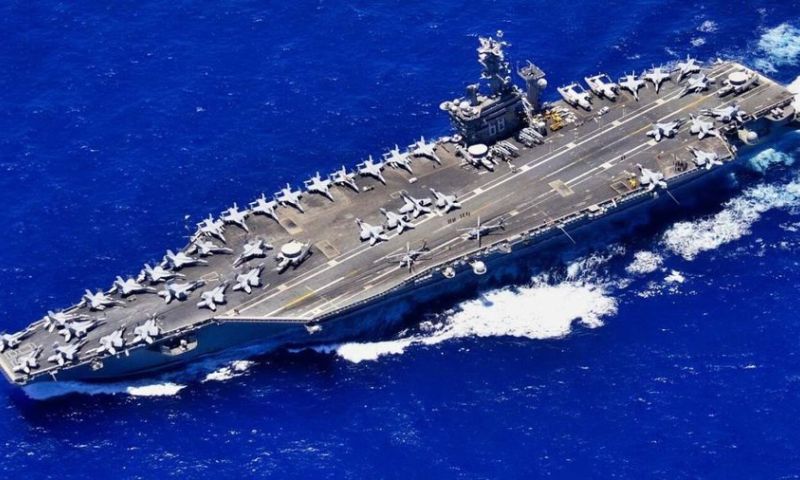
DUBAI: The United States aircraft carrier USS Gerald R. Ford has left the Greek island of Crete and is heading towards Israel, Western media reported, as Washington ramps up its military presence in the Middle East amid heightened tensions with Iran.
The USS Gerald R. Ford, the largest aircraft carrier in the US fleet, departed a port near the Greek island of Crete on Thursday and is expected to arrive at the northern Israeli port of Haifa on Friday, Reuters reported.
US officials have also indicated that Washington has dispatched 12 F-22 Raptor fighter jets to Israel, marking what would be the first deployment of American fighter aircraft on Israeli soil.
However, the Pentagon and the Trump administration have not officially confirmed the reported deployment.
The movements come as the United States increases its military footprint in the region during a critical phase of indirect nuclear talks with Iran.
US military build-up near Iran
The carrier deployment coincides with rare simultaneous US naval operations in the region.
The United States already has the USS Abraham Lincoln carrier strike group operating in Middle Eastern waters, alongside nine destroyers and three additional combat ships.
It is unusual for two US aircraft carriers — each carrying dozens of aircraft and thousands of personnel — to operate in the region at the same time.
The build-up follows repeated warnings from US President Donald Trump.
On February 19, Trump gave Iran a 10- to 15-day deadline to reach a nuclear agreement, warning that “bad things” would happen if Tehran failed to strike a deal. He later extended the timeline to 15 days.
In his recent State of the Union address, Trump accused Iran of pursuing “sinister nuclear ambitions” and developing missiles capable of threatening Europe and US bases overseas.
He claimed Tehran was working on missiles that could reach the United States.
Iran’s foreign ministry dismissed the allegations as “big lies”.
Tehran maintains that the maximum range of its missiles is 2,000 kilometres.
The US Congressional Research Service estimates the range at around 3,000 kilometres — well short of the US mainland.
US Secretary of State Marco Rubio said Iran must also negotiate over its ballistic missile programme.
He described Tehran’s refusal to discuss missiles as “a big, big problem” but added that “the president wants diplomatic solutions”.
US Vice President JD Vance told Fox News that Trump had a “right” to use military force if necessary and that Iran should take the warnings seriously.
Nuclear talks resume in Geneva
Amid the military manoeuvres, Iran and the United States held indirect nuclear talks in Geneva on Thursday under Omani mediation.
The discussions were mediated by Oman’s Foreign Minister Badr Albusaidi and took place at the Omani ambassador’s residence under tight security.
Oman has long acted as a quiet intermediary between Tehran and Washington.
Oman’s foreign ministry confirmed that negotiations had begun and said both sides had shown “unprecedented openness to new and creative ideas and solutions”.
The meeting was later paused and is expected to resume soon.
Iran’s state news agency IRNA reported that the delegations left the residence after about three hours of talks.
Iran’s foreign ministry spokesperson Esmaeil Baghaei said Tehran’s delegation had come “fully prepared” and was participating “with full seriousness to secure our national interests”.
He said the talks were focused on nuclear issues, including sanctions relief and Iran’s nuclear rights.
Baghaei added that discussions between the United States and Oman had begun earlier in the day and that Rafael Grossi, head of the International Atomic Energy Agency (IAEA), was expected to join the third round of negotiations, as he had in the previous round.
Oman’s foreign ministry said Albusaidi met Grossi in Geneva to discuss technical issues related to Iran’s nuclear file.
It stressed the importance of the IAEA’s professional and technical role in ensuring transparency and credibility in nuclear oversight.
A source close to the talks told AFP that Grossi had joined the negotiations. Iranian state television also reported his presence.