WARSAW: Poland has officially withdrawn from the international treaty banning antipersonnel land mines and announced plans to use these weapons to strengthen its defence against Russia.
The 1997 Anti-Personnel Mine Ban Treaty, commonly referred to as the Ottawa Convention, forbids its signatories from possessing or using antipersonnel mines. These weapons can remain active for many years and have been responsible for widespread civilian suffering in past conflict zones such as Cambodia, Angola, and Bosnia and Herzegovina.
Poland had ratified the treaty in 2012 and destroyed its stockpile of such mines by 2016. But on Friday, the country formally left the agreement and said it would resume production of both antipersonnel and anti-tank mines.
Paweł Zalewski, Poland’s deputy defence minister, described these mines as a crucial component of the defensive infrastructure being built on NATO’s eastern flank.
This includes areas along Poland’s border with Russia to the north and Belarus to the east. He stressed the need for Poland to defend itself against Russia, characterising the country as having highly aggressive intentions toward its neighbours and noting that Russia never committed to the land mine ban treaty.
Zalewski confirmed that Poland will start domestic production of both antipersonnel and anti-tank land mines, working in cooperation with Polish manufacturers. He emphasised the country’s goal of achieving self-sufficiency.
Land mines are explosive devices placed on or just beneath the ground, designed to detonate when a person or vehicle passes over them.
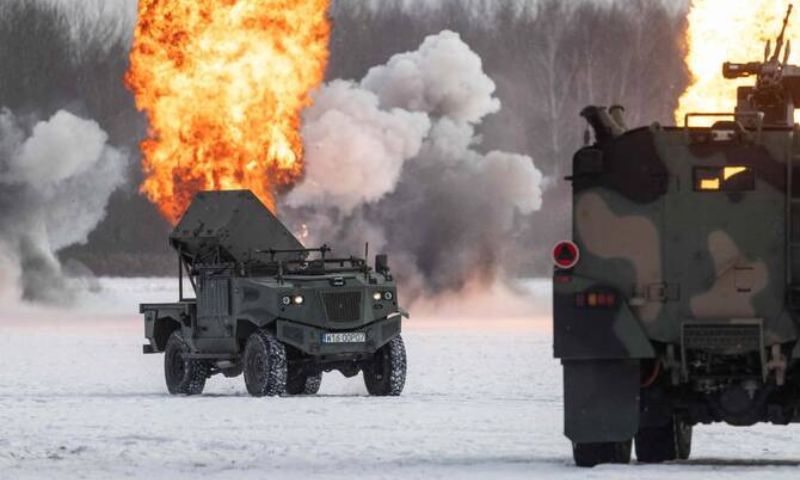
The day before the announcement, Polish Prime Minister Donald Tusk attended a demonstration of Bluszcz, an unmanned vehicle designed to lay anti-tank mines. The vehicle was developed by Polish company Belma SA together with a military research institute. Following the demonstration, Tusk indicated that Poland would soon be capable of mining its eastern borders within 48 hours if a threat arises.
Zalewski explained that Poland intends to build up mine stockpiles as part of the Eastern Shield, a system of reinforced fortifications being constructed along the borders with Belarus and Russia since 2024.
Human rights groups have criticised the decision to leave the Ottawa Convention, pointing out that antipersonnel mines pose unacceptable dangers to civilian populations. In response, Zalewski argued that Poland is finding a balance by keeping the mines in reserve unless the country is actually facing an attack. He maintained that Poland is not an aggressive nation but must use every available means to deter Russia.