
Key points
- Strong plans help India handle pressure
- Bowling control and early spin key
- Calm leadership keeps India tournament-ready
ISLAMABAD: India’s 61-run win over Pakistan in Colombo on 15 February 2026 did more than seal another high-profile rivalry result — it effectively underlined why India remain one of the most reliable tournament teams in men’s T20 cricket. They posted 175/7, then bowled Pakistan out for 114, with Ishan Kishan named player of the match for his attacking 77.
So what sits behind that consistency? In this World Cup, India’s pattern has been clear: a defined game plan, adaptable bowling resources, and leadership that keeps the side stable when chaos hits.
1) They don’t panic when early plans fail
India’s opener against the USA offered a warning sign: a strong opposition with nothing to lose, and India briefly under pressure. Yet they still won by 29 runs, with captain Suryakumar Yadav producing a rescuing innings to reset the match.
That ability to recover — without tearing up the blueprint mid-innings — is a hallmark of consistent World Cup sides. India are comfortable winning “ugly”: by absorbing a wobble, rebuilding, then accelerating late.
2) Their bowling is built for control
India’s most repeatable weapon is not one magic over — it is sustained control across phases. Modern T20 is increasingly shaped by how quickly teams force opponents into low-percentage shots, and India’s attack is designed for that squeeze.
A major trend in subcontinent conditions has been the rise of spin in the Powerplay, once considered too risky. A Hindustan Times analysis notes that spin has become a growing percentage of Powerplay overs in recent years, and highlights India’s increasing comfort using spin early as a wicket-taking and run-stemming tool.
That matters because early overs often define who controls the tempo. India’s willingness to use spinners up front is not just tactical — it is psychological, forcing opponents to reconsider pre-planned hitting patterns from ball one.
3) Match-ups are planned
India’s most consistent teams are rarely “one-style” sides. Their approach is match-up driven: pace when conditions suit, spin when batters are set up for it, and constant tweaks to fields and lengths rather than waiting for the game to drift.
The Pakistan match is an example. On a surface expected to grip and assist spin, India still found a scoring pattern, then defended with discipline and wicket-taking.
4) Leadership is calm
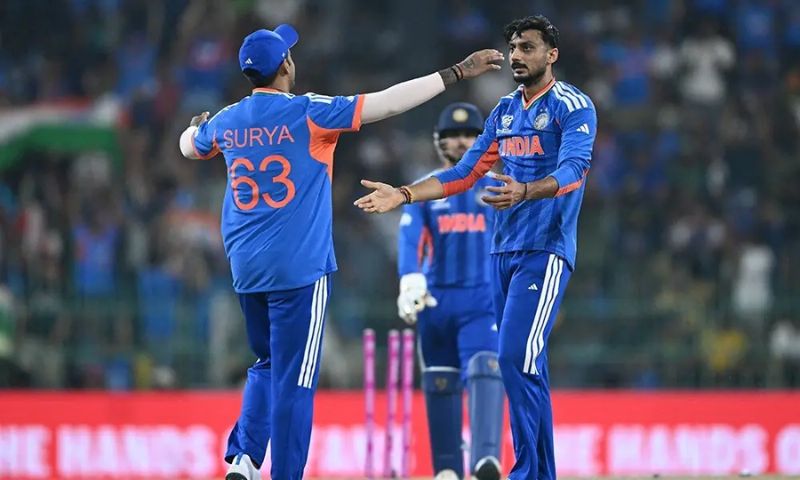
Tournament consistency is not only about skills; it is about decision-making under pressure. India’s current set-up has leaned into calm leadership, with Suryakumar’s captaincy frequently described in terms of clarity and player-management rather than theatrics.
That calmness shows up in body language and decision speed: fewer visible arguments, fewer reactive changes, and a clearer sense of roles. Even small moments of on-field camaraderie have become talking points — not because they are viral, but because they reflect a group that looks comfortable in high-stress games.
5) They keep qualification pressure off themselves
The simplest form of consistency is points-table control: win early, avoid mathematical drama. India’s victory over Pakistan effectively confirmed their Super Eight place, allowing them to manage workloads and combinations with less desperation than teams still chasing qualification.
India’s consistency at this World Cup is not magic — it is repeatable process: planned match-ups, phase control with the ball, and leadership that stabilises the side when a game turns uncomfortable. In tournament cricket, that combination is often the difference between being merely talented — and being reliably hard to beat.