TEHRAN, Iran: Iran’s Revolutionary Guards began military exercises in the Strait of Hormuz on Monday, state media reported, amid tensions with the United States.
State television said the drills, conducted by the Islamic Revolutionary Guard Corps (IRGC), are aimed at preparing forces for “potential security and military threats” in the strategic waterway. The duration of the exercises was not specified.
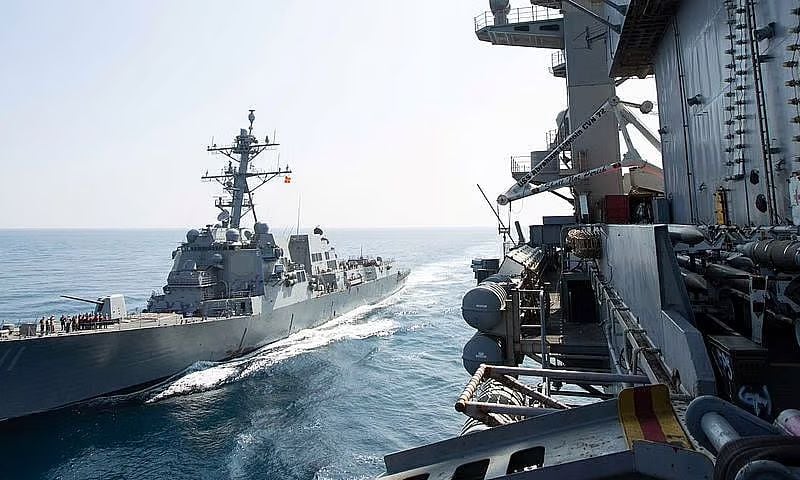
The manoeuvres come after the United States deployed a large naval force to the region. US President Donald Trump has described the deployment as an “armada”.
Strategic waterway
The Strait of Hormuz is one of the world’s most important oil transit routes.
About 20% of global oil production passes through the narrow channel between Iran and Oman.
Iranian politicians have repeatedly threatened to block the Strait during periods of heightened tension with Washington.
According to Iranian media, the exercises are being overseen by IRGC chief General Mohammad Pakpour and are intended to enhance the Guards’ rapid response capability.
In January, Washington sent the aircraft carrier USS Abraham Lincoln and accompanying warships to the Middle East.
On Friday, Trump said a second carrier, the Gerald R. Ford, would depart “very soon” for the Middle East.
US-Iran talks in Geneva
The drills coincide with preparations for indirect talks between Tehran and Washington in Geneva on Tuesday, mediated by Oman.
The two sides resumed discussions on February 6 in Muscat, their first since diplomacy collapsed last June during the Iran-Israel conflict, which saw Israeli and US strikes on Iranian nuclear facilities.
Iran’s Foreign Minister Abbas Araghchi arrived in Geneva on Sunday night with a high-level diplomatic and technical delegation.
He is scheduled to hold talks with US representatives on Tuesday through Omani mediation.
“I am in Geneva with real ideas to achieve a fair and equitable deal. What is not on the table: submission before threats,” Araghchi wrote on X after his arrival.
He said he would meet International Atomic Energy Agency (IAEA) Director General Rafael Grossi for “deep technical discussions”, as well as Oman’s Foreign Minister Badr Al-Busaid, ahead of the US talks.
The first round of talks in Muscat last week was described by both sides as a “good start”.
Iran’s position
Ali Larijani, Secretary of Iran’s Supreme National Security Council, said in an interview with Al Jazeera that Tehran is ready for “fair” nuclear talks to resolve concerns.
He said Iran has increased its level of preparedness and denied issuing any written response to US demands, adding that exchanges of views are ongoing.
Tehran views negotiations positively if they remain within the nuclear framework and are not used to impose additional issues, he said.
Larijani reiterated that Iran accepts IAEA monitoring within the framework of the Nuclear Non-Proliferation Treaty (NPT).
However, he said it was unrealistic to demand that Iran reduce its enrichment capability to zero.
Iran requires enriched uranium for peaceful civilian purposes, including cancer treatment, he said, noting that a research reactor in Tehran requires 20% enriched uranium to produce medical isotopes.
“Our negotiations are exclusively with the United States – we are not engaged in any talks with Israel,” Larijani said.