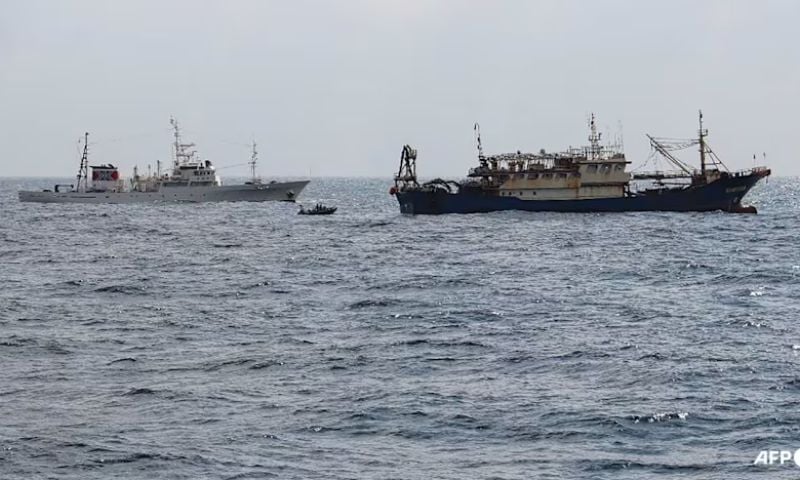



TOKYO: Japan has seized a Chinese fishing vessel and arrested its captain after the boat allegedly ignored orders to stop for inspection inside Japan’s exclusive economic zone (EEZ), authorities said on Friday—an episode that could further inflame tensions between Asia’s two largest economies.
The incident occurred on Thursday in waters off southern Japan, around 89.4 nautical miles (166 kilometres) south-southwest of Meshima island in the Goto archipelago. Japanese officials stressed the area was not disputed territory.
According to Japan’s fisheries agency, a patrol vessel ordered the fishing boat to halt for an inspection, but the vessel failed to comply and attempted to flee.
“The vessel’s captain was ordered to stop for an inspection by a fisheries inspector, but the vessel failed to comply and fled,” the agency said in a statement. “Consequently, the vessel’s captain was arrested on the same day.”
According to AFP, the arrested skipper was identified as Chinese national Zheng Nianli, 47. The status of the other 10 people aboard the vessel—named Qiong Dong Yu—was not immediately clear.
Chief government spokesman Minoru Kihara said Japan would maintain a tough stance on maritime law enforcement. “To prevent illegal fishing operations by foreign vessels, we will continue to take firm action and engage in enforcement activities,” he told reporters.
It marked the first seizure of a Chinese fishing boat by Japan’s fisheries agency since 2022. China had yet to comment on the incident as of Friday.
Background of maritime frictions
Japan and China have a history of maritime disputes, with repeated incidents around the Senkaku Islands—known as Diaoyu in China—in the East China Sea.
A 2010 arrest of a Chinese fishing boat captain near the islands escalated into a major diplomatic standoff between the two countries.
The latest episode comes amid a broader downturn in relations following remarks by Japanese Prime Minister Sanae Takaichi, who said three months ago that Japan would intervene militarily if China sought to take Taiwan by force.
Japan and China maintain close economic ties, but tensions have risen sharply over security issues and regional alignments. Beijing considers Taiwan its territory and has not ruled out the use of force to achieve what it calls “reunification.”
Taiwanese President Lai Ching-te warned in an interview with Agence France-Presse this week that other countries could face pressure if China were to seize the self-governing island.
“The next countries under threat would be Japan, the Philippines, and others in the Indo-Pacific region, with repercussions eventually reaching the Americas and Europe,” he said.
Diplomatic fallout
Following Takaichi’s comments, China summoned Japan’s ambassador, issued warnings to Chinese citizens about travel to Japan, and conducted joint air drills with Russia.
In December, Japan said J-15 fighter jets from China’s Liaoning twice locked radar on Japanese aircraft in international waters near Okinawa.
Beijing has also tightened export controls on certain items to Japan with potential military applications, stoking concerns in Tokyo over possible disruptions to supplies of critical rare-earth minerals.
In a symbolic move highlighting strained ties, Japan’s last two giant pandas were returned to China last month.
Hawkish leadership, cautious tone
Takaichi, 64, long regarded as a hawk on China, became Japan’s first woman prime minister in October and went on to win a landslide victory in snap elections on Sunday, consolidating her position for the next four years.
She said this week that under her leadership Japan—which hosts around 60,000 US military personnel—would strengthen its defences and “steadfastly protect” its territory, while also signalling openness to dialogue with Beijing.
China’s foreign ministry responded coolly. “Genuine dialogue should be built on respect for one another,” spokesman Lin Jian said. “Proclaiming dialogue with one’s mouth while engaging in confrontation—no one will accept this kind of dialogue.”
“If Japan truly wants to develop a strategic and mutually beneficial relationship with China, it’s very easy and clear: withdraw Takaichi’s erroneous remarks about Taiwan,” he added.
The seizure of the fishing vessel now risks becoming another flashpoint in a relationship already under pressure from competing territorial claims, security concerns, and deepening strategic mistrust across the region.