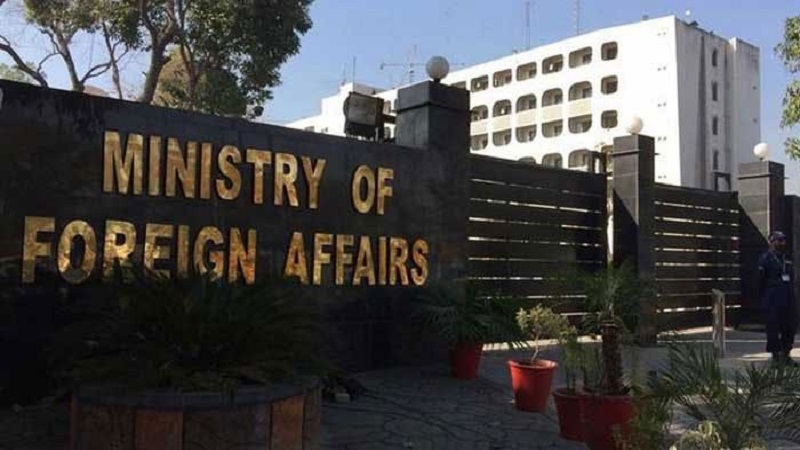
ISLAMABAD: Pakistan will not shut the door on diplomacy with Afghanistan but will also not allow its neighbour’s territory to be used for attacks against it, the Foreign Office spokesperson said on Thursday, urging Kabul to act against terrorist groups operating from Afghan soil.
“Diplomacy continues even in wars. Diplomacy continues even during skirmishes. So we would not shut the door of diplomacy, as much as we would not want to open the door of wars between our two brotherly countries,” Foreign Office spokesperson Tahir Andrabi said at a weekly press briefing.
“We wish peace and prosperity to our Afghan brothers and sisters. But we do not want their territory to be used against Pakistan,” the spokesperson said.
His remarks come amid rising tensions between the two countries over cross-border attacks claimed by the banned Tehreek-e-Taliban Pakistan (TTP) terrorist group with its sanctuaries in Afghanistan.
Asked about Defence Minister Khawaja Asif’s recent statement that Pakistan could strike inside Afghanistan before the Muslim holy month of Ramadan, Andrabi said the comments reflected “deep disappointment” in Islamabad over the Afghan authorities’ failure to act against terrorists.
“In the context of this statement, the views of the Defence Minister are fully comprehensible,” he said.
UN report backs Pakistan’s concerns
Spokesperson Andrabi cited the latest United Nations Security Council (UNSC) report by the 1267 Sanctions Committee’s Analytical Support and Sanctions Monitoring Team, published on February 4, as backing Pakistan’s long-standing concerns.
He said the report “extensively supports Pakistan’s narrative on TTP and Afghanistan” and highlights that Afghanistan’s interim authorities continue to provide a “permissive environment” to various terrorist groups.
According to the UN report, TTP has been accorded greater operational liberty and support in Afghanistan, leading to an increase in attacks inside Pakistan. The report said the terrorist group operates as one of the largest terrorist organisations in Afghanistan.
The report also stated that Al-Qaeda continues to enjoy patronage in Afghanistan and acts as a “service provider and multiplier” to other terrorist groups, particularly the TTP, through training and advice.
Al-Qaeda in the Indian Subcontinent (AQIS) was reported to be active in south-eastern Afghanistan.
Andrabi said the report validates Pakistan’s position that the resurgence of the TTP is linked to the Taliban’s return to power in 2021.
“It explicitly highlights that Pakistan is the main target of TTP attacks, validating that Pakistan is a victim of terrorism,” he said.
He added that Islamabad would follow up the findings with the UN Secretariat, members of the Security Council and other international stakeholders.
Pakistan’s right to self-defence
Responding to a question on the Islamic State group’s regional affiliate, Islamic State Khorasan (ISIL-K or Daesh), Andrabi said the mastermind of a recent attack in Pakistan was believed to be present in Afghanistan.
He said the UN report also corroborated the presence of Daesh in Afghanistan and its role in planning attacks.
“We reserve the right to defend our country under Article 51 of the UN Charter against such attacks, and our security forces stand vigilant in this regard,” he said.
Pakistan and Afghanistan maintain embassies, and some exchanges take place through diplomatic channels, he added, though the matter is primarily being raised with international partners.
The UN report said ISIL-K remains active, particularly in northern Afghanistan and areas close to the Pakistani border. While under sustained counter-terrorism pressure, it retains the capability and intent to conduct external operations.
The UN report also highlighted concerns about collaboration among terrorist groups, including the banned Baloch Liberation Army (BLA), TTP and ISIL-K, through shared training camps and coordinated attacks.
Islamabad mosque attack
The UNSC report was released days before a deadly suicide bombing at a mosque in Islamabad.
At least 32 people were killed and around 169 injured when a suicide bomber struck during Friday prayers, according to authorities. It was the deadliest attack in the capital in more than a decade.
Pakistan’s Interior Minister Mohsin Naqvi said on Saturday that an Afghan national linked to Daesh had been arrested as the mastermind of the attack. Four facilitators were also detained in raids in Peshawar and Nowshera.
“All the planning for this incident took place in Afghanistan, where they were trained,” Naqvi told a press conference, adding that one police officer was killed and three others injured during the operations.
Major breakthrough in the investigation of the Tarlai Kalan suicide attack. Based on technical and human intelligence, coordinated raids were conducted in Peshawar and Nowshera districts of Khyber Pakhtunkhawa province leading to the arrest of four facilitators,
— Ministry of Interior GoP (@MOIofficialGoP) February 7, 2026
including the Afghan ISIS mastermind behind the attack. Evidence confirms that planning, training, and indoctrination were carried out in Afghanistan by ISIS. The nexus of terrorism under Afghan Taliban patronage remains a serious threat to regional peace.
— Ministry of Interior GoP (@MOIofficialGoP) February 7, 2026
Security sources said that the attacker’s indoctrination and training were carried out by Daesh in Afghanistan.
Naqvi also accused India of financing Islamic State operations in Pakistan. He said Pakistan would raise the issue at international forums.
Regional concerns over terrorist groups in Afghanistan
The UN report said attacks on Pakistan by the TTP from Afghan territory had increased.
The report noted that Afghanistan’s Taliban regime claims there are no terrorist groups operating within their borders, but said “no member state supported this view”.
The report also warned of cooperation between TTP and Al-Qaeda-aligned groups that could pose extra-regional threats.
It cited concerns about modern weapons circulating among terrorist groups, including advanced rifles, night-vision and drone systems, some originating from stockpiles left after the withdrawal of foreign forces from Afghanistan.
Pakistan has repeatedly said that terrorist sanctuaries in Afghanistan threaten not only its own security but regional stability.
Andrabi reiterated that Islamabad’s issue was not with the Afghan people but with the use of Afghan territory by terrorist groups targeting Pakistan.
“We seek peace and prosperity for Afghanistan,” he said. “But we cannot accept attacks on our soil.”