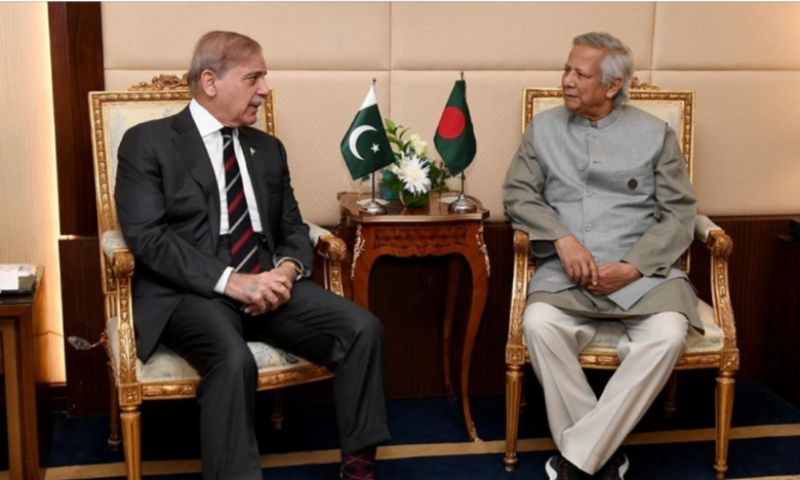
ISLAMABAD: After years of diplomatic freeze under the government of Sheikh Hasina, ties between Bangladesh and Pakistan have entered a decisive phase of renewal following the political transition in Dhaka in August 2024. The caretaker administration moved swiftly to re-engage Islamabad, signalling a strategic shift toward regional balance, economic diversification and pragmatic diplomacy.
Since then, the pace of engagement has accelerated across diplomatic, economic, defence and cultural domains — marking what officials describe as the most comprehensive reset in bilateral relations in decades.
High-Level Diplomatic Engagement
The revival gained momentum with sustained official contacts, culminating in the August 2025 visit to Dhaka by Pakistan’s Deputy Prime Minister and Foreign Minister Ishaq Dar. The visit focused on restoring structured dialogue mechanisms, expanding trade corridors and strengthening political trust.
Both sides agreed to:
- Reactivate foreign office consultations
- Revive joint economic commission mechanisms
- Enhance parliamentary and institutional exchanges
- Expand cooperation at multilateral forums including the OIC and UN
- Officials described the engagement as “forward-looking and opportunity-driven.”
Restoration of Air and Connectivity Links
A major breakthrough came with the resumption of direct commercial flights between Dhaka and Karachi, restoring a key air corridor suspended for years. Aviation authorities also discussed expanding frequencies and facilitating business travel.
In addition:
- Discussions advanced on maritime connectivity and direct shipping routes
- Trade logistics coordination was strengthened
- Visa facilitation measures for business communities were reviewed
- The restoration of physical connectivity has been widely seen as the backbone of the renewed partnership.
Expanding Trade and Economic Cooperation
Economic diplomacy now anchors the relationship.
Both governments initiated measures to:
- Ease banking channel constraints to facilitate bilateral trade
- Reduce non-tariff barriers
Promote business-to-business exchanges
Explore preferential trade mechanisms in selected sectors
Pakistani textiles, pharmaceuticals, rice and engineering goods have gained renewed access discussions, while Bangladesh’s garments, jute products and processed foods are being promoted in the Pakistani market.
Strengthening Defence Cooperation
Defence ties have also expanded. Bangladesh’s air force chief recently visited Islamabad and met Pakistan’s top military leadership, including Chief of Defence Forces Field Marshal Syed Asim Munir. The engagements focused on professional cooperation, training exchanges and defence technology dialogue.
Discussions are ongoing regarding Bangladesh’s potential acquisition of Pakistan-manufactured JF-17 fighter aircraft — a move that would significantly deepen strategic collaboration.
Military training slots, staff-level exchanges and defence industry cooperation are also under consideration, reflecting growing institutional trust.
Cultural, Academic and People-to-People Reconnection
The reset extends beyond state institutions.
Both countries have:
- Revived academic exchange programmes
- Encouraged student mobility
- Expanded cultural and media cooperation
- Promoted tourism and heritage links
Observers note that rebuilding societal goodwill is central to sustaining long-term normalization.
Historical Context and Reconciliation
While the legacy of 1971 remains a sensitive chapter, Islamabad has previously acknowledged the need for reconciliation. During a 2001 visit to Dhaka, former Pakistani president Pervez Musharraf expressed “regret” over the tragic events of that year — a gesture widely viewed as an important step toward healing.
The current phase, however, is being shaped less by history and more by shared economic and strategic interests.
A Strategic Recalibration
Analysts say the renewed warmth reflects Bangladesh’s broader effort to diversify partnerships and avoid overdependence on any single regional actor. For Pakistan, the thaw represents a strategic opportunity to restore engagement with a key South Asian nation through respect, mutual benefit and sovereign equality.
With institutional dialogue restored, flights operational, trade expanding and defence discussions advancing, Islamabad and Dhaka appear to be building a structured, multidimensional partnership grounded in pragmatism and regional stability.
If sustained, this momentum could redefine Pakistan–Bangladesh relations for the next generation.