
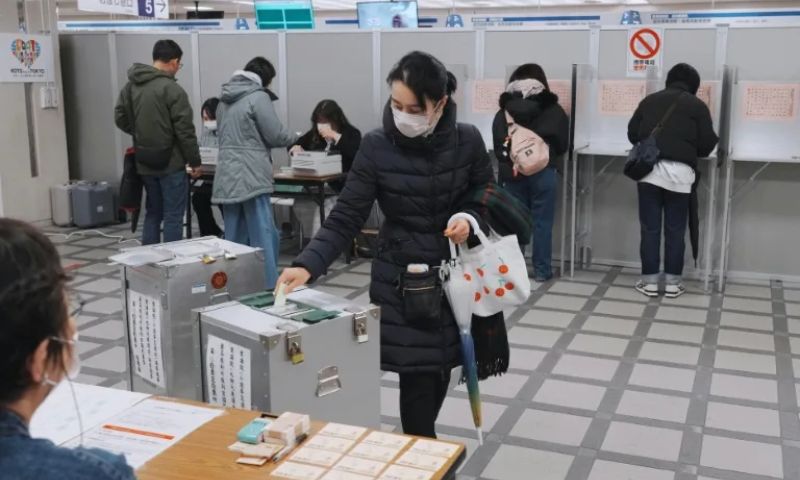



TOKYO: Japan voted in snow-hit snap elections Sunday, with Prime Minister Sanae Takaichi hoping to turn a honeymoon start into a resounding ballot box victory that could stir tensions with China and rattle financial markets.
Opinion polls suggest that Takaichi’s Liberal Democratic Party (LDP), which has governed almost continuously for decades, is poised to win more than the 233 seats needed to secure a majority in the 465-member lower house.
Heavy snowfall blanketed many parts of the country on election day, including Tokyo and regions that rarely see winter snow, according to AFP.
“I think it’s important to come, so that we can properly take part in politics as well,” said a 50-year-old woman, who gave her surname only as Kondo, near a voting station in Tokyo.
“I struggled to find a way to the ballot box as snow was accumulating around it, and it was a pain to arrive here with bad road conditions,” a man in his 70s in Aomori in northern Japan told public broadcaster NHK. “I wish the election was held in a snowless season.”
This marks the first time in decades that Japan has held a general election in snowy February. As of 2:00 pm (0500 GMT), voter turnout stood at 16.05 percent, down 3.07 points from the last lower house election in 2024.
Pollsters cautiously suggest that the LDP and its coalition partner could secure 310 seats, giving them a comfortable two-thirds majority. This would mark the party’s strongest showing since 2017, when Takaichi’s mentor, the late ex-premier Shinzo Abe, achieved a similar result.
Takaichi, a former heavy metal drummer and admirer of Britain’s “Iron Lady” Margaret Thatcher, rose from the ultra-conservative fringe of the LDP to party leadership in October.
She has surprised skeptics by appealing to a broad range of voters, including young people, with her style and public appearances, from handbag choices to jamming to a K-pop song with South Korea’s president.
However, concerns remain over her handling of Japan’s finances, with the nation’s debt exceeding twice the size of its economy. She launched a $135-billion stimulus package to ease inflationary pressure and pledged to suspend a consumption tax on food, aiming to alleviate household burdens.
“Takaichi always talks about taking responsibility through expansionary fiscal policy, and I don’t know whether that will actually lead us in a better direction,” Chika Sakamoto, 50, told AFP in Tokyo.
“Still, I wanted to see what would happen with her fiscal spending, hoping it would ease the impact of rising prices.”
Barely two weeks in office, Takaichi, long viewed as a China hawk, suggested Japan could intervene militarily if Beijing sought to seize self-ruled Taiwan.
China reacted strongly, summoning Tokyo’s ambassador, warning its citizens against travel to Japan, conducting joint drills with Russia, and even taking back Japan’s last two pandas.
Takaichi also received public support from US President Donald Trump, who praised her as a “strong, powerful, and wise leader” devoted to her country.
Margarita Estevez-Abe, associate professor of political science at Syracuse University, said the China episode boosted Takaichi’s popularity.
“Now she doesn’t have to worry about any elections until 2028, when the next upper house elections will take place. The best scenario for Japan is that Takaichi takes a deep breath and focuses on amending the relationship with China,” she said.
Polling stations are set to close at 8:00 pm (1100 GMT), with media predictions based on partial results expected shortly thereafter.