
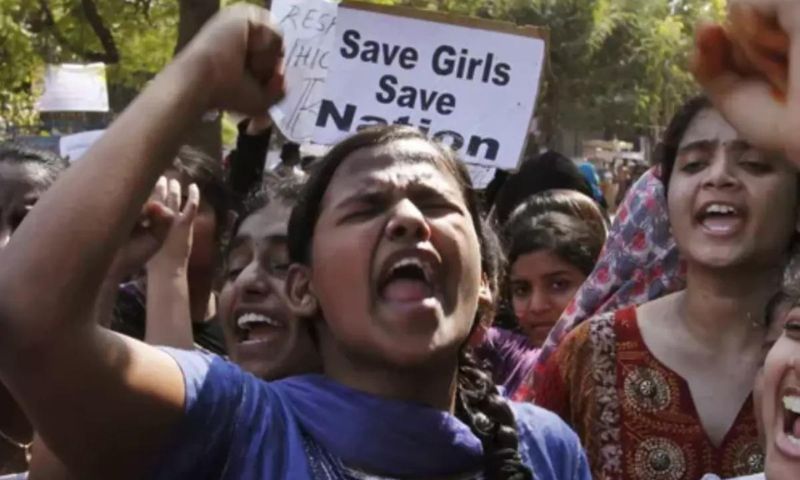



NEW DELHI: The frequency of rape incidents has been climbing at an alarming rate in India since 2012 making it one of the most vulnerable and dangerous country for its own citizens and foreign visitors. The increasing frequency of such crimes, coupled with insufficient legal reforms and societal attitudes, has created a situation where personal safety is under constant threat. The horrible gang rape case in Kolkata is a testimony which justifies that India be declared unsafe for women on all platforms.
According to a report by the National Crime Records Bureau (NCRB), India recorded an alarming 4,45,256 cases of crimes against women in 2022, translating to approximately 51 cases every hour. This statistic underscores a troubling reality, with Delhi being dubbed as the rape capital of the world.
The grim reality of India’s rape crisis is marked by several high-profile cases. The brutal gang rape and murder of a 23-year-old physiotherapy student, commonly known as the Nirbhaya case, in Delhi in 2012 ignited nationwide protests. This case shocked the nation and led to changes in legislation and increased awareness regarding women’s safety.
A minor girl was allegedly raped by a politician in Uttar Pradesh’s Unnao district on June 4, 2017, and her parents were subsequently attacked by her rapists. The case was commonly as Unnao Rape Case (2017). The case gained significant attention due to the accused’s political connections and subsequent legal battles, highlighting issues of power and justice. The rapist, Kuldeep Singh Senger, was an ex-BJP leader, and four-time MLA from Bangermau in the Unnao district of Uttar Pradesh.
In November 2019, the gang rape and murder of a 26-year-old veterinary doctor by four men in Shamshabad, near Hyderabad, sparked outrage across India. Her body was found in Shadnagar on 28 November 2019, the day after she was murdered. The shameful incident spurred public outrage and demands for swift justice.
In January 2018, the abduction, rape, and murder of an 8-year-old Muslim girl, Asifa Bano, in occupied Jammu and Kashmir exposed deep communal tensions and the challenges faced by victims and their families. The minor was abducted, gang raped, and murdered by seven males in the Rasana village near Kathua.
The recent brutal assault on a young female doctor during her shift at Kolkata’s R.G. Kar Medical College in August 2024 shocked the nation. The young female doctor, while working a marathon 36-hour shift at the hospital, took a quick nap in an empty seminar room used by on-duty doctors. Tragically, she was brutally raped and murdered during her rest. The victim’s family decried that it was a gang rape, involving more than one person.
Tens of thousands of people have marched across India, demanding justice for the victim and a radical reshaping of attitudes towards women. The incident has led to widespread protests and calls for urgent reforms, illustrating the violation of trust within institutions that are meant to provide safety.
This case has garnered significant attention because the victim was a doctor, and hospitals are supposed to be safe places. However, such crimes are unfortunately not uncommon in India.
In 2022, a woman was raped on average every 17 minutes, with many cases going unreported in the media and often resulting in no punishment1. The outrage stems from the violation of trust and safety within a public facility where she was serving others.
The danger extends beyond Indian citizens. On March 1, 2024, a 28-year-old vlogger and her 64-year-old husband, traveling on motorcycles, fell victim to a horrifying assault near Ranchi. With no available hotels for an overnight stay, the couple had to camp out, where the woman was brutally attacked by her assailants for over two hours. The attackers were taking turns for about two hours. This incident highlights the extreme risks faced by foreigners in India, where the safety of even well-prepared travelers can be compromised.
Despite legislative efforts, such as the 2013 amendments to the Criminal Law introducing stricter penalties for sexual offenses, the implementation and enforcement remain inadequate in India. The gaps in the legal system often result in delays and inconsistent justice.
Cultural norms and patriarchal attitudes further complicate matters. Victim-blaming and stigmatization frequently discourage reporting crimes involving sexual assaults, perpetuating a cycle of silence and impunity. Moreover, police and other law enforcement agencies failed to address the issue and infect these are found to be complicit in these rape incidents due to political and social influence and pressure.
India’s persistent rape crisis is a grave threat not only to its citizens but also to international visitors. The rising number of incidents and the inadequate response from legal and societal systems call for immediate and effective measures.