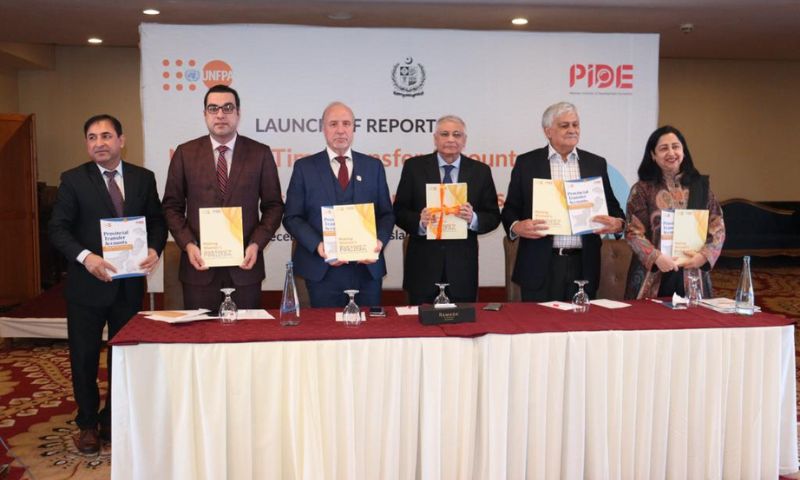
ISLAMABAD: Pakistan’s Minister for Planning, Development, and Special Initiatives Muhammad Sami Saeed reiterated country’s commitment to the agenda set by the International Conference on Population and Development (ICPD) held in Thailand last month. He said this during his speech at the launch of two reports jointly compiled by the United Nations Population Fund (UNFPA) and the Pakistan Institute of Development Economics (PIDE).
Sami commended the research efforts undertaken by UNFPA and PIDE researchers, highlighting Pakistan as the first country in the region to engage in such valuable endeavors beneficial for policymakers, academics, and researchers.
The reports, titled “National Time Transfer of Account (NTTA)” and “National Transfer of Account (NTA),” were meticulously developed by PIDE in collaboration with UNFPA. The primary objective of the NTA report is to elucidate the complex linkages between population growth, evolving age structures, economic growth, public finances, and other crucial aspects of the macro-economy, with a focus on gender and generational equity.
Recognizing the changing population demographics in Pakistan, Sami emphasized the importance of analyzing inter-generational dynamics and the computation of unpaid work contributed by women. The study introduced the NTTA to address limitations in capturing unpaid work falling outside production boundaries, categorizing it into general household production, care work, and learning activities.
Sami underscored the government’s intention to utilize these reports in the policymaking and development planning process. Regarding the gendered economy report, he acknowledged its potential contribution to societal well-being, family institutions, and economic development. The minister emphasized the known correlation between the division of unpaid work, the economic status of households, and the implications for women’s participation in the labor market.