
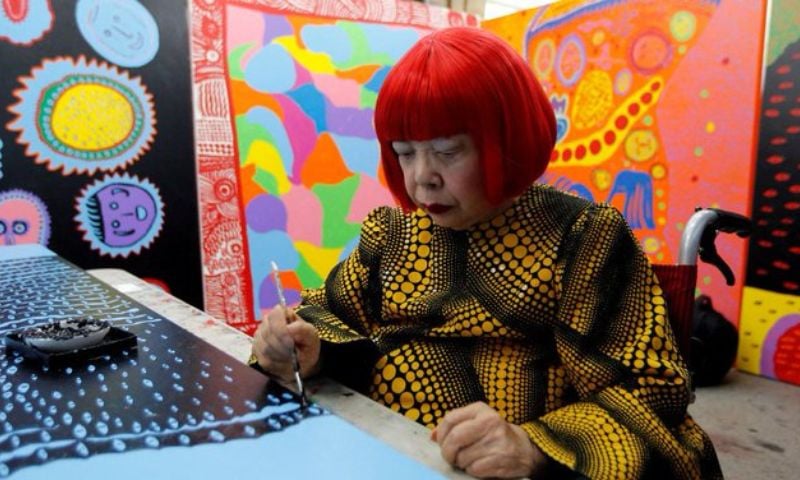
TOKYO: Yayoi Kusama, one of Japan’s most internationally renowned contemporary artists, has died at the age of 97, her company announced on Thursday, prompting tributes from the global art community.
Known worldwide for her distinctive polka dots, infinity motifs, nets and immersive installations, Kusama transformed personal experiences and hallucinations into a highly recognisable artistic language that made her one of the most influential figures in contemporary art.
According to a statement issued by her company, Kusama died on August 14 after a lifetime devoted to artistic creation. The statement described her as an avant-garde artist whose work extended beyond visual art to include performance, fiction and poetry. It said she continued painting until the final days of her life.
🖌️ Yayoi Kusama, the Japanese avant-garde artist who earned the moniker of the “polka dot queen”, died on August 14 at the age of 97, her company said on Thursday.
Making her first artwork at the age of 10, Kusama channelled her hallucinations and trauma into her pieces over… pic.twitter.com/nHpkW1g03o
— FRANCE 24 English (@France24_en) August 27, 2026
Born in 1929 into a wealthy but conservative family in Japan, Kusama began creating the distinctive imagery that would later define her career when she was just 10 years old.
She later described experiencing vivid visual hallucinations as a child, including an episode in which a pattern of red flowers appeared to spread across an entire room and over her body.
After studying art in Japan, Kusama moved to the United States in the late 1950s, encouraged in part by American artist Georgia O’Keeffe. She soon became involved in New York’s avant-garde art scene.
As a Japanese woman working in a largely male-dominated artistic environment, Kusama faced discrimination but nevertheless gained recognition for her large-scale paintings and experimental performances.
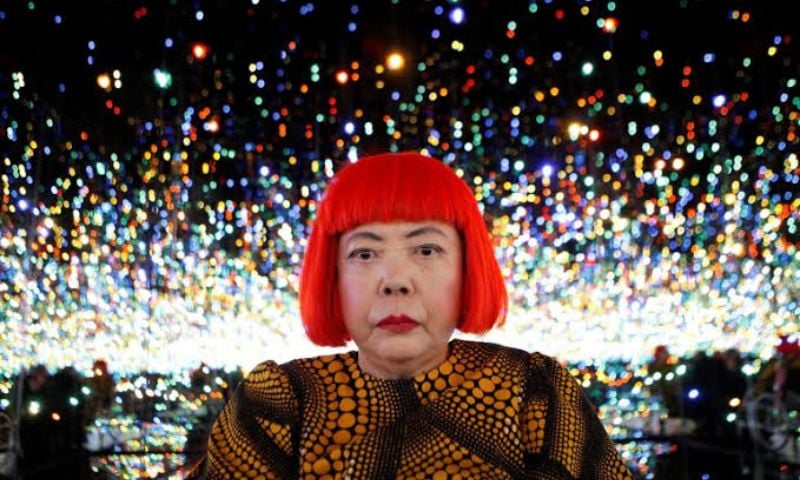
During the 1960s, she staged provocative artistic events known as “happenings”, incorporating body painting, polka dots and public performances. She also ventured into fashion and established a project she called the Church of Self-Obliteration.
Kusama returned to Japan in the 1970s and voluntarily entered a psychiatric hospital in Tokyo. She continued to live and work there for the remainder of her life, maintaining an extraordinary artistic output.
Global recognition
Kusama’s international reputation expanded dramatically from the 1980s onwards. Her striking appearance, often featuring a bright red wig and boldly patterned clothing, became almost as recognisable as her artwork.
Her Infinity Mirror Rooms, pumpkin sculptures and large-scale installations have attracted millions of visitors around the world. Some of her works have fetched millions of dollars at auction.
One of her most famous pumpkin sculptures stands on Naoshima, an island in Japan widely known for its contemporary art.
Visitors and admirers continued to praise Kusama’s ability to make complex artistic ideas accessible through vivid colours and repetitive patterns.
According to AFP, Velislava Nuneva, a 21-year-old university student from Bulgaria, said Kusama had inspired her through her ability to establish herself in New York’s male-dominated art world. “It’s a great quality to be weird and to express yourself no matter what,” she said.
READ ALSO: ‘Demon Slayer’ Becomes First Japanese Film to Surpass ¥100 Billion Worldwide
Yasuko Minami, 58, described Kusama as an artist who expressed her inner world intensely through her work. “She expressed herself honestly,” Minami said.
Students who had visited Naoshima also highlighted the accessibility and visual impact of Kusama’s work, particularly her famous yellow polka-dot pumpkin.
Hibiki Karasawa, 20, said Kusama’s vibrant designs could be appreciated even by people without a background in art, while Hinata Sakamoto, 19, praised her use of vivid colours.
Tributes pour in
Tributes to Kusama quickly emerged following news of her death. Apple chief executive Tim Cook described her as a “true visionary”, praising her imagination and influence on the art world.
Kusama’s career, which spanned more than eight decades and crossed artistic and geographical boundaries, established her as a unique force in contemporary culture.
Her distinctive visual vocabulary of dots, mirrors, pumpkins and infinite spaces turned deeply personal experiences into works that reached audiences across generations and continents.
Her death marks the end of an extraordinary chapter in modern Japanese and international art, while her vast body of work is expected to continue influencing artists and attracting visitors worldwide.