Key Points
- Xi urges stronger China-US commercial cooperation
- Delegation includes leading US technology and finance executives
- Meeting held alongside Trump’s China visit
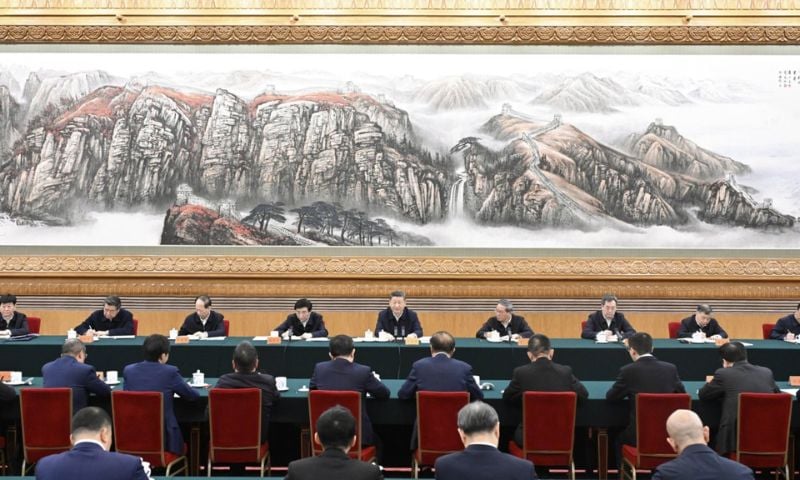
ISLAMABAD: Chinese President Xi Jinping has called for stable and mutually beneficial business ties with the United States during a meeting with senior American executives accompanying US President Donald Trump on his visit to China.
The delegation included executives from major US companies spanning technology, finance, manufacturing, and aviation sectors.
Chinese state media reported that Xi emphasised the importance of continued economic cooperation and stronger commercial engagement between the world’s two largest economies despite ongoing tensions over trade and technology.
Analysts said the participation of leading American corporate figures in Trump’s China tour signalled continued US business interest in the Chinese market.
Disputes involving tariffs, semiconductor restrictions, and rivalry in artificial intelligence still pose a bilateral challenge.
The meeting took place alongside President Trump’s visit, focused on trade, technology, and regional security issues.
Among the prominent attendees were Tesla Chief Executive Elon Musk and Nvidia Chief Executive Jensen Huang.
Other business leaders attending the meeting included BlackRock Chief Executive Larry Fink, Visa Chief Executive Ryan McInerney, Mastercard Chief Executive Michael Miebach, Boeing Commercial Airplanes President Stephanie Pope, Blackstone Chief Executive Stephen Schwarzman, Qualcomm Chief Executive Cristiano Amon, FedEx Chief Executive Raj Subramaniam and Citigroup Chief Executive Jane Fraser, according to international media reports.
Experts describe Musk and Huang as “commercial extensions of state leverage” in sectors where Washington and Beijing are locked in structural rivalry.
A senior Washington-based Asia policy analyst said Musk’s presence is tied to Tesla’s exposure to China, its largest overseas manufacturing hub.
Tesla finds that regulatory approvals, autonomous driving permissions, and production stability depend heavily on government policy in China.
“Elon Musk effectively represents the EV and advanced manufacturing bridge between the two economies,” the analyst noted, adding that Tesla’s Shanghai operations make him a “natural stakeholder in any attempt to stabilise US-China trade tensions.”
Huang’s inclusion, experts say, is even more strategically sensitive. NVIDIA sits at the centre of global artificial intelligence development.
The company’s advanced chips are subject to strict US export controls aimed at limiting China’s access to frontier AI computing power.
A semiconductor policy expert said Huang’s presence signals “controlled commercial engagement under strategic restriction. ”
It also explains that Washington is attempting to balance economic opportunity with national security concerns.
“China is one of the largest potential markets for AI infrastructure, but it is also viewed in Washington as a strategic competitor,” the expert said. “Nvidia is caught directly in that tension.”
US restrictions on advanced chips have pushed China to accelerate the domestic alternatives, intensifying a technology race that both sides frame as critical to national security.
Musk’s engagement with China has also been politically sensitive in Washington due to Tesla’s reliance on Chinese supply chains and Beijing’s long-standing support for the Shanghai gigafactory’s expansion.
Analysts say this makes him a rare corporate figure with “operational stakes on both sides of the geopolitical divide.”
Huang, meanwhile, has repeatedly argued that restricting technology flows risks accelerating China’s independent chip ecosystem, a view that has divided policymakers in the United States.
The trip comes as Washington and Beijing attempt to stabilise relations amid disputes over tariffs, export controls, rare earth supplies, and artificial intelligence governance.