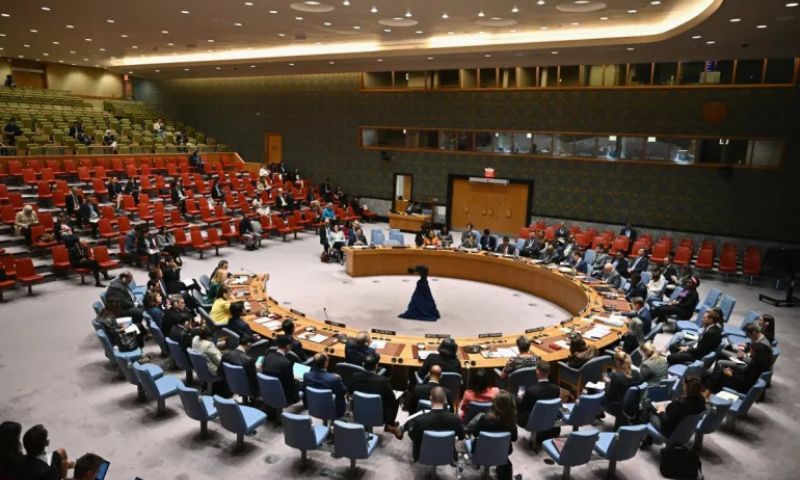
ISLAMABAD: Pakistan’s efforts to secure a United Nations terrorist designation for the banned Baloch Liberation Army (BLA) and its Majeed Brigade have gained renewed attention after a joint Pakistan-China proposal was blocked at the UN Security Council earlier this month.
Islamabad maintains that the BLA poses a serious threat to regional peace and security through attacks on civilians, security personnel, strategic infrastructure and foreign nationals.
Pakistani officials have repeatedly argued that the group’s activities extend beyond local militancy and carry broader implications for regional stability.
Pakistan’s Permanent Representative to the United Nations, Ambassador Asim Iftikhar Ahmad, recently told the Security Council that terrorist organisations, including ISIL-K, Al-Qaeda, Tehreek-e-Taliban Pakistan (TTP), the East Turkestan Islamic Movement, BLA and the Majeed Brigade continue to operate from sanctuaries in Afghanistan, facilitating cross-border attacks and violence.
Although the United States, France and the United Kingdom opposed the proposal on procedural grounds linked to the mandate of the UN’s 1267 sanctions regime, a decision surprised many observers, particularly because Washington already classifies the BLA as a terrorist organisation under its domestic counterterrorism framework.
Supporters of the move argue that a global designation would significantly enhance international counterterrorism efforts.
A UN listing would legally oblige all member states to freeze assets linked to the organisation, restrict financial networks, impose travel bans on designated individuals and prevent the supply of weapons or logistical support.
Security experts believe such measures would make it more difficult for terrorist networks to secure funding, recruit members and maintain operational capabilities.
The United States already designates the BLA as a Specially Designated Global Terrorist organisation, while the Majeed Brigade has also been included under that designation framework.
Observers note that supporting a UN listing would reinforce existing international counterterrorism commitments and close potential loopholes that allow terrorist groups to exploit gaps between national and multilateral sanctions regimes.
Pakistani officials maintain that combating terrorism requires a coordinated international response and argue that a UN designation would send a strong message against groups responsible for terrorism and instability in the region.
Aligning International Policy With Existing US Designations
The most obvious argument is consistency.
In 2019, the US State Department designated the BLA as a Specially Designated Global Terrorist (SDGT) organisation, citing its involvement in deadly attacks against civilians and security forces. In 2025, Washington expanded that designation to include the Majeed Brigade, the group’s most lethal operational wing.
The State Department itself described these measures as part of America’s commitment to combating terrorism and curtailing support networks for militant organisations.
Given that Washington already recognises the BLA as a terrorist group, supporting a UN designation would merely extend that position to the multilateral arena.
Doing so would reinforce the credibility of American counterterrorism policy and eliminate the perception of a gap between its domestic actions and international posture.
Strengthening Global Counterterrorism Efforts
A UN designation carries consequences that no single country’s sanctions regime can fully replicate.
Listing under the UNSC’s sanctions framework would require all UN member states to freeze assets linked to the organisation, restrict financial transactions, impose travel bans on designated individuals and prevent the transfer of weapons, military equipment or logistical support.
Such measures would make it significantly more difficult for the group to raise funds, recruit operatives or sustain international networks.
At a time when terrorist organisations increasingly exploit cross-border financial systems and digital platforms, a coordinated global response is often more effective than isolated national measures.